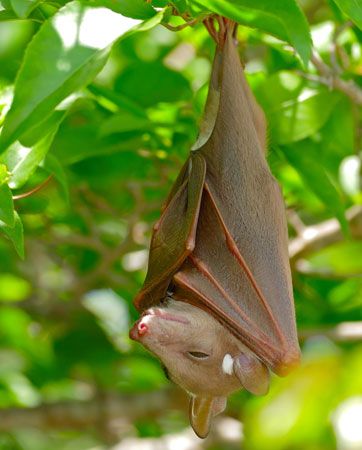
Sheath-tailed Bat
Sheath-tailed bats belong to the family Emballonuridae within the order Chiroptera.
What is the taxonomic classification of sheath-tailed bats within the order Chiroptera?
Sheath-tailed bats belong to the family Emballonuridae within the order Chiroptera.12
While the order Chiroptera is traditionally divided into the suborders Megachiroptera (large fruit bats) and Microchiroptera (small, typically insectivorous bats), sheath-tailed bats are classified as members of the latter group. These bats are characterized by their unique tail structure, which protrudes from a sheath in the membrane connecting their hind legs, and they include approximately 50 species across 13 genera, such as the sac-winged bats (Saccopteryx) and tomb bats (Taphozous).132
What are the main threats to sheath-tailed bat populations, and are any species endangered?
The provided information does not contain details regarding the specific threats to sheath-tailed bat populations or their conservation status.
Sorry, the Britannica knowledge base does not contain this information.
How do sheath-tailed bats reproduce, and what is known about their mating behaviors?
Specific details regarding the reproductive cycles of sheath-tailed bats (family Emballonuridae) are not explicitly documented in the provided literature, as comprehensive life cycle data is known for only a few bat species. However, general patterns observed in tropical bats provide insight into their potential reproductive behaviors.
Unlike temperate-zone bats that often hibernate and exhibit delayed fertilization, tropical bats—which include the sheath-tailed species—typically inhabit regions where they do not undergo hibernation. These species may exhibit a single annual sexual cycle, or they may be diestrous (having two periods of fertility) or polyestrous (having many). In these populations, sexual cycles are often closely synchronized, ensuring that mating, gestation, and weaning occur within specific, favorable timeframes.
Socially, many bats segregate by sex, with pregnant females often gathering in specialized nursery roosts to provide a warm environment for their young. While the specific mating systems of sheath-tailed bats remain under-researched, the broader study of bat life cycles highlights that reproductive success is heavily influenced by environmental conditions and the availability of stable roosting sites.
What is the diet of sheath-tailed bats, and how do they hunt for their food?
The provided search results do not contain specific information regarding the diet of sheath-tailed bats. While the literature details their physical characteristics, roosting habits, and unique ability to scramble across vertical surfaces, it does not explicitly describe their feeding behaviors or prey preferences.
Because the available data focuses on their classification and locomotion rather than their nutritional ecology, I cannot provide an accurate answer regarding what they eat or how they hunt.
Sources
- sheath-tailed bat — Encyclopædia Britannica
- bat - General features — Encyclopædia Britannica
- Emballonuridae — Merriam-Webster
- bat - Social interactions — Encyclopædia Britannica
- Dormancy - Reproductive cycles — Encyclopædia Britannica
- bat - Life cycle — Encyclopædia Britannica
- bat - Annotated classification — Encyclopædia Britannica
- bat - Locomotion — Encyclopædia Britannica
Published on · 2 min read