Flying Lemur
The term "flying lemur" is a misnomer, as these animals are not true lemurs. While they share some superficial physical similarities with lemurs—such as…
What is a flying lemur and how is it different from true lemurs?
The term “flying lemur” is a misnomer, as these animals are not true lemurs. While they share some superficial physical similarities with lemurs—such as their nocturnal habits and facial structure—they are biologically distinct.1
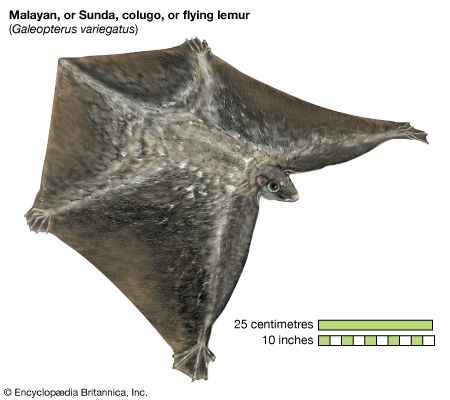
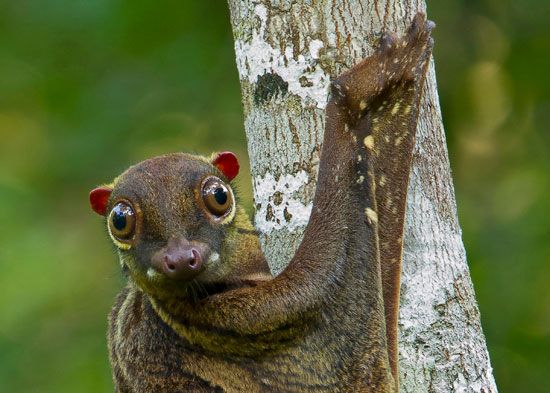
True lemurs are primates belonging to the suborder Strepsirrhini, found primarily on the island of Madagascarirrhini, found primarily on the island of Madagascar. In contrast, flying lemurs, also known as colugos, belong to their own separate taxonomic order, Dermoptera. Found in Southeast Asia, these mammals are specialized gliders equipped with broad folds of skin that stretch between their limbs, allowing them to glide long distances between trees.21
While true lemurs and colugos differ significantly in their classification and locomotion, they share a common evolutionary history as they are both closely related to primates. Unlike the varied diet of true lemurs, which includes fruit, insects, and leaves, flying lemurs have a specialized digestive tract adapted for a strict vegetarian diet.13
What are the unique physical characteristics of flying lemurs that allow them to glide?
Flying lemurs, also known as colugos, possess specialized physical adaptations that enable them to perform long, controlled glides between trees. Their primary mechanism for gliding is the patagium, a broad, fur-covered fold of skin located on each side of the body.14
This membrane extends from the animal’s forelimbs—specifically the wrists or forearms—backward along the body to the hind limbs, reaching the shanks or ankles. When a colugo prepares to glide, it leaps from a high position and assumes a “spread-eagle” posture, which unfolds the patagia and transforms its body into a flat, aerodynamic surface. By increasing the surface area exposed to wind resistance, the patagium allows the animal to glide significant distances rather than simply falling. This adaptation is categorized as gravitational gliding, which serves to enhance the animal’s glide ratio, or the horizontal distance covered per unit of descent.45
What is the scientific name for flying lemurs and which order do they belong to?
Flying lemurs, also known as colugos, belong to the taxonomic order Dermoptera. There are two recognized species of flying lemurs:1
- Philippine flying lemur: Cynocephalus volans13
- Malayan (or Sunda) flying lemur: Galeopterus variegatus (synonym Cynocephalus variegatus)13
Despite their name, these mammals are not true lemurs; they are primitive gliding mammals most closely related to primates.3
How have flying lemurs evolved over time, and what are their closest living relatives?
The evolutionary history of flying lemurs, or colugos, is closely tied to the study of early fossil mammals. While some Paleocene fossils—such as the genera Plesiadapis, Ignacius, and Palaechthon—were traditionally classified as early primates, recent paleontological discoveries of limb and finger bones suggest that these specimens may actually belong to the order Dermoptera rather than Primates.1
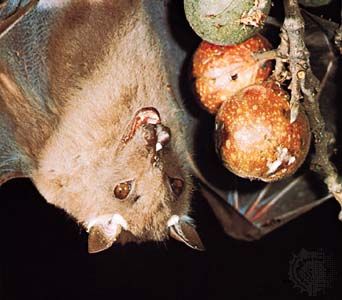
Regarding their closest living relatives, molecular data confirm that colugos and primates are closely related. There has been significant scientific debate concerning the relationship between these groups and bats. While some researchers once proposed that bats were “flying primates” that shared a common ancestor with colugos due to similarities in their visual systems, molecular evidence indicates that bats form a distinct, monophyletic group. Consequently, it remains a subject of ongoing research whether these shared visual specializations evolved independently in different lineages or were inherited from a common ancestor.9
Sources
- flying lemur — Merriam-Webster
- lemur — Encyclopædia Britannica
- flying lemur — Encyclopædia Britannica
- flying squirrel — Encyclopædia Britannica
- Locomotion - Gliding — Encyclopædia Britannica
- Flight — Encyclopædia Britannica
- List of insects - order Embioptera — Encyclopædia Britannica
- insect - Annotated classification — Encyclopædia Britannica
- primate - Classification — Encyclopædia Britannica
- primate - Eocene — Encyclopædia Britannica
- insect - Insect phylogeny — Encyclopædia Britannica
- primate - Paleocene — Encyclopædia Britannica
Published on · 3 min read