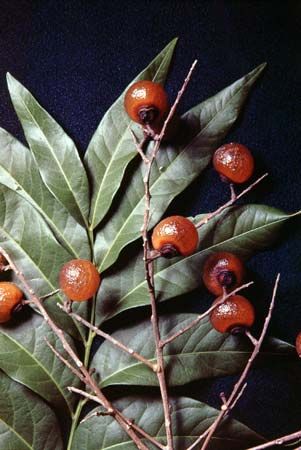
Shorea
Shorea is a genus of approximately 360 species of tall, evergreen trees belonging to the family Dipterocarpaceae. These trees are primarily native to the…
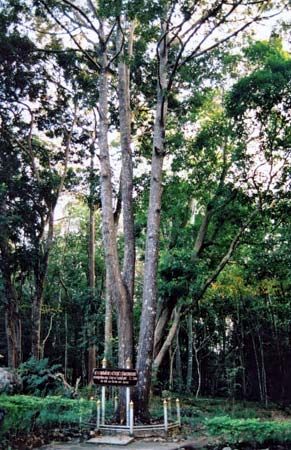
What is Shorea?
Shorea is a genus of approximately 360 species of tall, evergreen trees belonging to the family Dipterocarpaceae1. These trees are primarily native to the Indo-Malayan region, with a distribution spanning from Sri Lanka to China and New Guinea.1
The genus is highly valued for its timber, which is categorized into types such as white and red meranti. Some species, such as S. polysperma, are known as Philippine mahogany and are used in cabinetwork and interior finishes. Beyond lumber, Shorea species provide various commercial products:231
- Resins: Species like S. robusta (sal) and S. oblongifolia (dumala) yield resins used in shellac, varnish, and incense.2
- Fats: S. macrophylla produces illipe nuts, which contain a fat used as a substitute for cocoa butter in chocolate production.21
Botanically, these trees are characterized by flowers with twisted petals and sepals that become enlarged and winglike as the fruit develops.4
What are the primary uses of dammar resin?
Dammar resin, a hard varnish obtained from various trees in Southeast and East Asia, serves several practical and industrial purposes:
- Art and Conservation: It is widely used as a picture varnish because, when mixed with oil of turpentine, it creates a clear, smooth, and hard finish that intensifies colors. In the field of art conservation, it has historically been a primary natural resin for protecting paintings, though it is known to yellow and become brittle over time. Additionally, a solution of dammar in xylene or chloroform is used to mount and preserve thin biological sections for microscopic study.56
- Industrial Applications: Dammar is utilized in the formulation of lacquers, including rapid-drying varieties that incorporate nitrocellulose. It is also used in the production of inks and various plasters.57
- Cultural and Traditional Use: The resin is highly valued in Asia for burning as incense.5
How do lac scale insects interact with the Sal tree?
The premise that lac scale insects interact with the Sal tree (Shorea robusta) is not supported by the provided information. According to the available data, the lac insect (Laccifer lacca) deposits its resinous secretion on the twigs and young branches of various species of soapberry and acacia trees, as well as the sacred fig (Ficus religiosa), rather than the Sal tree.9
Why are many Shorea species considered endangered?
The provided information does not contain details regarding the conservation status of Shorea species or why many are considered endangered. While the text notes that Shorea trees are extremely valuable for their timber and highlights their economic importance—such as the production of sal timber, lac resin, illipe nuts, and dammar—it does not address the environmental threats or population declines affecting the genus.1
Sources
- Shorea — Encyclopædia Britannica
- Shorea — Merriam-Webster
- meranti — Merriam-Webster
- Malvales - Sarcolaenaceae and Dipterocarpaceae — Encyclopædia Britannica
- dammar — Encyclopædia Britannica
- black dammar — Merriam-Webster
- Art conservation and restoration - Paintings on canvas — Encyclopædia Britannica
- damar — Merriam-Webster
- lac — Encyclopædia Britannica
Published on · 2 min read