Bellwort
Bellwort refers to any of five species of woodland plants belonging to the genus Uvularia. While some older or general dictionary sources may categorize…
What is bellwort and which plant family does it belong to?
Bellwort refers to any of five species of woodland plants belonging to the genus Uvularia. While some older or general dictionary sources may categorize these plants under the lily family (Liliaceae), they are taxonomically classified within the family Colchicaceae.123
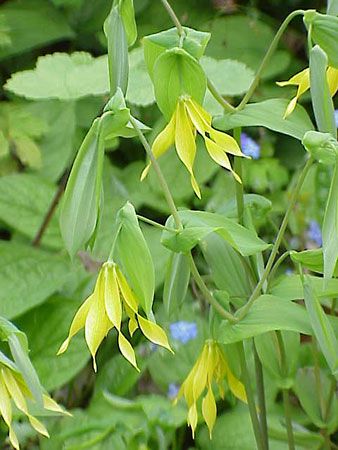
These plants are native to eastern North America and are characterized as low-growing perennials with slender, creeping rootstocks. They typically produce leafy stems ranging from 6 to 20 inches in height, which bear solitary, drooping, pale yellow flowers that bloom between April and June. Notable species include the large-flowered bellwort (U. grandiflora) and the perfoliate bellwort (U. perfoliata), both of which feature leaves that appear to be impaled by the stem.1
What are the distinctive features of bellwort flowers and leaves?
Bellworts, which belong to the genus Uvularia, are woodland perennials with distinct floral and foliar characteristics. It is important to note that while some sources may historically group them with the lily family, they are taxonomically classified within the family Colchicaceae.14
Floral Features
Bellwort flowers are typically pale or lemon-yellow and are known for their drooping, bell-shaped appearance. These flowers are generally solitary, appearing at the ends of the branches, and consist of six parts. In the large-flowered bellwort (U. grandiflora), these blossoms reach approximately 1.5 inches (4 cm) in length.13
Leaf Characteristics
The leaves of bellworts vary by species, but they are primarily defined by their attachment to the stem:
- Perfoliate leaves: In species such as U. grandiflora and U. perfoliata, the leaves appear as if they are impaled by the stem, a condition known as perfoliate.15
- Sessile leaves: The remaining three species of bellworts possess sessile leaves, which are attached directly to the stem without a stalk.1
The overall plant structure consists of slender, creeping rootstocks that produce leafy stems ranging from 6 to 20 inches in height.1
In which regions or habitats can bellwort plants typically be found?
Bellwort plants are native to eastern North America, where they thrive in woodland habitats. These low-growing perennials are typically found in shaded, forested environments, utilizing their slender, creeping rootstocks to establish themselves in the forest floor.1
The distribution of specific bellwort species across these regions is quite broad:
- Large-flowered bellwort (U. grandiflora): This species has a wide range, extending from Quebec in the north, westward to Minnesota, and southward to Georgia and Kansas.1
- Perfoliate bellwort (U. perfoliata): This species is found from Quebec and Ontario in the north, stretching south to Florida and Mississippi.1
The remaining three species of the genus Uvularia are generally smaller and share similar woodland preferences within these geographic ranges.1
How many species of bellwort are known to exist?
There are five known species of bellwort that constitute the genus Uvularia.1
These woodland perennials are native to eastern North America and are characterized by their low-growing habit and slender, creeping rootstocks. While they share common traits such as drooping, pale yellow flowers, they are distinguished by their leaf structure: two species feature perfoliate leaves, which appear as if they are impaled by the stem, while the remaining three species possess sessile leaves.1
Sources
- bellwort — Encyclopædia Britannica
- bellwort — Merriam-Webster
- uvularia — Merriam-Webster
- large-flowered bellwort — Merriam-Webster
- perfoliate — Merriam-Webster
- Bellflower — Encyclopædia Britannica
Published on · 2 min read