Smithsonian Tropical Research Institute
The Smithsonian Tropical Research Institute (STRI) has significantly bolstered Panama’s scientific landscape by establishing the country as a premier hub for…
How has STRI’s presence influenced Panama’s scientific community and economy?
The Smithsonian Tropical Research Institute (STRI) has significantly bolstered Panama’s scientific landscape by establishing the country as a premier hub for global ecological research. Since its inception as a biological reserve in 1923, STRI has provided advanced infrastructure, such as specialized canopy cranes and marine laboratories, which allow researchers to conduct high-level studies on tropical forest and marine ecosystems.1
By facilitating continuous research on sites like Barro Colorado Island, STRI fosters international collaboration and provides local scientists with access to world-class facilities and a vast tropical sciences library. Regarding the economy, STRI contributes to Panama’s development by integrating scientific activity with public engagement; for instance, the opening of a visitor’s centre in 1997 directly supports ecotourism, helping to monetize the preservation of natural resources. Furthermore, the institute’s focus on identifying new drugs and sustainable forest management provides a foundation for potential bio-economic growth.1
How does STRI collaborate with local communities and international scientists?
The Smithsonian Tropical Research Institute (STRI) facilitates international scientific collaboration by operating a network of specialized facilities in Panama, including marine laboratories, a research vessel, and the renowned Barro Colorado Island biological reserve. These sites serve as a hub for global researchers, supporting continuous studies on tropical forest and marine ecosystems through advanced infrastructure like canopy cranes.1
As part of the Smithsonian Institution’s Center for Tropical Forest Science, STRI coordinates research programs across 12 international locations, focusing on critical areas such as global climate regulation, species relationships, and sustainable resource management. While the provided information highlights STRI’s extensive international scientific partnerships and its role in hosting researchers, it does not explicitly detail specific collaborative programs with local Panamanian communities beyond the general operation of education and visitor centers.1
What facilities and research stations does STRI operate in Panama?
The Smithsonian Tropical Research Institute (STRI) operates a diverse array of facilities across Panama to support its ecological research mission.1
Key Research Facilities
- Barro Colorado Island: A 1,500-hectare (3,700-acre) biological reserve located in Gatun Lake. It has been studied continuously since 1923 and accommodates 35 scientists.1
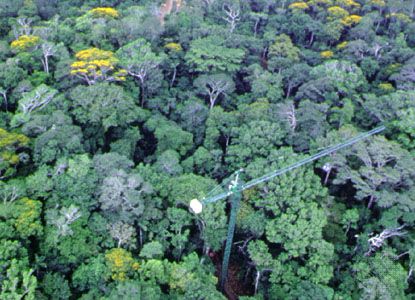
- Canopy Cranes: STRI utilizes two specialized cranes located at opposite ends of the Panama Canal. These allow for three-dimensional research in both tropical deciduous forests (Pacific side) and tropical rainforests (Caribbean side).1
- Marine and Specialized Infrastructure: The institute operates two marine research laboratories and a 30-metre (96-foot) ocean research vessel.1
- Support and Education Centers: STRI maintains a conference and research centre, a tropical sciences library, various education centres, and a visitor’s centre established in 1997 to support ecotourism.1
These facilities enable comprehensive studies on tropical ecosystems, ranging from species relationships to the role of forests in global climate regulation.1
How does STRI’s work contribute to sustainable development practices in tropical regions?
The Smithsonian Tropical Research Institute (STRI) contributes to sustainable development by conducting rigorous scientific research aimed at understanding how to utilize forest resources without degrading or destroying vital ecosystems.1
Through its role in the Smithsonian Institution’s Center for Tropical Forest Science, STRI coordinates programs across 12 global locations to address critical environmental challenges. Key areas of contribution include:
- Climate Regulation: Investigating the essential role that tropical forests play in global climate regulation.1
- Resource Management: Developing knowledge to balance human needs with the preservation of forest integrity.1
- Biodiversity Research: Identifying the complex relationships between the vast number of species within tropical ecosystems, which is fundamental to conservation efforts.1
- Scientific Innovation: Searching for new drugs, which highlights the potential for sustainable economic and medical benefits derived from tropical biodiversity.1
By providing the scientific foundation for these practices, STRI helps inform strategies that protect the long-term health of tropical environments.1
Sources
- Smithsonian Tropical Research Institute — Encyclopædia Britannica
Published on · 3 min read