Snipe
Snipes are shorebirds belonging to the family Scolopacidae, characterized by a chunky build, short legs, and a long, flexible bill used for probing mud for…
What are the physical characteristics of snipe birds?
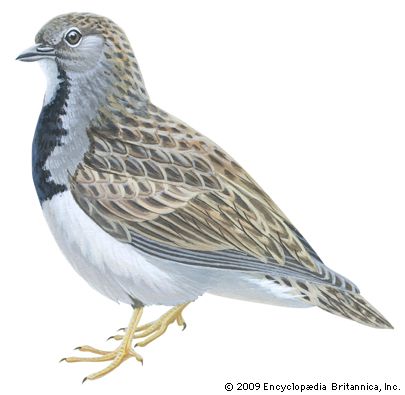
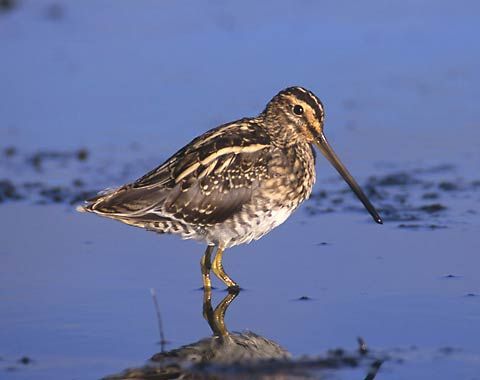
Snipes are shorebirds belonging to the family Scolopacidae, characterized by a chunky build, short legs, and a long, flexible bill used for probing mud for worms. Their plumage typically features a pattern of brown, black, and white stripes and bars. Physically, they possess pointed, angular wings and eyes that are set toward the rear of the head.1
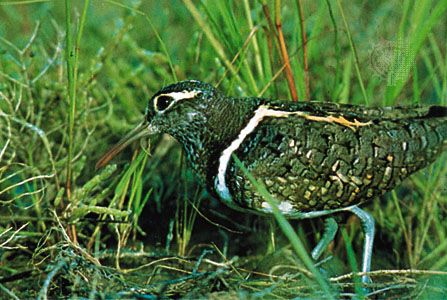
While most snipes are roughly 30 cm (12 inches) long, including the bill, the great snipe is noted for a heavier build. Distinct from these are the painted snipes (family Rostratulidae), which are smaller at approximately 25 cm (10 inches) and exhibit bold brown and white markings. In painted snipe species, females are notably larger and more brightly colored than males.12
Where can snipe birds be found in the wild?
Snipe birds are found in temperate and warm regions across the globe, typically frequenting wet meadows and marshes where they can probe the mud for food.1
Their specific distribution varies by species:
- Common Snipe: This species inhabits temperate regions and includes populations such as Wilson’s snipe in North America, as well as Eurasian and South American varieties.1
- Great Snipe: Found in northern Europe.1
- Pintail Snipe: Native to India.1
- Jacksnipe: Found throughout Eurasia.1
- Painted Snipe: The Old World painted snipe ranges from Africa to Australia and Japan, while the South American painted snipe is found in South America.2
Because they rely on specific environmental conditions, their movements and presence in these habitats are often influenced by temperature and weather patterns.3
What is the mating behavior and breeding cycle of snipe birds?
The mating behavior and breeding cycle of snipe birds vary significantly between the family Scolopacidae and the family Rostratulidae (painted snipes).
Family Scolopacidae (Typical Snipes)
Most species in this family are solitary during the breeding season. Their courtship is characterized by specialized flight displays:2
- Courtship Flights: Males typically circle high in the air and then dive toward the female on the ground. During these maneuvers, they produce a “drumming” or “bleating” sound using their specialized tail or wing feathers.21
- Timing: These displays often occur at dusk, under moonlight, or on overcast days.2
- Nesting: These birds nest on the ground, typically in marshes.21
Family Rostratulidae (Painted Snipes)
Painted snipes exhibit a notable reversal of traditional sex roles:51
- Sexual Dimorphism and Courtship: Females are larger and more brightly colored than males. The female takes the lead in courtship, displaying with spread wings and tails, and is generally more aggressive.51
- Parental Care: After the female lays her eggs—typically four for the Old World painted snipe and two for the South American species—she leaves the incubation and care of the chicks entirely to the male.51
- Nesting: They build shallow nests on the ground or on platforms of bent reeds. The eggs are incubated for approximately 19 days, and the downy young are capable of taking to the water shortly after hatching.51
Are there different species of snipe birds, and how do they differ?
There are two distinct groups of birds commonly referred to as snipes, which belong to different biological families within the order Charadriiformes: the family Scolopacidae (typical snipes) and the family Rostratulidae (painted snipes).21
Typical Snipes (Family Scolopacidae)
This group includes approximately 20 species of shorebirds that are generally chunky, short-legged, and long-billed.1
- Appearance: They are characterized by striped and barred plumage in shades of brown, black, and white, with pointed, angular wings.1
- Behavior: They are solitary during the breeding season and are known for their unique courtship displays, where males perform high-altitude flights followed by a dive, creating a “drumming” or “bleating” sound with their tail feathers.1
- Examples: The common snipe, which includes North American Wilson’s snipe, the great snipe of northern Europe, the pintail snipe of India, and the jacksnipe of Eurasia.1
Painted Snipes (Family Rostratulidae)
This family consists of only two species, which are distinct from typical snipes in both appearance and social structure.28
- Appearance: These birds are smaller (about 25 cm) and exhibit bold, cryptic patterns. A key difference is their sexual dimorphism: females are larger and more brightly colored than males.28
- Behavior: Unlike typical snipes, the female painted snipe takes the lead in courtship. Additionally, the male is responsible for the majority of nesting duties and chick care.2
- Species: The Old World painted snipe, found from Africa to Australia and Japan, and the South American painted snipe.28
Sources
- Snipe — Encyclopædia Britannica
- Painted snipe — Encyclopædia Britannica
- Migration - Physiological stimulus of migration — Encyclopædia Britannica
- whole snipe — Merriam-Webster
- Charadriiform - Shorebirds (suborder Charadrii) — Encyclopædia Britannica
- Animal social behavior - Social interactions involving sex — Encyclopædia Britannica
- Animal social behavior - Social interactions involving the costs and benefits of parental care — Encyclopædia Britannica
- Charadriiform - Annotated classification — Encyclopædia Britannica
Published on · 3 min read