Species Richness
Species richness is the total count of unique species within a defined biological community, ecosystem, or biome. While it serves as a fundamental component…
What is species richness?
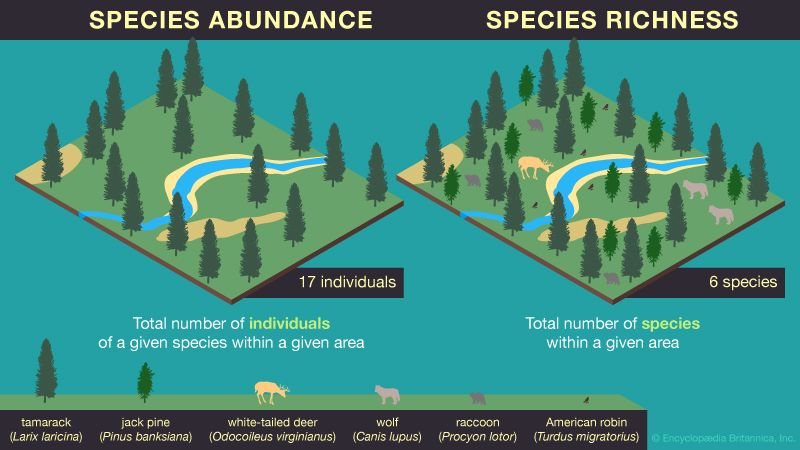
Species richness is the total count of unique species within a defined biological community, ecosystem, or biome. While it serves as a fundamental component of biodiversity, it does not account for the population sizes of individual species or the evenness of their distribution, which are instead measured by species abundance.12
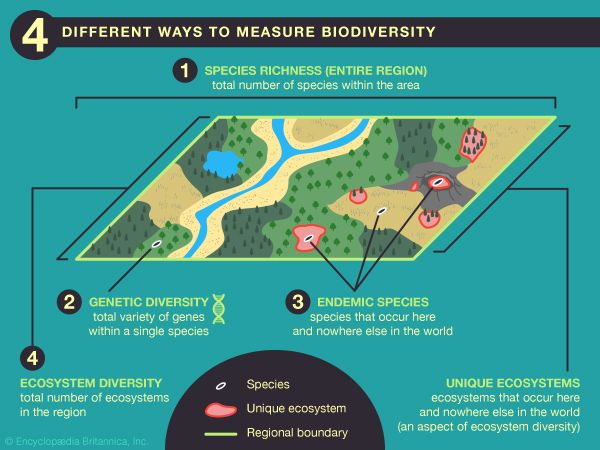
Ecologists often categorize species richness by spatial scale:
- Alpha diversity: Richness within a local area or small habitat Richness within a local area or small habitat.1
- Beta diversity: The rate at which richness changes between habitats.1
- Gamma diversity: The total richness across larger geographies, such as a country or entire biome.1
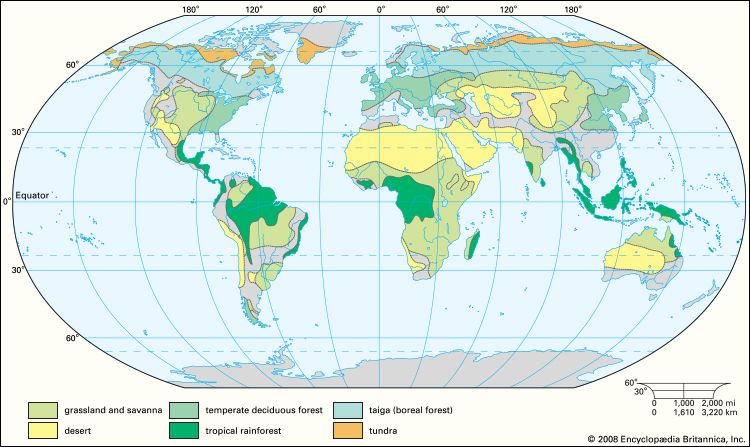
Species richness generally follows a latitudinal gradient, increasing toward the Equator and decreasing toward the poles due to factors like climate stability and growing season length. Other influences include geographic isolation and the presence of physical barriers.12
How does species abundance differ from species richness?
Species richness and species abundance are distinct metrics used by ecologists to assess biodiversity, and they do not necessarily correspond to one another.3
- Species richness is a simple count of the number of unique species present within a defined area, such as an ecosystem or biome. It does not account for the number of individuals within those species or how evenly they are distributed.31
- Species abundance measures the total number of individuals of a given species within an area. It can also refer to population density, biomass, or the proportion of one species relative to the wider biological community of one species relative to the wider biological community.3
In practice, an area might have low species richness—meaning few unique species are present—but high species abundance if those few species are highly successful and numerous. Conversely, a region could have high richness but low abundance for many of its species. To gain a more comprehensive view, researchers often use species diversity, a term that combines both richness and abundance to gauge the number of unique species alongside their respective population sizes.3
Why do tropical regions typically have higher species richness?
Tropical regions exhibit higher species richness compared to temperate or polar zones due to a combination of favorable ecological factors. These regions benefit from higher temperatures, greater climate predictability, and longer growing seasons, which collectively create more inviting habitats that support a wider diversity of life.2
The high biological productivity characteristic of tropical environments—particularly in tropical rainforests—further facilitates this diversity. Because these conditions are less limiting to plant growth, they sustain larger biomass and year-round biological activity. Additionally, species richness is enhanced in areas with complex topography or geological features, which provide a variety of distinct habitats. Geographic isolation, such as that found in island-studded regions, can also lead to the development of different but related species, significantly increasing total regional diversity.45
What is the difference between alpha, beta, and gamma diversity?
Ecologists categorize biodiversity across different spatial scales using alpha, beta, and gamma diversity. These metrics help researchers understand how species are distributed across local and regional landscapes.1
- Alpha diversity (or point diversity) refers to the species richness within a specific, local area, such as a single habitat or a small biological community.1
- Beta diversity measures the rate of change in species composition between different habitats. It effectively captures how species richness shifts as you move from one environment to another.1
- Gamma diversity represents the total species richness across a much larger geographic scale, such as an entire ecosystem, biome, or country.1
Mathematically, these scales are interconnected: as the survey area expands to include more habitats, alpha diversity approaches gamma diversity, while beta diversity—representing the variation between those habitats—approaches zero.1
Sources
- species richness — Encyclopædia Britannica
- biogeographic region - Components of species diversity: species richness and relative abundance — Encyclopædia Britannica
- species abundance — Encyclopædia Britannica
- Tropical rainforest - Biological productivity — Encyclopædia Britannica
- Tropical rainforest - Biota — Encyclopædia Britannica
Published on · 3 min read