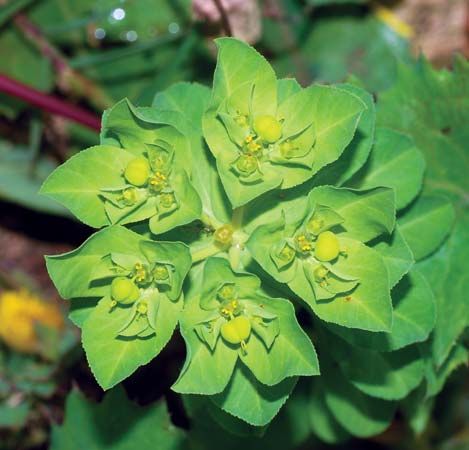
Spurge
A spurge is a member of the genus Euphorbia, a large and diverse group of flowering plants within the family Euphorbiaceae that includes at least 2,100…
What is a spurge plant?
A spurge is a member of the genus Euphorbia, a large and diverse group of flowering plants within the family Euphorbiaceae that includes at least 2,100 species. These plants range from small, creeping herbs to large shrubs and trees, with some succulent species in arid regions resembling cactus plants some succulent species in arid regions resembling cactus plants.12
Unlike cacti, spurges are characterized by a milky, often poisonous sap. Their unique floral structure, known as a cyathium, consists of a single female flower surrounded by several male flowers, all enclosed within a cup-shaped, leaflike structure.12
The genus is economically and ecologically significant:
- Ornamentals: Popular varieties include the poinsettia, crown of thorns, and various temperate perennials.1
- Industrial uses: Some species, such as the wax plant, provide materials for polishes and lubricants.1
- Weeds: Several species, including leafy spurge and spotted spurge, are considered invasive species or agricultural pests.13
What does a spurge plant look like?
Spurge plants (Euphorbia) are remarkably diverse in appearance, ranging from flat, creeping herbs to towering shrubs and trees. Because the genus includes at least 2,100 species, their physical forms vary significantly:1
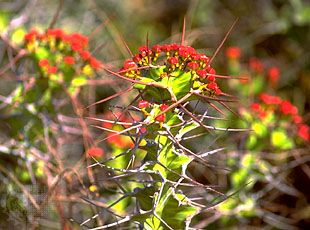
- Growth Habit: They can appear as low-growing annual herbs, woody-stemmed shrubs, or large, branched trees. Some arid-climate species are succulent and thorny, often resembling cactus plants.1
- Distinguishing Features: Unlike cacti, spurges contain a milky, often poisonous sap. While cacti possess specialized structures called areoles that produce spines, spurges lack these.14
- Floral Structure: Their flowers are unique and complex. They feature a specialized structure called a cyathium, which consists of a single female flower surrounded by multiple male flowers, all enclosed within a cup-shaped, leaflike structure.1
- Foliage and Bracts: Many species are prized for their colorful, leaflike structures called bracts, such as the scarlet bracts of the poinsettia or the golden bracts of the cypress spurge.1
Where do spurge plants commonly grow?
Spurge plants (Euphorbia) are a globally distributed genus, with species native to a wide variety of environments ranging from tropical regions to temperate climates.15
Their natural habitats include:
- Tropical and Arid Regions: Many succulent, cactus-like species are native to arid parts of Africa, India, and the East Indies. Other species, such as the poinsettia and the crown of thorns, originate from Mexico, Central America, and Madagascar.1
- Temperate Zones: Various perennial ornamentals, such as cypress spurge and cushion spurge, are native to Europe, while others like E. griffithii originate from the Himalayas.1
- North America: Several species are native to the United States, including the snow-on-the-mountain in the North American West and the flowering spurge in the eastern regions.1
Beyond their native ranges, many spurges have become naturalized in new areas, often growing as weeds in diverse settings, including agricultural fields and even sidewalk cracks.1
What are some common types of spurge?
The genus Euphorbia is incredibly diverse, encompassing over 2,100 species that serve various roles as ornamentals, industrial sources, or weeds. Common types of spurge include:
Ornamental Varieties
- Poinsettia: Famous for its scarlet bracts, this Mexican native is a staple of the Christmas season.19
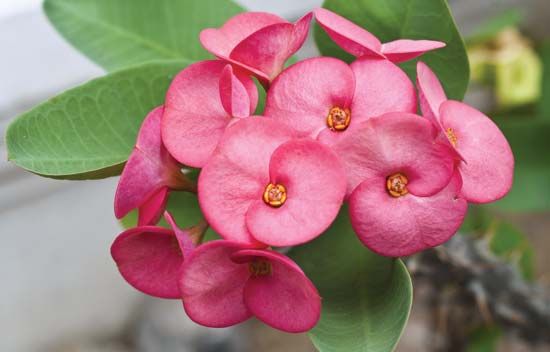
- Crown of thorns: A popular, thorny, woody-stemmed houseplant from Madagascar known for its year-round flowering.110
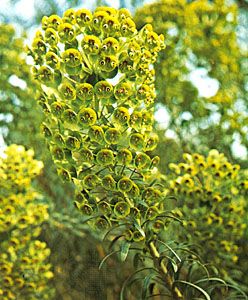
- Temperate Perennials: These include the globe-shaped cypress spurge with needlelike foliage, the Mediterranean spurge with greenish-yellow heads, and the cushion spurge, which blooms in a vibrant gold to chartreuse.1
- Annuals: Species such as snow-on-the-mountain are frequently grown for their decorative foliage.1
Succulent and Industrial Types
- Cactus-like Species: Many arid-climate spurges, such as the candelabrum tree, resemble cacti but are distinguished by their milky, poisonous sap.1
- Wax Plant: The rodlike E. antisyphilitica is a source of wax used in polishes and lubricants.1
Weedy Species
- Common Weeds: This category includes the leafy spurge, spotted spurge, and the prostrate spurge, which is often found growing in sidewalk cracks.1
Sources
- spurge — Encyclopædia Britannica
- spotted spurge — Merriam-Webster
- spurge — Merriam-Webster
- flowering spurge — Merriam-Webster
- list of plants in the family Euphorbiaceae — Encyclopædia Britannica
- spurge flax — Merriam-Webster
- wolf's-milk — Merriam-Webster
- Caryophyllales - Cactaceae — Encyclopædia Britannica
- crown of thorns — Encyclopædia Britannica
- poinsettia — Encyclopædia Britannica
Published on · 3 min read