Stingless Bee
A stingless bee is a member of the tribe Meliponini, a group comprising more than 600 species of social honey-making bees characterized by highly reduced…
What is a stingless bee?
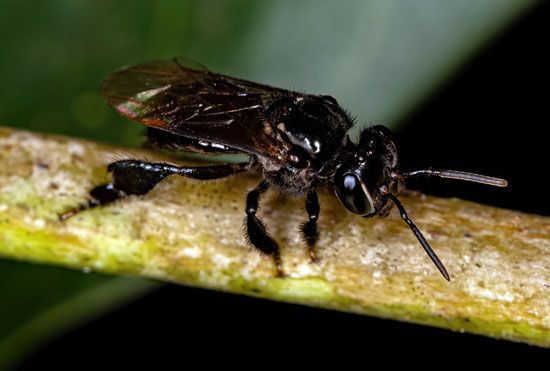
A stingless bee is a member of the tribe Meliponini, a group comprising more than 600 species of social honey-making bees characterized by highly reduced stingers. Found primarily in tropical and subtropical regions, these insects are particularly diverse in the Western Hemisphere.1
While they lack functional stingers for defense, they are not defenseless; they often protect their nests by biting with strong mandibles. As eusocial insects, they live in cooperative colonies that include a queen, male drones, and female workers. They are vital pollinators and have been kept by humans for their honey since pre-Columbian times, a practice known as meliponiculture. Their honey is distinct from that of the western honeybee, typically being less viscous and having a higher water content. Today, these bees face significant threats from deforestation, climate change, and the introduction of non-native species.1
How are stingless bees different from other bees?
Stingless bees (tribe Meliponini) differ from other bees, particularly the familiar western honeybee, in several key biological and behavioral aspects:
- Defense Mechanisms: As their name implies, stingless bees possess highly reduced stingers that are ineffective for defense. Instead of stinging, they rely on strong mandibles to inflict painful bites on threats to their nests. Unlike honeybees, whose barbed stingers cause them to die after stinging a human, stingless bees do not suffer fatal injuries from defending their colonies.23
- Honey Characteristics: While both groups produce honey, stingless bee honey is distinct; it is generally less sweet, less viscous, and has a higher water content than that of domestic honeybees. Because of this higher moisture, it is more prone to spoilage and often requires refrigeration or pasteurization.2
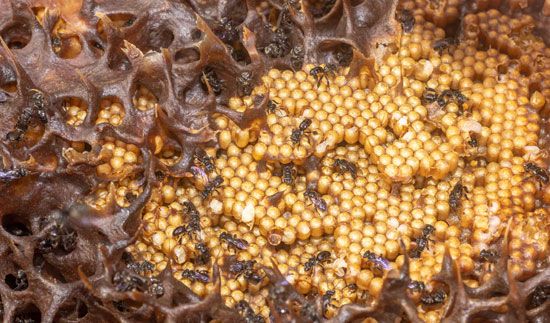
- Colony and Hive Structure: Stingless bee colonies are typically smaller than those of honeybees, often numbering in the tens of thousands rather than hundreds of thousands. Their hive architecture is also more varied; while honeybees typically use a uniform honeycomb pattern, stingless bees may arrange their cells in spirals or irregular patterns, and they often use unique materials like geoprolis (a mix of mud, resin, wax, and saliva) for construction.2
- Economic Accessibility: Although stingless bees are prolific producers, the total harvestable honey per colony is lower than that of honeybees because the colonies are smaller and the honey is often stored in less accessible areas of the hive, making it more labor-intensive and expensive to collect.2
Where do stingless bees live?
Stingless bees (tribe Meliponini) are found in tropical and subtropical regions across the globe, with a particularly high level of diversity in the Western Hemisphere.1
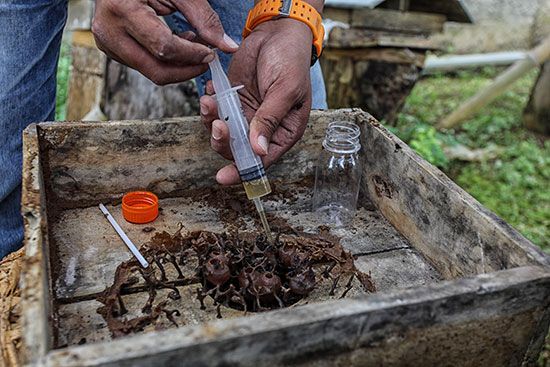
These bees typically establish their nests in preexisting cavities, such as hollows within tree trunks, crevices in walls, or abandoned nests previously occupied by ants or termites in the ground. While most species prefer these sheltered locations, some, such as the West African slender-stingless bee (Dactylurina staudingeri), are known to construct exposed nests.1
What do stingless bees eat and what do they make?
Stingless bees primarily feed on pollen and nectar collected from flowers. However, there is a notable exception: at least three species of the genus Trigona, known as vulture bees, are the only bees documented to scavenge for nutrition from decomposing animal carcasses.2
These bees are prolific producers of several substances used for both their own survival and human use:
- Honey: They produce honey that is generally less sweet and less viscous than that of domestic honeybees. Due to its higher water content, it is more prone to spoilage and often requires refrigeration or pasteurization.2
- Beebread: This is a mixture of stored pollen that serves as a vital food source for the colony.2
- Nest-building materials: They create geoprolis—a mixture of mud, tree resin, saliva, and wax—and cerumen, which is a blend of resin, saliva, and wax used to construct their hives.2
There is also emerging evidence suggesting that their honey, beebread, and geoprolis may possess antibiotic, antiseptic, and anticancer properties.2
Sources
- stingless bee — Merriam-Webster
- stingless bee — Encyclopædia Britannica
- How long do queen bees live? — Encyclopædia Britannica
- Do bees die after stinging? — Encyclopædia Britannica
- Hymenoptera - Social forms — Encyclopædia Britannica
- mason bee — Encyclopædia Britannica
Published on · 3 min read