Jabiru
The term jabiru primarily refers to a large stork species (Jabiru mycteria) native to the New World, with a range extending from Mexico to Argentina.
What is Jabiru?
The term jabiru primarily refers to a large stork species (Jabiru mycteria) native to the New World, with a range extending from Mexico to Argentina.1
As one of the largest flying birds in the Americas, it can reach a length of 140 cm (4.5 feet). It is characterized by its mostly white plumage, a black and red head and upper neck, and an unusually heavy, slightly upturned bill. Additionally, the name jabiru is sometimes applied to a different stork species, Xenorhyncus asiaticus, which is found from India through Southeast Asia to Australia.12
What are the main characteristics of the stork family?
The stork family (Ciconiidae) consists of approximately 20 species of large, long-necked birds. They are characterized by several distinct physical and behavioral traits:
- Physical Build: Storks are stoutly built, ranging from 60 to over 150 cm (2 to 5 feet) in height. They possess long, massive bills that may be straight, curved, or feature a gap between the mandibles. Their legs are long, with partial webbing between the middle and outer toes, and a smaller, raised hind toe.
- Plumage: Many species feature bold black-and-white patterns. In several species, parts or all of the head and upper neck are bare of feathers and may be brightly colored.
- Vocalization: Storks are largely voiceless due to the lack of a fully developed syrinx (vocal organ). Instead, they often communicate by clattering their bills loudly when excited.
- Flight: They fly with their necks outstretched and legs trailing, using a combination of flapping and soaring.
- Diet and Feeding: Most storks are carnivorous, feeding on small animals like fish, reptiles, amphibians, and insects in shallow water or fields. Some species, such as the marabou, are scavengers that feed on carrion.
- Nesting: Both sexes participate in building large twig platforms for nests, which are placed in trees, on rock ledges, or on man-made structures like chimneys.
How do storks differ from other large wading birds?
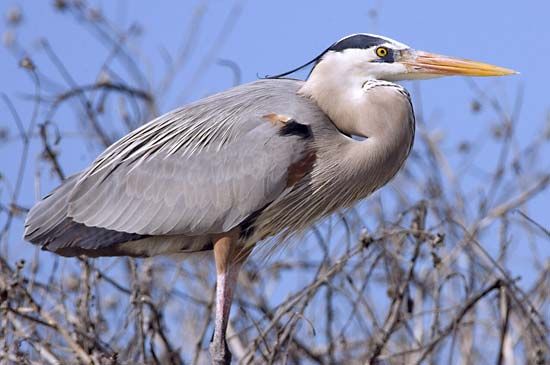
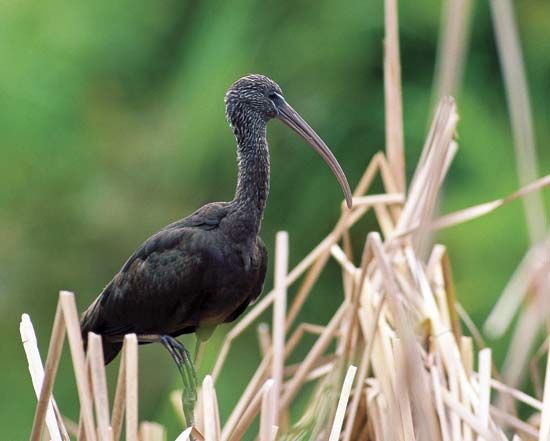
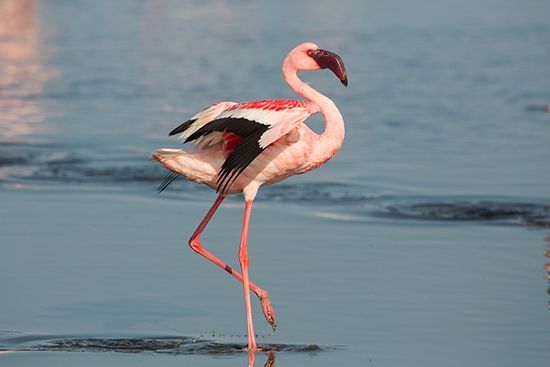
Storks (family Ciconiidae) are distinguished from other large wading birds—such as herons, ibises, and flamingos—by several key structural and behavioral traits:
- Flight Posture: Unlike herons, which typically fly with their necks drawn back, most storks fly with their necks stretched straight forward.8
- Vocalization: Storks lack a fully developed syrinx, rendering them largely voiceless. They communicate primarily by clattering their massive bills, a behavior distinct from the vocalizations of many other wading species.6
- Physical Build: Storks are notably stout-bodied compared to the often slimmer herons and egrets. Their bills are long and massive, exhibiting significant variety in shape—ranging from straight to curved or featuring a gap between the mandibles.6
- Legs and Feet: Storks have long legs with a partial web between the middle and outer toes, and a hind toe that is characteristically smaller and raised above the level of the front toes.6
- Plumage: While herons often display blues, grays, or solid white, storks are frequently characterized by bold, contrasting black-and-white plumage patterns.9
What is the significance of the Tupi language in naming animals?
The Tupian languages, particularly the extinct Tupinambá language, have played a significant role in the naming of New World flora and fauna. As European explorers encountered the diverse wildlife of South America, they adopted many indigenous terms into Portuguese, which subsequently entered other European languages.2
This linguistic influence is evident in the names of various animals:
- Jabiru: The name for the large tropical American stork (Jabiru mycteria) is derived from the Tupi words jamburú or jamurú.13
- Tataupa: This term for a South American tinamou (Crypturellus tataupa) also originates from Tupi, having passed through Portuguese into common usage.14
The widespread adoption of these terms reflects the historical importance of Tupian-speaking groups, who occupied vast regions from the Andes to the Atlantic coast at the time of European contact. Their language served as a vital bridge for identifying and classifying the unique biodiversity of the region for the outside world.152
Sources
- Jabiru — Encyclopædia Britannica
- jabiru — Merriam-Webster
- Stork — Encyclopædia Britannica
- Migration - In Europe — Encyclopædia Britannica
- Ciconiiform - Feeding habits — Encyclopædia Britannica
- Ciconiiform - Annotated classification — Encyclopædia Britannica
- homopteran - Annotated classification — Encyclopædia Britannica
- Ciconiiform - Size range and diversity of structure — Encyclopædia Britannica
- Ciconiiform - Relations with humans — Encyclopædia Britannica
- Ciconiiform - Plumage and coloration — Encyclopædia Britannica
- Gruiform - Food habits — Encyclopædia Britannica
- Ciconiiform - Locomotion — Encyclopædia Britannica
- Tupian languages — Encyclopædia Britannica
- South American Indian languages - Tupian — Encyclopædia Britannica
- tataupa — Merriam-Webster
Published on · 3 min read