Sweat Bee
A sweat bee is a member of the family Halictidae, a large group comprising nearly 4,500 species of bees found on every continent except Antarctica. They are…
What is a sweat bee?
A sweat bee is a member of the family Halictidae, a large group comprising nearly 4,500 species of bees found on every continent except Antarctica. They are named for their attraction to human perspiration.12
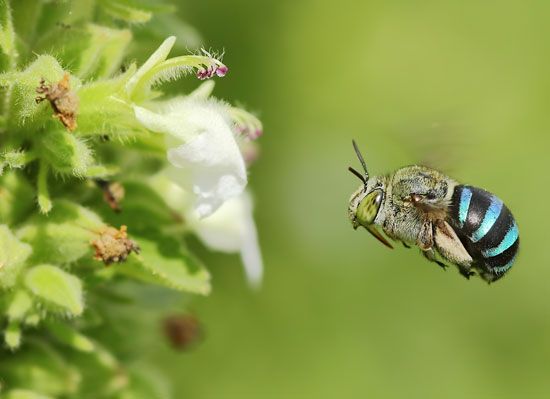
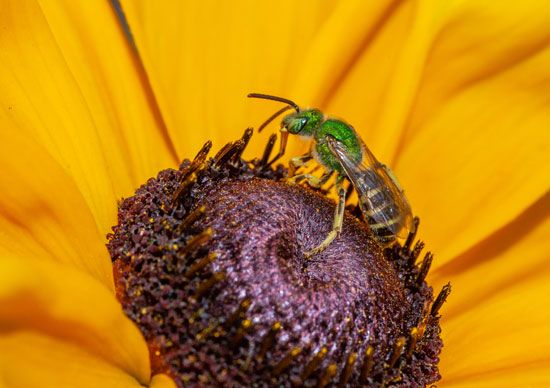
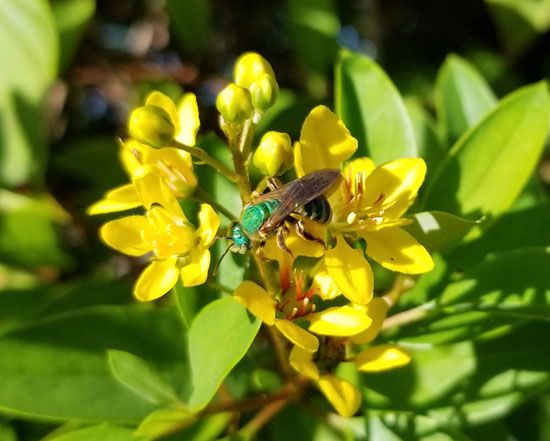
These insects are typically tiny to medium-sized, ranging from 3 to 10 mm in length, and are often slender. While many are black or brown, some species exhibit metallic green, blue, or purple coloration. They do not produce honey and generally only sting if provoked.1
Sweat bees are vital native pollinators that have coevolved with local flowering plants. They are essential for agricultural crops such as alfalfa, apples, and sunflowers, and many species are capable of buzz-pollination, which allows them to release pollen from specific plants like tomatoes and blueberries. Their social behaviors are highly diverse, ranging from solitary to primitively eusocial.1
Why are they called sweat bees?
Sweat bees (family Halictidae) are called by this name because they are frequently attracted to human perspiration on human skin.213
These small, often slender bees are found globally and are known for their diverse social behaviors, ranging from solitary to primitively eusocial. While they may land on people to seek out the moisture and salts found in sweat, they are generally not aggressive and typically only sting if they are provoked.132
What do sweat bees look like?
Sweat bees (family Halictidae) are diverse in appearance due to the large number of species within the family, but they generally share several physical characteristics:
- Size and Shape: They are tiny to medium-sized insects, typically measuring between 3 and 10 mm (0.1 to 0.4 inches) in length, and are generally slender in form.1
- Coloration: While most species are black or brown, some exhibit striking metallic green, blue, or purple colors.1
- Markings: Many species feature stripes similar to those of honeybees, with colors ranging from green and red to yellow.1
- Distinguishing Features: A universal trait among sweat bees is their relatively short tongue length compared to other bee types. Additionally, individual species can often be distinguished by their specific wing venation.1
Where do sweat bees live and build their nests?
Sweat bees (family Halictidae) are found on every continent on Earth except Antarctica. Regarding their nesting habits, they are highly diverse:1
- Ground-nesting: The vast majority of sweat bee species build their nests in the ground.13
- Wood-nesting: Some species choose to nest in rotten wood.1
- Parasitic exceptions: Certain species are kleptoparasitic, meaning they do not construct their own nests. Instead, they invade the nests of other bee species, consume the host’s eggs, and lay their own eggs in the already-provisioned cells.1
Within these environments, their social structures vary significantly. Some species are solitary, while others are communal, semi-social, or primitively eusocial. Solitary females often use unique chemical markers called lactones to identify and return to their specific burrows. In social colonies, nest complexity ranges from small groups with a single queen to long-lived, elaborate structures housing multiple queens and hundreds of workers.1
Sources
- sweat bee — Encyclopædia Britannica
- sweat bee — Merriam-Webster
- 8 Buzzworthy Types of Bees — Encyclopædia Britannica
Published on · 2 min read