Tardigrade
Tardigrades exhibit diverse reproductive strategies, utilizing both sexual and asexual methods. Asexual reproduction can occur through parthenogenesis or…
How do tardigrades reproduce and what is their life cycle like?
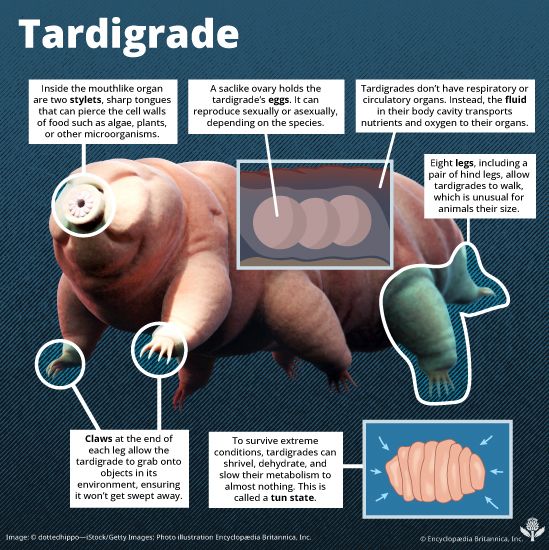
Tardigrades exhibit diverse reproductive strategies, utilizing both sexual and asexual methods. Asexual reproduction can occur through parthenogenesis or self-fertilization via hermaphroditism. When reproducing, these tiny invertebrates discharge their eggs either directly to the exterior through an opening near the anus or into the posterior end of the alimentary canal.1
Regarding their life cycle and growth, tardigrades undergo ecdysis, a process of molting where they shed their outer covering to facilitate growth or changes in body shape. A defining aspect of their life cycle is the ability to enter a state of suspended animation known as the “tun” state when environmental conditions become unfavorable. In this dehydrated, ball-like form, their metabolism drops significantly, allowing them to survive extreme desiccation and temperatures for years or even decades before reviving when conditions improve.21
What are the unique physical characteristics of tardigrades?
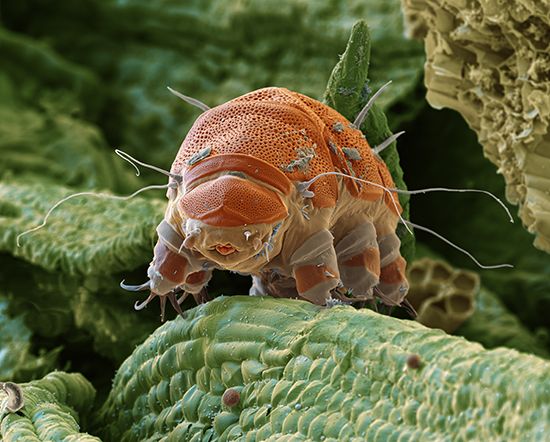
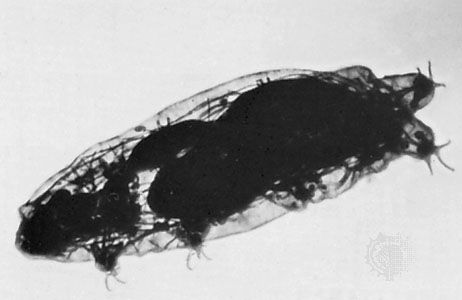
Tardigrades, often called water bears, are tiny invertebrates typically measuring 1 mm (0.04 inch) or less in length. Their physical structure is characterized by a well-developed head and a short body consisting of four fused segments. Each segment supports a pair of short, stout, unjointed limbs that generally terminate in several sharp claws.31
Internally, these animals lack specialized organs for circulation or respiration. Instead, they possess a fluid-filled body cavity known as a hemocoel, which transports blood and oxygen; oxygen diffuses through the animal’s integument and is stored in cells within the hemocoel. An alimentary canal runs the length of the body, and many species utilize specialized spearlike structures near the mouth called stylets to pierce plant cells.1
Perhaps their most unique physical adaptation is the ability to enter a “tun” state, where the body dehydrates into a lifeless, ball-like form to survive extreme environmental stress.1
Where can tardigrades be found in nature?
Tardigrades are highly adaptable invertebrates that inhabit a wide variety of environments across the globe. They are primarily found in moist habitats, including:
- Terrestrial environments: They frequently reside in damp moss, on flowering plants, and in sand.13
- Aquatic environments: They are common in both fresh water and the sea, often dwelling within underwater sediment.13
Because of their remarkable ability to enter a “tun” state—a form of suspended animation that allows them to survive extreme desiccation and temperature fluctuations—tardigrades can be easily dispersed by wind and water, enabling them to colonize diverse ecosystems worldwide.1
How do tardigrades survive in extreme environments?
Tardigrades survive extreme environments through a remarkable process of suspended animation known as the “tun” state, or cryptobiosis. When faced with unfavorable conditions—such as extreme desiccation, intense cold, or high heat—the tardigrade dehydrates its body, retracting its head and limbs to form a lifeless, ball-like structure called a tun.31
In this state, the organism’s metabolism drops to as little as 0.01 percent of its normal rate. This adaptation allows them to endure for years or even decades in environments that would be lethal to most other life forms, including exposure to a vacuum, helium gas, and temperatures as low as −272 °C (−458 °F). Once environmental conditions improve and the tardigrade is exposed to water, it can rehydrate and return to its active life.531
Sources
- tardigrade — Encyclopædia Britannica
- Molt — Encyclopædia Britannica
- tardigrade: Top Questions — Encyclopædia Britannica
- heteropteran - Legs — Encyclopædia Britannica
- 8 Animals That Live in Extreme Environments — Encyclopædia Britannica
Published on · 3 min read