How the 1815 Eruption of Mount Tambora Produced the “Year Without a Summer”
The 1815 eruption of Mount Tambora on the island of Sumbawa, Indonesia, is recognized as the largest and most destructive volcanic eruption in recorded…
What is How the 1815 Eruption of Mount Tambora Produced the “Year Without a Summer”?
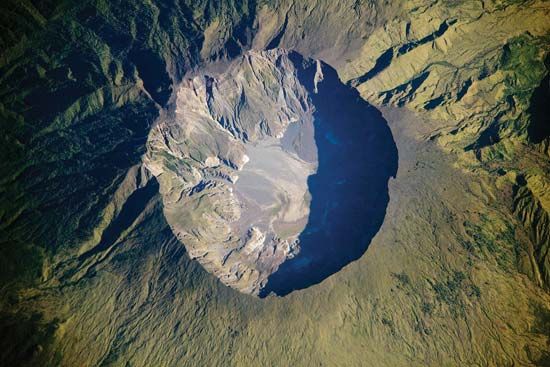
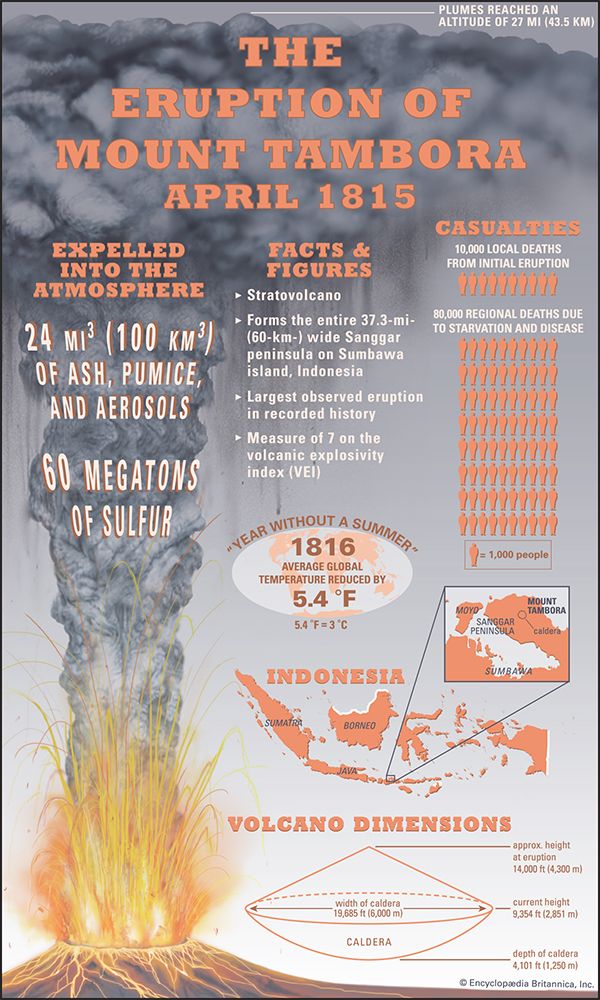
The 1815 eruption of Mount Tambora on the island of Sumbawa, Indonesia, is recognized as the largest and most destructive volcanic eruption in recorded history.12
The event produced the “Year Without a Summer” in 1816 by drastically altering the global atmosphere. During the eruption, the volcano expelled massive quantities of ash, pumice, and approximately 60 megatons of sulfur into the air. This material mixed with atmospheric gases to form aerosols, which created a haze that blocked significant amounts of sunlight from reaching the Earth’s surface.3124
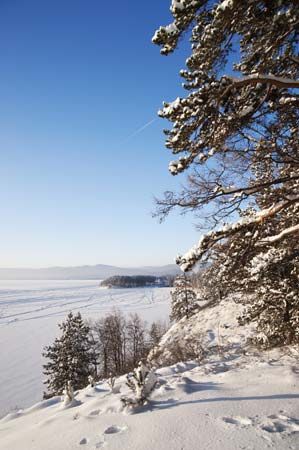
As a result, the average global temperature dropped by as much as 3 °C (5.4 °F). This cooling caused severe weather anomalies, including heavy snow and killing frost during the summer months of 1816 in parts of western Europe and eastern North America. These conditions led to widespread crop failures and famine, resulting in significant loss of life.312
How do volcanic aerosols differ from volcanic ash in their effect on the atmosphere?
Volcanic ash and volcanic aerosols differ significantly in their composition, longevity, and impact on the Earth’s climate.
Volcanic Ash
Volcanic ash consists of pulverized rock and mineral fragments ejected during an eruption. While these particles can decrease regional visibility for a few months following an event, they are relatively heavy and tend to settle out of the atmosphere more quickly than aerosols. Although ash clouds can cause temporary darkness and local weather disruptions, they are not the primary drivers of long-term global cooling.35
Volcanic Aerosols
In contrast, the most significant climate-altering agents are aerosols—specifically tiny droplets of sulfuric acid formed from sulfur dioxide gas.53
- Longevity: Because the stratosphere lacks the turbulent weather found in the lower atmosphere, these aerosols can remain suspended for several years, spreading globally to form a haze that blankets the Earth.563
- Climatic Impact: These aerosols reflect incoming solar radiation back into space and absorb terrestrial radiation. This process reduces the amount of sunlight reaching the surface, leading to a decline in global temperatures.36
While ash is a physical byproduct of the explosion, the chemical conversion of volcanic gases into sulfate aerosols is the primary mechanism behind the global cooling associated with “volcanic winters”.53
What are some other historical volcanic eruptions that have significantly impacted global climate?
Beyond the 1815 eruption of Mount Tambora, several other historical volcanic events have significantly impacted the global climate by injecting sulfur aerosols into the stratosphere, which reflect solar radiation and cool the Earth’s surface.63
- Mount Toba (c. 71,000–74,000 years ago): One of the most severe volcanic winters in history, this eruption in Sumatra expelled massive amounts of ash. Ice-core evidence indicates global temperatures plunged by 3–5 °C (5.4–9.0 °F) for years, with some models suggesting a decline of up to 10 °C (18 °F) in the Northern Hemisphere.6
- Laki (1783–1784): This fissure eruption in Iceland released enormous quantities of volcanic gas, creating a persistent haze over Europe. Scientists link this event to the severe winter of 1783–84 in the Northern Hemisphere.67
- Krakatoa (1883): This eruption in the Sunda Strait discharged nearly 21 cubic km of rock fragments. The resulting dust and aerosols caused global temperature drops of approximately 0.5 °C (0.9 °F) and produced spectacular atmospheric optical effects, such as vivid sunsets, for the following year.638
- Mount Pinatubo (1991): Located in the Philippines, this eruption cooled the global climate by about 0.5 °C (0.9 °F) for several years, providing modern data on how volcanic aerosols influence climate.63
How does the stratospheric layer protect or influence Earth’s climate?
The stratosphere plays a critical role in protecting and influencing Earth’s climate through its unique physical and chemical properties.
Protection via the Ozone Layer
The stratosphere contains the ozone layer, a region roughly 15 to 35 km above the surface where ozone molecules (O₃) are concentrated. This layer acts as a vital shield by absorbing the majority of the Sun’s harmful ultraviolet radiation, specifically wavelengths less than 290 nm. By blocking this radiation, the stratosphere prevents damage to living organisms and ecosystems.93
Influence on Temperature and Climate
The stratosphere influences Earth’s climate in several key ways:
- Thermal Structure: The absorption of solar radiation by ozone warms the stratosphere, causing temperatures to increase with altitude—a phenomenon that creates strong thermodynamic stability and inhibits vertical mixing. This warming produces temperatures ranging from approximately -15 to 10 °C at an altitude of 50 km.9103
- Atmospheric Stability: Because the stratosphere is highly stable and lacks the turbulent weather found in the troposphere, it acts as a reservoir for particles. When volcanic eruptions inject sulfur dioxide into this layer, it converts into sulfuric acid aerosols. These aerosols can remain suspended for years, spreading globally to reflect solar radiation and potentially lower global surface temperatures.111012
- Radiative Balance: While the troposphere acts as a “radiative blanket” that traps heat, the stratosphere’s interaction with solar and infrared radiation helps regulate the overall energy balance of the planet.3
Sources
- Mount Tambora: Top Questions — Encyclopædia Britannica
- Mount Tambora — Encyclopædia Britannica
- volcano - Long-term environmental effects — Encyclopædia Britannica
- How the 1815 Eruption of Mount Tambora Produced the “Year Without a Summer” — Encyclopædia Britannica
- Global warming - Volcanic aerosols — Encyclopædia Britannica
- volcanic winter — Encyclopædia Britannica
- Krakatoa — Encyclopædia Britannica
- Little Ice Age — Encyclopædia Britannica
- Did you know? — Merriam-Webster
- Ozone layer — Encyclopædia Britannica
- Climate - Effects of the atmosphere — Encyclopædia Britannica
- Atmosphere - Stratosphere and mesosphere — Encyclopædia Britannica
- Earth - The atmosphere of Earth — Encyclopædia Britannica
- Climate - Characteristics — Encyclopædia Britannica
- Atmosphere - Convection , circulation, and deflection of air — Encyclopædia Britannica
Published on · 4 min read