Thickknee
The name "thickknee" refers to the distinctive physical appearance of these birds. Specifically, the name is derived from the thickened intertarsal joint…
How did thickknee birds get their unusual name?
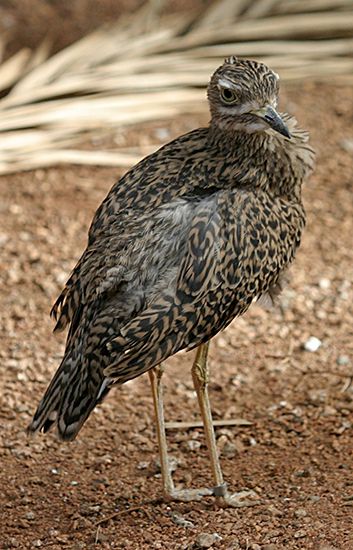
The name “thickknee” refers to the distinctive physical appearance of these birds. Specifically, the name is derived from the thickened intertarsal joint found on their long, yellowish or greenish legs.1
Alternatively, the name is sometimes associated with the bird’s size—which is comparable to a curlew—combined with its cryptic brown plumage and its tendency to inhabit stony environments. These birds are also frequently called “dikkop,” an Afrikaans term meaning “thickhead,” which references their large, broad heads.1
What are the distinctive physical characteristics of thickknee birds?
Thickknee birds, which belong to the family Burhinidae, possess several distinctive physical characteristics:
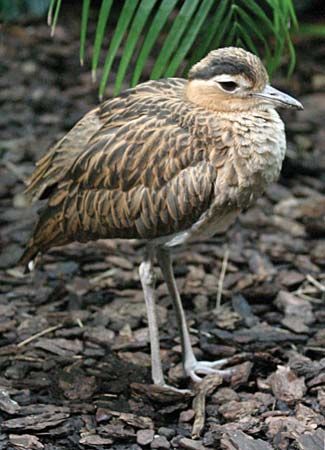
- Legs and Joints: They are named for the thickened intertarsal joint found on their long, yellowish or greenish legs. Their tarsi are reticulate.23
- Head and Bill: These birds have large, broad heads, which has led to them being commonly called “dikkop” (an Afrikaans term meaning “thickhead”). Their bills are stout and range from short to moderately long, often featuring a swollen tip.23
- Eyes: Most species are nocturnal and are characterized by their large, prominent yellow eyes.23
- Plumage: They exhibit cryptic, camouflaging plumage patterns consisting of brown, gray-brown, black, and white colors, which help them blend into their preferred stony environments.23
- Size: They are medium-sized birds, typically measuring between 35 and 52 centimeters (14 to 20 inches) in length.23
How do thickknee birds communicate and what sounds do they make?
Thickknee birds are primarily nocturnal, and their communication is most active during the twilight hours. At dusk, these birds are known to utter distinct, vocal calls that are described as wailing or croaking in nature.2
These vocalizations serve as a primary means of interaction for the nine species within the Burhinidae family, helping them maintain contact or signal presence in their environments, which range from stony wastelands to coastal regions.2
What family do thickknee birds belong to, and how many species are there?
Thickknee birds belong to the family Burhinidae within the order Charadriiformes. There are nine species of thickknees found across temperate and tropical regions of Eurasia, Africa, Australia, and the American tropics.24
Sources
- thick-knee — Merriam-Webster
- Thickknee — Encyclopædia Britannica
- Charadriiform - Annotated classification — Encyclopædia Britannica
- monkey - Classification — Encyclopædia Britannica
- Burhinidae — Merriam-Webster
- Burhinus — Merriam-Webster
Published on · 2 min read