Curlew
Curlews are medium-sized to large shorebirds belonging to the genus Numenius that are primarily distinguished by their unique bill structure. Unlike many…
What are the physical characteristics that distinguish curlews from other shorebirds?
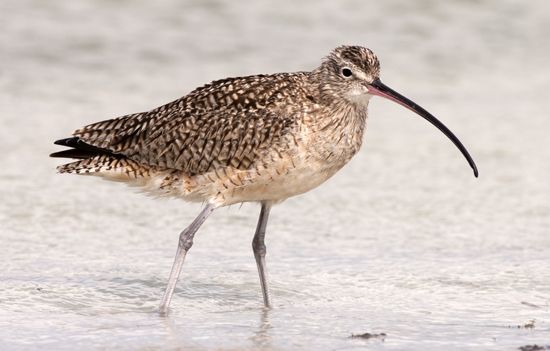
Curlews are medium-sized to large shorebirds belonging to the genus Numenius that are primarily distinguished by their unique bill structure. Unlike many other shorebirds, curlews possess a long, decurved (sickle-shaped) bill that curves downward at the tip, which they use to probe for food in marshes and coastal mud flats.1
Beyond their distinctive bills, curlews share several physical characteristics:
- Body Plan: They are characterized by long necks and fairly long legs, which assist them in their terrestrial and wading habits.1
- Plumage: Their feathers are typically streaked in shades of gray or brown, providing camouflage in their varied habitats.1
- Size: They are among the larger shorebirds, with some species reaching lengths of up to 60 cm (24 inches).1
While they belong to the broader order of Charadriiformes—a diverse group that includes sandpipers and plovers—curlews are easily identified by their specific combination of size, long legs, and that signature downward-curving bill.12
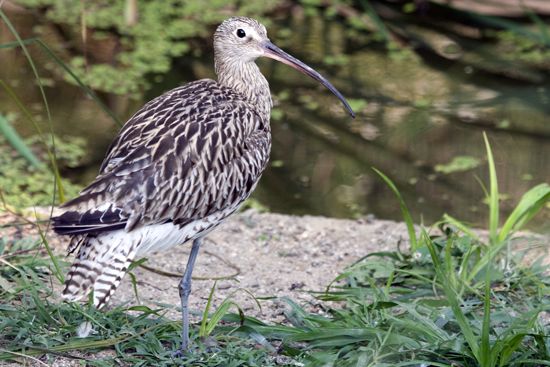
How do curlews use their distinctive long, curved bills for feeding?
Curlews utilize their distinctive long, downcurved bills as specialized tools for foraging across a variety of environments. Their feeding strategy is primarily based on probing, which allows them to access food sources that are otherwise unreachable to many other shorebirds.3
Their specific feeding behaviors include:
- Probing: In coastal areas and marshes, curlews use their bills to probe deep into mudflats to extract worms and into crustacean burrows to capture prey such as fiddler crabs.36
- Surface Foraging: When occupying inland habitats like grasslands or tundra, they use their bills to pick up insects and seeds from the surface of the ground.36
By adapting their bill shape to these different substrates, curlews effectively exploit diverse food sources throughout their migratory cycles.6
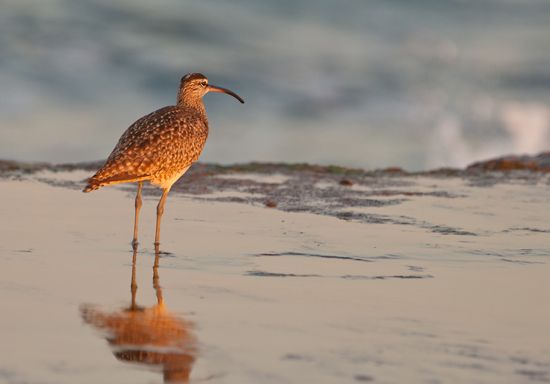
What are the migration patterns of curlews, and how far do they typically travel?
Curlews are migratory shorebirds that typically breed in inland temperate and sub-Arctic regions of the Northern Hemisphere before traveling long distances to winter in warmer climates. During these journeys, they frequent dry uplands to feed on insects and seeds, while their wintering grounds are primarily located in marshes and coastal mud flats where they forage for worms and crustaceans.1
The distance traveled varies significantly by species:
- Bristle-thighed curlew: This species is known for an impressive migration, traveling approximately 6,000 miles (9,650 km) from its breeding grounds in the mountains of Alaska to winter on islands in the South Pacific.1
- Eskimo curlew: Historically, this species undertook extensive migrations, breeding in the Arctic and traveling to the Pampas of South America for the winter.1
Migration is a complex process governed by internal rhythms and physiological changes, such as the accumulation of body fat, which are regulated by the pituitary gland and influenced by environmental factors like day length and food availability.8
What are the different species of curlews found around the world?
There are eight species of curlews belonging to the genus Numenius. These shorebirds are characterized by their streaked, gray or brown plumage and their distinctive downcurved, sickle-shaped bills.1
The eight species are:
- Bristle-thighed curlew (Numenius tahitiensis): Breeds in Alaska and migrates to the South Pacific.1
- Common (Eurasian) curlew (N. arquata): The largest European shorebird, breeding from Britain to Central Asia.1
- Eskimo curlew (N. borealis): A historically abundant species that is now virtually extinct.1
- Least curlew (N. minimus): A small species found in eastern Asia, measuring about 30 cm.1
- Long-billed curlew (N. americanus): A North American species known for its exceptionally long bill.1
- Eastern curlew (N. madagascariensis): The largest bird in the family, found in eastern Asia and Australia.1
- Slender-billed curlew (N. tenuirostris): Formerly of Eurasia and Africa, this species was declared extinct in 2024.1
- Whimbrel (N. phaeopus): The most widely distributed species, found in both the Old and New Worlds.1
Sources
- Curlew — Encyclopædia Britannica
- Charadriiform - General features — Encyclopædia Britannica
- Slender-billed curlew: Top Questions — Encyclopædia Britannica
- Numenius — Merriam-Webster
- Galliform - Form and function — Encyclopædia Britannica
- Charadriiform - Locomotion and feeding behaviour — Encyclopædia Britannica
- Ciconiiform - Bill shape — Encyclopædia Britannica
- Migration - Physiological stimulus of migration — Encyclopædia Britannica
Published on · 3 min read