Surfbird
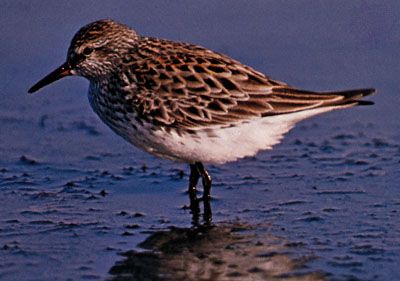
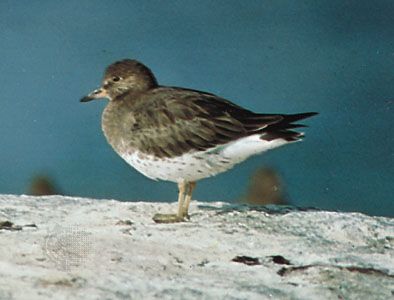
The surfbird (Aphriza virgata) is an American shorebird belonging to the family Scolopacidae and the subfamily Calidritinae, which it shares with the knots.…
What is Surfbird?
The surfbird (Aphriza virgata) is an American shorebird belonging to the family Scolopacidae and the subfamily Calidritinae, which it shares with the knots. Measuring approximately 25 centimetres (10 inches) in length, the species is characterized by a distinctive black triangle on its otherwise white tail.1
These birds breed in high-elevation rock fields within the mountains of south-central Alaska. During the nesting period, the male takes on parental duties after the female lays four eggs on the ground; the male is known to flush suddenly from the nest, a behavior thought to protect the eggs from being trampled. During the winter, surfbirds migrate to rocky, seaweed-rich coastal areas, ranging from Alaska and California as far south as southern Chile.1
What are some other types of shorebirds?
Shorebirds, also known as waders, belong to the suborder Charadrii within the order Charadriiformes. These birds are typically found along sea beaches, inland mudflats, and other open areas where they walk or wade to feed.34
Common types of shorebirds include:
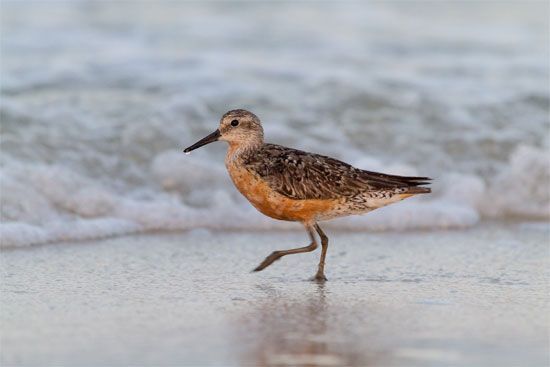
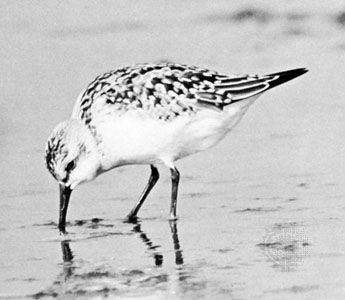
- Sandpipers: A diverse group including species like the knot, sanderling, dunlin, and woodcocks.5
- Plovers: Often found on beaches, this group also includes the lapwing and the crab plover.34
- Oystercatchers: Stout-bodied birds recognized by their long, flattened, orange-red bills used to feed on mollusks.6
- Avocets and Stilts: Members of the family Recurvirostridae, often found in tropical and temperate regions.4
- Other notable groups: These include snipes, phalaropes, coursers, pratincoles, thickknees, jacanas, seedsnipe, and sheathbills.34
How do birds like the surfbird survive in harsh coastal environments?
The surfbird (Aphriza virgata) and other shorebirds have evolved several specialized strategies to survive in the harsh, unpredictable conditions of coastal and high-elevation environments.
Physiological and Behavioral Adaptations
- Migration and Energy Storage: Many shorebirds undergo significant physiological changes before migration, controlled by the endocrine system. As autumn approaches, birds accumulate fat in their body tissues to provide the energy required for long-distance travel.13
- Thermoregulation: In extreme heat, many species use evaporative cooling methods such as panting or “throat fluttering,” which allows them to regulate body temperature with minimal energy expenditure. Some birds also expose their legs or raise their dorsal feathers to dissipate heat.910
- Salt Excretion: For species that consume seawater or marine prey, specialized lateral nasal glands act as salt excretory organs, allowing them to eliminate excess sodium chloride that their kidneys cannot process.9
Nesting and Survival Strategies
- Defensive Behaviors: To protect their young from predators or trampling, many shorebirds perform injury-feigning displays to distract threats. Surfbirds specifically are known to flush suddenly from their ground nests, a behavior believed to prevent eggs from being crushed.1011
- Environmental Resilience: Shorebirds often rely on cryptic coloration to blend into their surroundings, protecting them while they incubate eggs on open ground. In some species, such as the sheathbill, the timing of egg-laying is an adaptation that allows them to fledge the maximum number of young possible based on fluctuating food supplies.10
What are the main challenges birds face during long-distance migration?
Migratory birds face significant challenges during their long-distance journeys, often exacerbated by the intersection of natural environmental variability and human-induced pressures.
Environmental and Ecological Challenges
- Resource Availability: Migration is a high-energy activity that requires birds to exploit fluctuating food resources. Because ecological conditions—such as the timing of insect hatching or vegetation growth—are highly variable from year to year, birds must navigate unpredictable environments where food may be scarce.101617
- Climate Change: Rapid shifts in climate patterns can disrupt the timing of seasonal processes, such as egg-laying and migration. Furthermore, rising temperatures and changing precipitation patterns threaten critical habitats like coastal wetlands and salt marshes, which are essential for migratory species.18
- Physical Obstacles: As birds attempt to relocate to more favorable climates, they frequently encounter man-made impediments, including highways, walls, and artificial waterways, which can obstruct their paths and increase the difficulty of their journey.18
Physiological Demands
- Metabolic Stress: To sustain long-distance flight, birds must undergo complex physiological changes, including the accumulation of fat in body tissues to serve as energy reserves. This process is tightly regulated by the endocrine system, and failure to meet these metabolic requirements can be fatal.1116
Sources
- Surfbird — Encyclopædia Britannica
- Charadriiform - Adaptations for feeding — Encyclopædia Britannica
- Shorebird — Encyclopædia Britannica
- Charadriiform — Encyclopædia Britannica
- Charadriiform - General features — Encyclopædia Britannica
- Sandpiper — Encyclopædia Britannica
- Oystercatcher — Encyclopædia Britannica
- beach plover — Merriam-Webster
- Charadriiform - Shorebirds (suborder Charadrii) — Encyclopædia Britannica
- How do birds know when to fly south? — Encyclopædia Britannica
- Migration - Physiological stimulus of migration — Encyclopædia Britannica
- Charadriiform - Locomotion and feeding behaviour — Encyclopædia Britannica
- Charadriiform - Adaptations for flight — Encyclopædia Britannica
- Pelecaniform - Physiological adaptations — Encyclopædia Britannica
- Charadriiform - Gulls (suborder Lari) — Encyclopædia Britannica
- Migration - Birds — Encyclopædia Britannica
- Global warming - Environmental consequences of global warming — Encyclopædia Britannica
- Migration - Birds — Encyclopædia Britannica
- Bird - Flight — Encyclopædia Britannica
- Migration - Ecological significance of migration — Encyclopædia Britannica
- Bird - Importance to man — Encyclopædia Britannica
Published on · 3 min read