Tsetse Fly
To control tsetse fly populations and mitigate the transmission of sleeping sickness and nagana, several strategies have been employed with varying success.
What methods are used to control tsetse fly populations and prevent the spread of diseases they carry?
To control tsetse fly populations and mitigate the transmission of sleeping sickness and nagana, several strategies have been employed with varying success.1
Environmental and Conventional Methods
Historically, the most effective approaches have focused on altering the fly’s habitat or food sources:
- Habitat Modification: Clearing woodlands and using periodic burning to prevent brush growth disrupts the environments where flies thrive.1
- Host Reduction: Destroying wild game populations removes the primary blood-meal sources for the flies.1
- Direct Control: The use of insecticides, trapping, and the introduction of natural parasites can reduce local populations, though these methods often struggle to achieve total eradication.1
Sterile Insect Technique
A highly effective alternative for total eradication in localized areas is the release of sterilized male flies. In this process, males are exposed to gamma radiation in laboratories. Because female tsetse flies mate only once, their union with a sterile male prevents them from producing offspring, effectively suppressing the population growth.1
What is the life cycle of a tsetse fly, and how does it differ from other insects?
The life cycle of the tsetse fly (Glossina) is highly specialized and differs significantly from most other insects, which typically lay eggs that hatch into independent, free-living larvae.12
The Tsetse Life Cycle
Tsetse flies are larviparous, meaning they do not lay eggs in the environment. Instead, they exhibit a form of development called adenotrophic viviparity. The process follows these stages:13
- Internal Development: A single egg hatches inside the female’s uterus. The larva remains there, nourished by a nutrient fluid secreted by specialized milk glands.12
- Larval Growth: The larva undergoes three stages of growth within the mother over approximately nine days.1
- Pupation: Once mature, the female deposits the larva onto the ground. Within one to five hours, the larva burrows into the soil and forms a pupa.1
- Emergence: After several weeks, the adult fly emerges from the pupa.1
Key Differences from Other Insects
Unlike many other flies that produce numerous eggs to be left in external environments, the tsetse fly invests heavily in the survival of a single offspring at a time. While most insects have an active, independent larval stage that feeds and grows in the environment, the tsetse larva has no independent life; it is entirely dependent on the mother until it is ready to pupate. Consequently, the active life of a tsetse fly is almost entirely spent as an adult.12
What are the physical characteristics of tsetse flies that distinguish them from other insects?
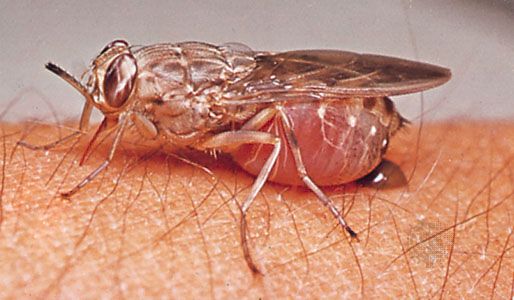
Tsetse flies (genus Glossina) possess several distinct physical characteristics that differentiate them from other insects, particularly other flies:
- Piercing Proboscis: They are distinguished by a forward-projecting, needlelike proboscis on the head used for puncturing skin to feed on blood. Unlike some other bloodsucking flies that use mandibles and maxillae to cut skin, the tsetse fly utilizes a specialized labium for this purpose, which is protected by a sheath formed from the palps of the lost maxillae.14
- Antennal Appendage: A unique feature is the bristlelike appendage (arista) on each antenna, which bears a single row of long, branched hairs on its upper edge. This specific structure differentiates the tsetse fly from all other fly species.1
- Wing Position: When at rest, tsetse flies hold their wings flat over their backs, folded one over the other like the blades of a pair of scissors.1
- General Appearance: They are robust, sparsely bristled insects ranging from 6 to 16 mm in length. Their coloration is generally drab, varying from yellowish brown to dark brown, often featuring a gray thorax with dark markings and a banded abdomen.1
How do tsetse flies compare to mosquitoes in terms of their impact on public health in Africa?
Tsetse flies and mosquitoes are both significant vectors of disease in Africa, but they differ in the specific pathogens they transmit and their broader impact on human development.
Disease Transmission
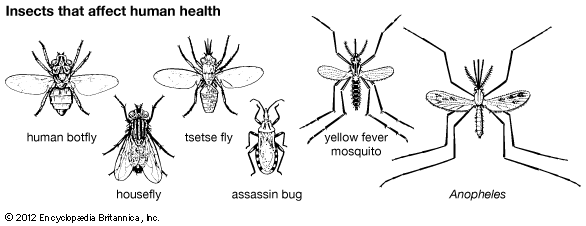
- Tsetse Flies: These flies are the exclusive vectors of trypanosomes, the protozoans that cause sleeping sickness in humans and nagana in domestic animals. Because they transmit diseases to both humans and livestock, they have historically acted as a major barrier to agriculture and human settlement in large regions of sub-Saharan Africa.167
- Mosquitoes: Mosquitoes are vectors for a wider variety of pathogens, including the protozoan responsible for malaria and various viruses such as dengue, yellow fever, and Rift Valley fever.87
Public Health Impact
While both insects have caused significant morbidity, their epidemiological profiles differ:
- Scope: Mosquito-borne diseases like malaria remain widespread and are major global public health challenges. In contrast, sleeping sickness cases have declined significantly due to intensive control efforts, with annual reports reaching all-time lows in the early 21st century.716
- Economic Influence: The impact of the tsetse fly is uniquely tied to the economic development of rural Africa; by causing nagana, it prevents the widespread use of cattle for farming and transport, directly affecting food security and economic stability in endemic areas.16
Sources
- tsetse fly — Encyclopædia Britannica
- adenotrophic — Merriam-Webster
- Diptera - General features — Encyclopædia Britannica
- insect - Head — Encyclopædia Britannica
- tsetse fly — Merriam-Webster
- viral hemorrhagic fever — Encyclopædia Britannica
- sleeping sickness — Encyclopædia Britannica
- insect - Medical significance — Encyclopædia Britannica
Published on · 4 min read