Snipe Fly
A snipe fly is any member of the insect family Rhagionidae within the order Diptera. These flies are typically dark-colored, measuring between 8 and 15 mm…
What is snipe fly?
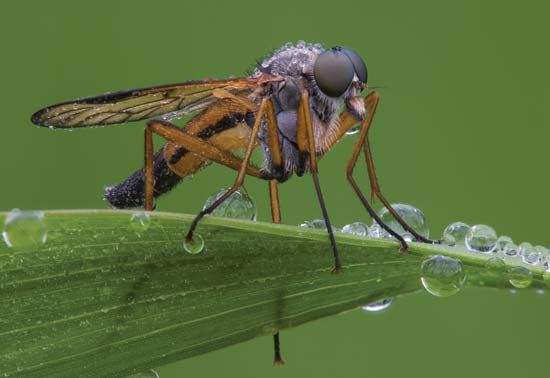
A snipe fly is any member of the insect family Rhagionidae within the order Diptera. These flies are typically dark-colored, measuring between 8 and 15 mm (0.3 to 0.6 inches) in length, and are characterized by a rounded head, a tapering abdomen, and long, slender legs.123
Adult snipe flies are commonly found in wooded areas, often resting on vegetation, while their larvae typically inhabit soil or water. Although both the adults and larvae are predacious, most species do not bite humans. An exception is the genus Symphoromyia, whose females are known to suck blood and can be significant pests along the Pacific coast of North America. Some species exhibit unique behaviors, such as certain Atherix females forming egg-laying swarms, or Vermileo larvae creating pits in dust to trap prey, similar to ant lions.12
What are some other types of flies that bite humans?
Many flies in the order Diptera have evolved specialized mouthparts to feed on the blood of vertebrates, including humans. While the females of many species require blood protein for egg production, the mechanisms they use to bite vary significantly.5
Common Bloodsucking Flies
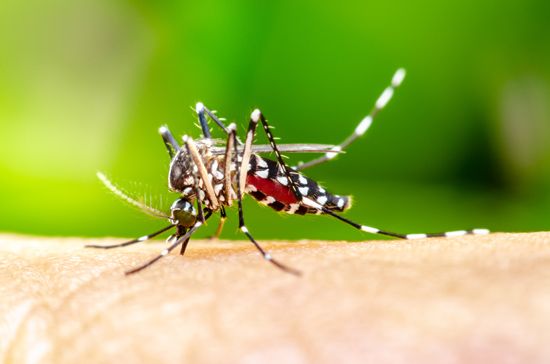
- Mosquitoes: Perhaps the most well-known bloodsuckers, they use bladelike, piercing stylets to feed and are primary vectors for diseases like malaria, yellow fever, and encephalitis.5
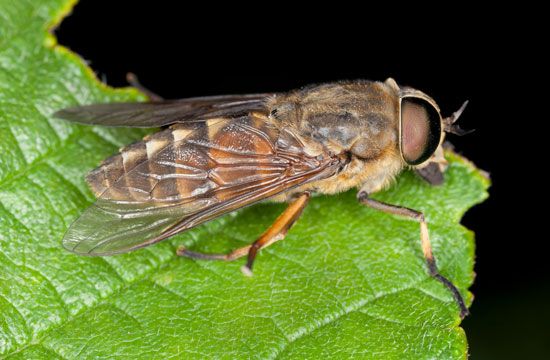
- Horse flies: These stout, fast-flying insects—which include the deer fly—possess mouthparts that act like a wedge-shaped tool to pierce skin. They can be serious pests and may transmit diseases such as anthrax and tularemia.65
- Black flies: Small, humpbacked flies that can be incredibly abundant. Some species transmit onchocerciasis, a parasitic disease that can lead to blindness.7
- Biting midges: Also known as “no-see-ums” or punkies, these tiny insects often attack in large numbers, causing significant irritation.8
- Sand flies: These flies are of major medical importance, as they can transmit viruses and parasites that cause conditions such as kala azar and Oriental sore.9
- Tsetse flies: Unlike many other biting flies, both males and females of this group feed on blood using a hard, drill-like proboscis. They are responsible for transmitting sleeping sickness.5
How do predacious insects like snipe flies help the environment?
Predacious insects like snipe flies (family Rhagionidae) contribute to the health of the environment primarily by serving as essential components of food chains and food webs.101112
As predators, both the adult and larval stages of snipe flies help regulate the populations of other organisms within their habitats, such as soil or water. By consuming other small insects or invertebrates, they act as natural population controllers, preventing any single species from becoming overly dominant.121314
Furthermore, these flies serve as a vital food source for a wide variety of other animals, including fish, birds, amphibians, spiders, and other insects. By transferring energy through these complex feeding relationships, they support the stability and biodiversity of their ecosystems. While some species are known to be pests, the predatory nature of the group as a whole plays a functional role in maintaining ecological balance.101112
What are the main differences between the suborders Nematocera and Brachycera?
The suborders Nematocera and Brachycera represent two major divisions within the order Diptera, distinguished primarily by their physical structure and development.
Key Differences
- Antennae: Nematocera (meaning “thread-horns”) possess long, whiplike antennae consisting of a scape, a pedicel, and a flagellum with many similar segments. In contrast, Brachycera (meaning “short-horns”) have antennae where the flagellum is contracted into a compound third segment, often featuring a bristle-like arista or a stumpy style.16217
- Mouthparts and Palpi: Nematocera typically have maxillary palpi with more than three segments, which are often pendulous. Brachycera generally have palpi with one to three segments that are often held forward (porrect).1617
- Wing Venation: In Nematocera, the anal cell of the wing is typically open. In Brachycera, the anal cell is narrowed and almost always closed on or before the wing margin.16
- Larval Characteristics: While both suborders include species with well-defined heads, their mandibles differ. Nematocera larvae usually have horizontally opposed mandibles, whereas Brachycera larvae have mandibles that move vertically or parallel and cannot be opposed.16
- Emergence: Adult Brachycera typically escape from the pupa through a rectangular slit, a characteristic associated with the group historically termed “Orthorrhapha”.16
Sources
- snipe fly — Encyclopædia Britannica
- Diptera - Annotated classification — Encyclopædia Britannica
- rhagionid — Merriam-Webster
- Rhagionidae — Merriam-Webster
- biting midge — Encyclopædia Britannica
- sand fly — Encyclopædia Britannica
- horse fly — Encyclopædia Britannica
- Diptera - Importance — Encyclopædia Britannica
- black fly — Encyclopædia Britannica
- Diptera: Top Questions — Encyclopædia Britannica
- Coleoptera - As predators — Encyclopædia Britannica
- insect - Role in nature — Encyclopædia Britannica
- heteropteran - Food habits — Encyclopædia Britannica
- food web — Encyclopædia Britannica
- insect - Commercial significance — Encyclopædia Britannica
- Diptera - Larval features — Encyclopædia Britannica
- Diptera - Antennae — Encyclopædia Britannica
- Brachycera — Merriam-Webster
Published on · 3 min read