Allosaurus
Allosaurus lived during the Jurassic Period, with the genus appearing as early as the Middle Jurassic. The most well-known fossils of these large carnivorous…
When and where did Allosaurus live during the prehistoric era?
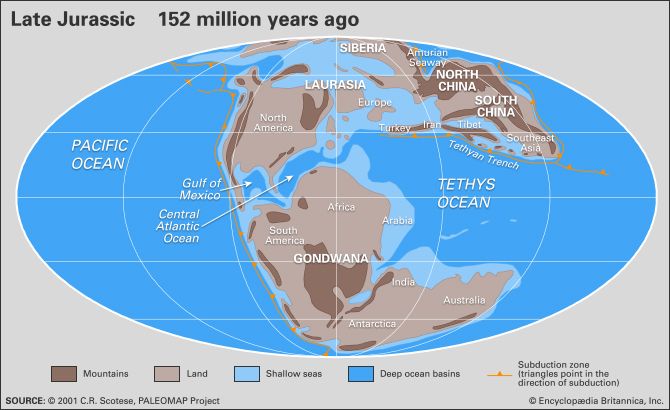
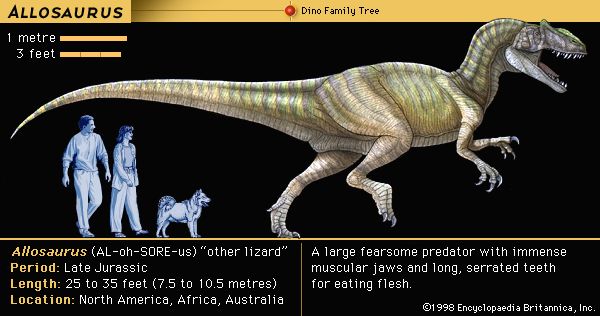
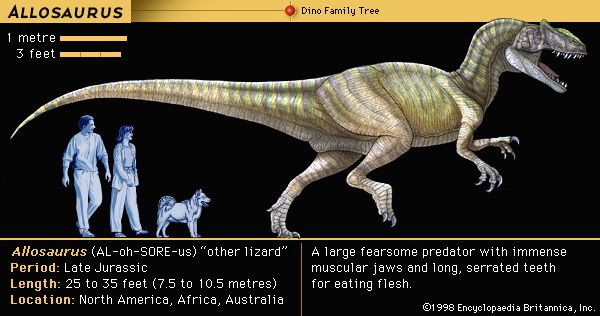
Allosaurus lived during the Jurassic Period, with the genus appearing as early as the Middle Jurassic. The most well-known fossils of these large carnivorous theropod dinosaurs date from the Late Jurassic, specifically between 150 million and 144 million years ago.12
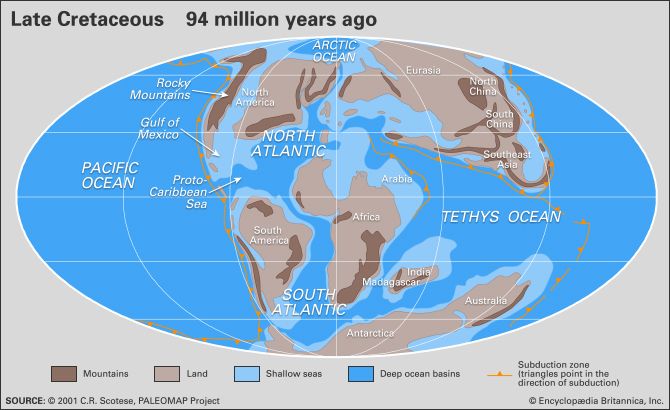
Geographically, Allosaurus is best known from fossils discovered in the western United States, with significant findings at the Cleveland-Lloyd Quarry in Utah and the Garden Park Quarry in Colorado. Descendants of the genus persisted into the Early Cretaceous Period, ranging from 144 million to 135 million years ago, and their fossils have been identified across North America, Africa, and Australia.2
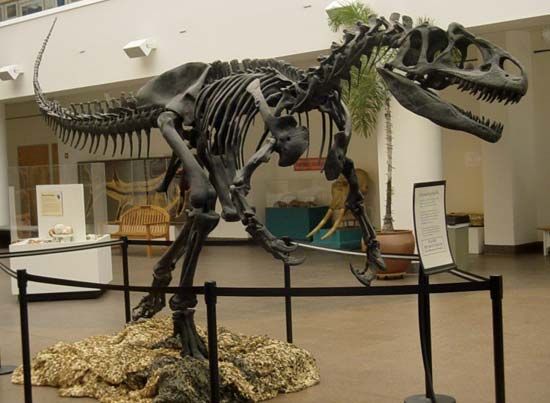
How does Allosaurus compare to other large theropod dinosaurs like Tyrannosaurus rex?
While Allosaurus and Tyrannosaurus rex were both large, bipedal carnivorous theropod dinosaurs, they differed significantly in anatomy and evolutionary lineage.
Anatomical Differences
- Forelimbs: A primary distinction lies in their arms. Allosaurus possessed relatively well-developed forelimbs with three fingers ending in sharp claws, which were likely used for grasping prey. In contrast, Tyrannosaurus rex had extremely reduced forelimbs that were too short to reach its mouth or grasp prey effectively.13
- Skull and Teeth: The Allosaurus skull is characterized by a large, roughened ridge in front of the eye and sharp, laterally compressed, bladelike teeth. Tyrannosaurus rex featured a more robust skull with fewer, larger teeth that were nearly round in cross-section—a shape optimized for puncturing bone and flesh.14
Evolutionary Context
Although once grouped together as “carnosaurs,” these resemblances were superficial and based primarily on their large size. Today, paleontologists classify Allosaurus as an allosaur, while Tyrannosaurus rex is considered a gigantic member of the coelurosaurs. Allosaurus lived during the Late Jurassic Period, whereas T. rex is known from the end of the Cretaceous Period.51
What does the name ‘Allosaurus’ mean and why was it given this name?
The name Allosaurus is derived from the Greek combining element allo-, meaning “other” or “different,” and -saurus, a common suffix for dinosaur names meaning “lizard.”
The genus was introduced by the American paleontologist Othniel Charles Marsh in 1877. He chose this name to highlight the distinctiveness of the dinosaur’s vertebrae, which were uniquely modified to ensure lightness compared to other known dinosaurs of the time.7
What was the average size and weight of an adult Allosaurus?
An adult Allosaurus typically weighed approximately two tons (about 1,800 kg) and reached an average length of 10.5 meters (35 feet). While these figures represent the standard size for the genus, fossil evidence indicates that some exceptionally large individuals could reach lengths of up to 12 meters (nearly 40 feet).1
Sources
- Allosaurus — Encyclopædia Britannica
- Jurassic Period - Vertebrates — Encyclopædia Britannica
- tyrannosaur - Classification — Encyclopædia Britannica
- Albertosaurus — Encyclopædia Britannica
- tyrannosaur - Other skeletal features — Encyclopædia Britannica
- Tyrannosaurus rex: Top Questions — Encyclopædia Britannica
- allosaurus — Merriam-Webster
- allosaur — Merriam-Webster
- dinosaur - American hunting expeditions — Encyclopædia Britannica
- How tall was T. rex? — Encyclopædia Britannica
Published on · 2 min read