Vine Snake
Vine snakes are characterized by their slender bodies, narrow heads, and pointed snouts. They are typically between 0.75 and 1.5 metres (2.5 to 5 feet) in…
What are the distinguishing physical characteristics of vine snakes?
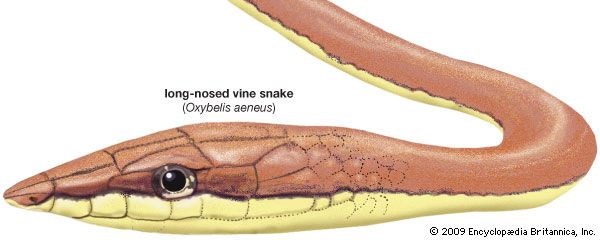
Vine snakes are characterized by their slender bodies, narrow heads, and pointed snouts. They are typically between 0.75 and 1.5 metres (2.5 to 5 feet) in length, with tails accounting for more than one-third of their total size. Their bodies are laterally compressed, and their coloration—ranging from green to gray or brown—serves as camouflage within their respective rainforest, savanna, or dry forest habitats.1
Key physical features vary by genus:
- Vision: Ahaetulla species possess a unique horizontal keyhole-shaped pupil and longitudinal grooves on their snouts, which facilitate acute, binocular vision. Other genera have different pupil shapes, such as the round pupil of Oxybelis or the horizontally elliptical pupil of Thelotornis.1
- Defense: These snakes are venomous and possess grooved fangs located below the eye. Some species, such as those in the genus Thelotornis, can inflate their neck region to display startling colors on the skin between their scales when threatened.1
In which regions or habitats are vine snakes typically found?
Vine snakes are found across diverse tropical and subtropical regions, with their specific habitats dictated by their genus and coloration:
- African Vine Snakes (Thelotornis): These are found throughout sub-Saharan Africa, with the highest diversity occurring in East Africa.1
- New World Vine Snakes (Oxybelis): These species have a broad range extending from Texas in the United States down to Peru.1
- Asian Vine Snakes (Ahaetulla): This genus is distributed across India, Southeast Asia, the Philippines, and the East Indies.1
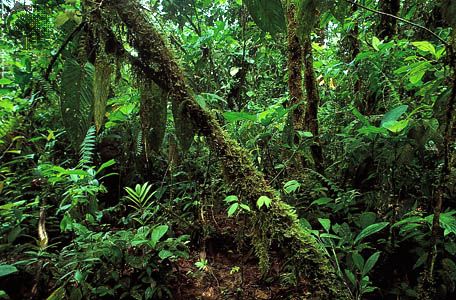
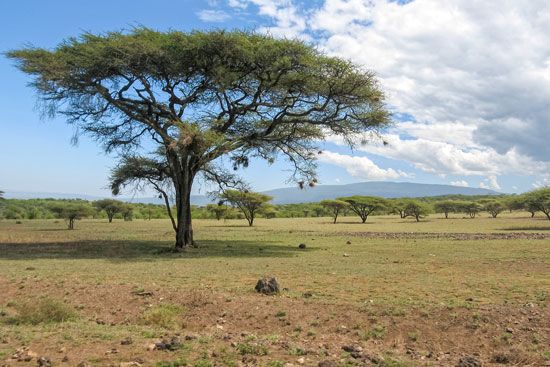
Regarding their environment, these snakes are highly adapted to their surroundings through camouflage. Green-colored species are typically found in rainforest areas, where they blend into the lush foliage. Conversely, gray or brown species are primarily inhabitants of savannas or dry forests, where their coloration provides effective concealment against branches and bark.1
What adaptations do vine snakes have that help them survive in their environment?
Vine snakes have evolved a suite of specialized adaptations that allow them to thrive in arboreal environments:
- Structural Mechanics: Unlike most snakes that sag when reaching across gaps, vine snakes can extend up to half their body length horizontally without support. This ability functions like an I-beam, supported by their reduced body weight and deepened, strengthened vertebrae.1
- Vision: Species in the genus Ahaetulla possess horizontal keyhole-shaped pupils and longitudinal snout grooves, which provide acute, binocular vision essential for navigating complex foliage and tracking prey.3
- Camouflage and Defense: Their coloration—green for rainforest dwellers and gray or brown for those in savannas—allows them to blend into their surroundings. When threatened, some species can inflate their necks to reveal startling colors on the skin between their scales.3
- Hunting Strategy: They utilize their venomous, rear-positioned fangs to subdue lizards, frogs, and birds. Additionally, they use their bright-colored tongues as lures, flicking them to mimic worms or insects to attract unsuspecting prey.3
How do vine snakes hunt and what is their primary diet?
Vine snakes are specialized predators that primarily consume lizards, frogs, and birds.1
To capture their prey, they utilize a combination of stealth, physical adaptation, and active luring:
- Camouflage: Their coloration is highly specialized to their environment, allowing them to blend seamlessly into foliage. Green species typically inhabit rainforest areas, while gray or brown species are found in savannas or dry forests1.
- Luring: A unique hunting method involves the snake extending its bright-colored tongue and flicking it back and forth. This motion mimics the appearance of a worm or insect, drawing unsuspecting prey within striking distance.1
- Venomous Strike: Once prey is close, the snake uses its rear-positioned, grooved fangs to deliver venom and subdue the animal.1
- Navigation: Their ability to bridge gaps between branches—extending up to half their body length horizontally like an I-beam—allows them to navigate complex arboreal habitats to reach and ambush prey.13
Sources
- vine snake — Encyclopædia Britannica
- snake - Skull and sense organs — Encyclopædia Britannica
- reptile - Clinging and climbing — Encyclopædia Britannica
Published on · 3 min read