Volga River
The Volga River served as a vital artery for the development of early Russian states by facilitating intensive commercial activity between northern European…
How did the Volga trade route contribute to the development of ancient Russian states?
The Volga River served as a vital artery for the development of early Russian states by facilitating intensive commercial activity between northern European merchant adventurers and Middle Eastern markets. Beginning around 770 CE, Scandinavian Varangians penetrated the Volga region to trade local resources—such as furs, wax, honey, and slaves—for silver and other goods.12
This trade fostered the emergence of the first political structures in the region. By 830 CE, Scandinavian traders established a center near Ryazan, where the first nominal ruler of Rus, known as a khagan, was recorded. This “Volga Rus” state is considered a direct political antecedent to the later Kievan state. The wealth generated by this commerce, evidenced by significant hoards of Middle Eastern coins, provided the economic foundation for these early principalities.12
While the focus of trade later shifted toward the Dnieper River and the Black Sea, the Volga remained a critical historical cradle for the Russian state, eventually supporting the rise of new centers like Moscow and Tver during the Mongol period.134
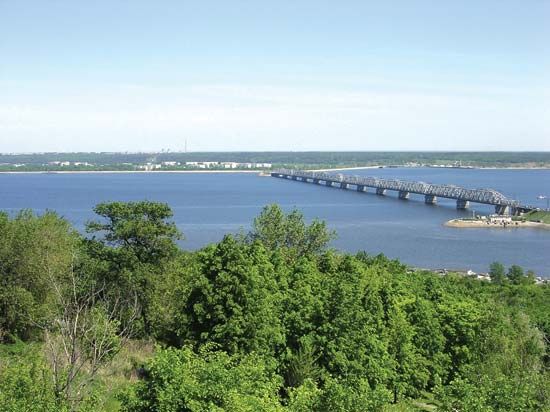
How does the climate vary along the course of the Volga River?
The climate of the Volga River basin exhibits significant variation as it traverses from north to south, transitioning through diverse geographic zones including dense forests, forest steppes, steppes, and semidesert lowlands.89
Temperature and Precipitation
The upper reaches of the river are situated in a temperate zone characterized by cold, snowy winters and warm, humid summers. As the river flows south and east, the climate becomes increasingly arid, with hotter, drier summers and winters featuring less snow.8
- Upper Reaches: Average winter temperatures range from 19 °F (−7 °C) to 6 °F (−14 °C), while July temperatures average between 62 °F (17 °C) and 68 °F (20 °C).8
- Lower Reaches (Astrakhan): Winter temperatures average 19 °F (−7 °C), but summer temperatures rise to 77 °F (25 °C).8
Annual rainfall decreases significantly along the river’s course, dropping from 25 inches (635 mm) in the northwest to 12 inches in the southeast.8
Ice Regime
The river typically freezes in late November in its upper and middle courses, and in December in the lower reaches. While the river is generally ice-free for about 200 days annually, this extends to 260 days near Astrakhan. The construction of Soviet-era reservoirs has altered this, increasing ice duration on headwaters while decreasing it below dams.8
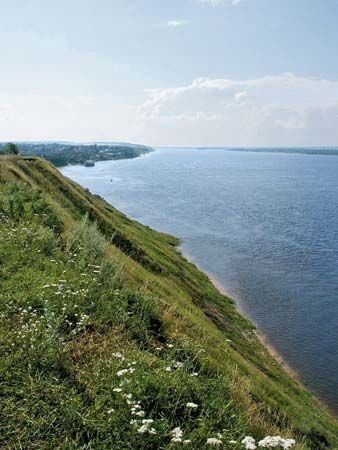
How has the construction of dams and reservoirs affected the Volga River and surrounding areas?
The construction of dams and reservoirs along the Volga River and its tributary, the Kama River, has fundamentally transformed the river from a free-flowing waterway into a series of man-made lakes. This extensive system, which includes eight hydroelectric stations on the Volga and three on the Kama, provides approximately 11 million kilowatts of power and includes navigation locks to support transport.11
However, this development has caused significant ecological disruption:
- Fisheries and Habitat: Dams have blocked access for anadromous fish, such as the beluga sturgeon and whitefish, which migrate from the Caspian Sea to spawn. These barriers, combined with industrial and agricultural pollution, have led to a decline in native fish populations, necessitating artificial breeding programs.12
- Hydrological Changes: Impoundment, evaporation, and water diversion for irrigation have reduced the river’s discharge at its mouth. This has contributed to a persistent decline in the level of the Caspian Sea since 1930.12
- Temperature and Ice: The massive reservoirs have altered the river’s thermal regime, increasing the duration of ice on headwaters while decreasing it in areas below the dams.13
How does the Volga River contribute to Russia’s economy and transportation system?
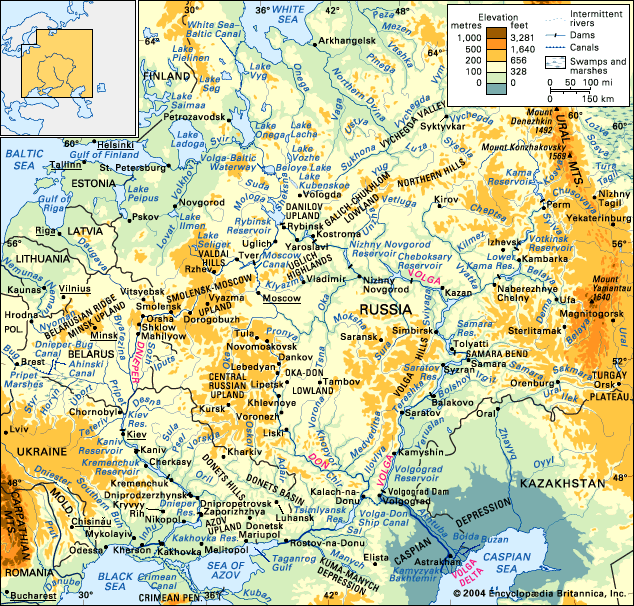
The Volga River is the principal waterway of western Russia and a cornerstone of the nation’s economy. Its basin covers about two-fifths of European Russia and supports nearly half of the country’s population.14
Transportation and Navigation
The Volga is navigable for approximately 2,000 miles and serves as the backbone of Russia’s inland waterway system. It carries nearly half of all passengers and more than half of all freight on Soviet-era inland waterways. Key cargoes include construction and raw materials—which account for 80 percent of freight—as well as petroleum, coal, foodstuffs, salt, and machinery.15
The river is integrated into a vast network of canals, linking Russia to the broader world:
- Volga-Baltic Waterway: Connects the Volga to the Baltic Sea and the White Sea.154
- Volga-Don Ship Canal: Links the Volga to the Don River, providing access to the Sea of Azov and the Black Sea.1115
- Moscow Canal: Connects the river directly to Moscow.15
Energy Production
The river’s economic utility is further bolstered by a series of eight hydroelectric stations, which, combined with three stations on the Kama River, provide an installed generating capacity of approximately 11 million kilowatts of power.16
Sources
- Russia - Prehistory and the rise of the Rus — Encyclopædia Britannica
- history of Sweden - Trade — Encyclopædia Britannica
- Russia - The decline of Kiev — Encyclopædia Britannica
- Volga River — Encyclopædia Britannica
- Volga River - Study and exploration — Encyclopædia Britannica
- Russia - The Mongol invasion — Encyclopædia Britannica
- Silk Road: Top Questions — Encyclopædia Britannica
- Volga River - Climate of the Volga River — Encyclopædia Britannica
- Volga River - Physical features — Encyclopædia Britannica
- Volga River - Hydrology — Encyclopædia Britannica
- Volga River - Dams and reservoirs — Encyclopædia Britannica
- Volga River - Environmental changes — Encyclopædia Britannica
- Volga River - Physiography — Encyclopædia Britannica
- Volga-Don Canal — Encyclopædia Britannica
- Volga River - Navigation — Encyclopædia Britannica
- Volga-Baltic Waterway — Encyclopædia Britannica
Published on · 4 min read