Waiau River
There are two distinct rivers in New Zealand named the Waiau River.
What is Waiau River?
There are two distinct rivers in New Zealand named the Waiau River.
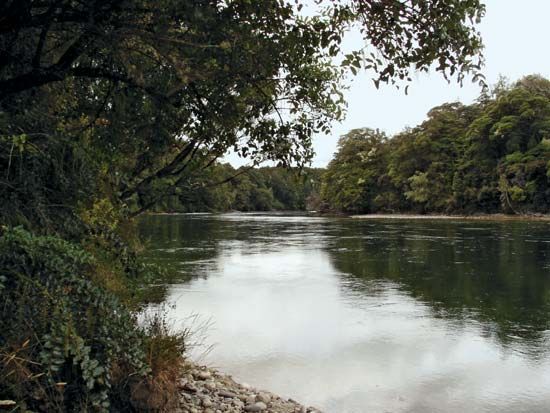
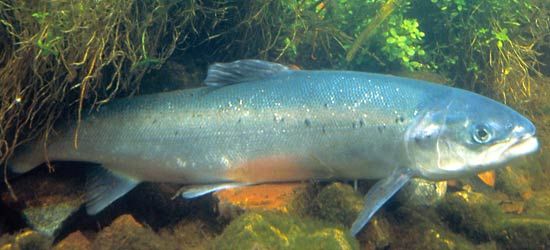
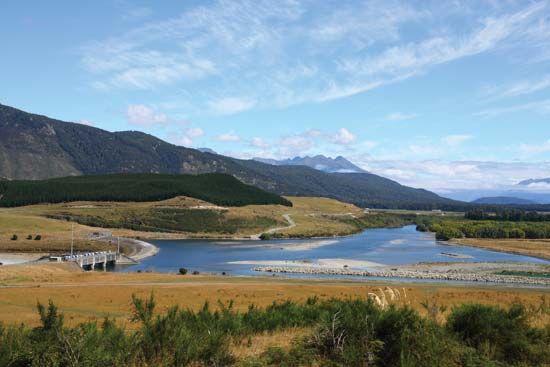
The first is located in the southwestern South Island. It originates in Lake Manapouri and flows 135 miles (217 km) south through the Southland district into Te Waewae Bay of the Tasman Sea. Its drainage basin includes Lakes Te Anau and Monowai, as well as the Mararoa River. The town of Tuatapere serves as a local center for farming and lumbering, and the river is known for salmon fishing.1
The second Waiau River is situated in the eastern South Island. It rises in the Spenser Mountains and flows 105 miles (169 km) south and east to the Pacific Ocean. Its drainage basin covers 1,270 square miles (3,290 square km) and includes tributaries such as the Lewis, Hope, and Hanmer rivers. This region is primarily used for livestock, and the river’s gorges are considered potential sites for hydroelectric power.2
How do hydroelectric power stations impact river ecosystems?
Hydroelectric power stations, primarily facilitated by the construction of dams, significantly alter river ecosystems and natural landscapes. While these stations provide renewable energy, their environmental impacts are profound and often the subject of intense debate.345
Disruption of Aquatic Life
Dams act as physical barriers that interrupt the migration of spawning fish, such as salmon. This blockage can lead to dramatic population declines and, in some cases, the threat of extinction for native species. To mitigate these effects, engineers have developed fish passes, such as fish ladders and locks, to help fish navigate around dams. However, the success of these technologies is often difficult to sustain as the number of dams on a river system increases.645
Sedimentation and Channel Erosion
When a river is impounded by a reservoir, the flow velocity decreases, causing sediment to settle and accumulate. This process, known as siltation, reduces the reservoir’s storage capacity and shortens its useful life. Conversely, the water released from a dam is often sediment-starved, which increases its capacity to erode the stream channel downstream.78
Habitat and Community Displacement
Large-scale reservoir projects can permanently submerge vast areas, destroying local ecosystems and displacing human communities. Notable examples, such as the Three Gorges Dam, have resulted in the relocation of millions of people and the loss of cultural and natural treasures. Additionally, some reservoirs can produce methane through the decomposition of submerged vegetation.754
We could dive deeper into the specific engineering solutions used to minimize these environmental impacts, or perhaps explore the history of dam-removal initiatives.
What are the main differences between the South Island’s eastern and western landscapes?
The South Island of New Zealand is bisected by the Southern Alps, a mountain chain that creates a sharp contrast between the island’s eastern and western landscapes.910
Western Landscape
The west coast, known as the Westland region, is characterized by a narrow coastal strip and precipitous slopes that rise rapidly into the Southern Alps. This area is defined by its rugged terrain, high rainfall, and extensive glacier systems, including the Fox and Franz Josef glaciers. In the southwest, the landscape transitions into the dissected, dramatic scenery of Fiordland, which features numerous coastal fjords and high lakes.91011
Eastern Landscape
In contrast, the eastern side of the island features broad, extensive alluvial plains, most notably the Canterbury Plains. The climate here is significantly influenced by the “rain shadow” effect of the Southern Alps, where the foehn wind results in lower humidity13. Further inland, the landscape transitions into a high central plateau known as Central Otago, which experiences an almost continental climate with thin, coarse-textured soils.9101213
Why are salmon populations important to New Zealand’s rivers?
The provided search results do not contain information regarding the specific ecological importance of salmon populations to New Zealand’s rivers. While the data notes that New Zealand is a location for salmon farming and mentions the presence of a percoid fish known as the Australian salmon in New Zealand coastal waters, it does not address the role of salmon within New Zealand’s river ecosystems.
Sources
- Waiau River — Encyclopædia Britannica
- Waiau River — Encyclopædia Britannica
- Did you know? — Merriam-Webster
- dam - Fish passes — Encyclopædia Britannica
- reservoir — Encyclopædia Britannica
- hydroelectric power — Encyclopædia Britannica
- dam - Rise of environmental and economic concerns — Encyclopædia Britannica
- river - Environments of deposition — Encyclopædia Britannica
- New Zealand - Relief of New Zealand — Encyclopædia Britannica
- South Island — Encyclopædia Britannica
- West Coast — Encyclopædia Britannica
- New Zealand - Soils of New Zealand — Encyclopædia Britannica
- New Zealand - Climate — Encyclopædia Britannica
- salmon — Encyclopædia Britannica
- protacanthopterygian - Importance — Encyclopædia Britannica
- Australian salmon — Merriam-Webster
- aquaculture - Trout and salmon — Encyclopædia Britannica
Published on · 3 min read