Western Australian Pitcher Plant
The Western Australian pitcher plant (Cephalotus follicularis) captures and digests prey using specialized, modified leaves that function as passive pitfall…
How does the Western Australian pitcher plant capture and digest its prey?
The Western Australian pitcher plant (Cephalotus follicularis) captures and digests prey using specialized, modified leaves that function as passive pitfall traps.12
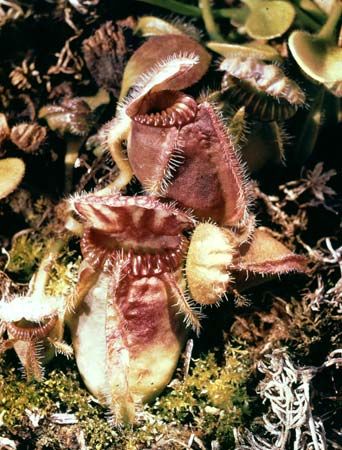
Capture Mechanism The plant attracts insects, particularly ants, using a combination of visual and chemical lures. Its pitchers feature a hairy, red-and-white-striped lid that attracts prey and prevents rainfall from diluting the trap’s contents. The opening of the pitcher is ringed with smooth, dark red tissue that produces nectar to entice insects. Once an insect lands on the rim, it encounters a slippery surface that causes it to tumble into the pitcher, where it is unable to climb back out. The pitcher also contains patches of semitransparent tissue that serve to confuse and exhaust flying insects, further ensuring they remain trapped.13
Digestion Once the prey is trapped, it falls into a pool of fluid at the bottom of the pitcher. The plant utilizes specialized glands located inside the pitcher to secrete digestive enzymes. These enzymes break down the insect’s body, allowing the plant to absorb essential nutrients, such as nitrogen, which are otherwise scarce in its native swampy or sandy soil.134
How does the Western Australian pitcher plant reproduce?
The Western Australian pitcher plant (Cephalotus follicularis) reproduces through the production of small, bisexual flowers borne on long stalks. These stalks serve to distance potential pollinators from the plant’s carnivorous traps, ensuring that the insects visiting the flowers are not captured as prey.1
In cultivation, the plant is primarily propagated by humans using seeds or cuttings rather than through collection from the wild, a practice encouraged due to the species’ status as vulnerable on the IUCN Red List of Threatened Species. As a perennial herb, the plant also features underground rhizomes, which allow it to persist and spread in its native swampy or sandy habitats.12
What is the scientific name of the Western Australian pitcher plant?
The scientific name of the Western Australian pitcher plant is Cephalotus follicularis.1
What are some interesting facts about the history of the discovery and study of the Western Australian pitcher plant?
Sorry, the Britannica knowledge base does not contain information regarding the history of the discovery and study of the Western Australian pitcher plant.
Sources
- Western Australian pitcher plant — Encyclopædia Britannica
- pitcher plant — Encyclopædia Britannica
- Carnivorous plant — Encyclopædia Britannica
- mimicry - Insect-luring plants — Encyclopædia Britannica
- conifer - Germination — Encyclopædia Britannica
Published on · 2 min read