Whitefish
Whitefish are valuable, cold-water fishes belonging to the family Salmonidae. Their anatomy and physiology include several notable characteristics:
What are some interesting facts about whitefish anatomy and physiology?
Whitefish are valuable, cold-water fishes belonging to the family Salmonidae. Their anatomy and physiology include several notable characteristics:
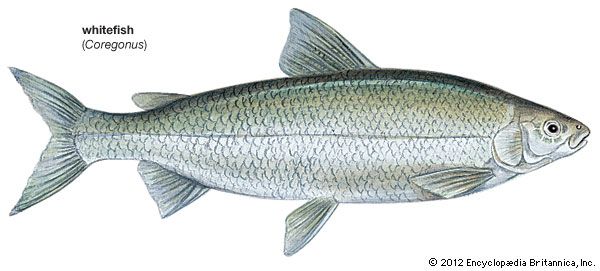
- Physical Features: Whitefish are distinguished from trout by their larger scales, smaller mouths, and weaker teeth. Like trout, they possess an adipose (fleshy) fin.1
- Sensory Systems: Like other aquatic vertebrates, whitefish utilize a lateral line system to detect water movement and pressure changes. This system consists of neuromasts—clusters of sensory hair cells—that help the fish perceive nearby prey, predators, or other members of their species.23
- Respiration and Buoyancy: As teleosts, whitefish use gills for gas exchange. Many also possess a swim bladder, a hydrostatic organ that helps them control buoyancy. In many whitefish, this bladder retains a connection to the digestive tract, a condition known as physostomous.4
- Temperature Regulation: As ectotherms, their body temperature is largely determined by the surrounding water. They employ various biochemical strategies to survive in cold environments, such as adjusting internal chemistry to prevent freezing.5
What are the main characteristics that define whitefish?
Whitefish are valuable, silvery fishes belonging to the family Salmonidae, typically found in the cold, deep northern lakes of Europe, Asia, and North America.1
Key characteristics that define them include:
- Anatomical Features: Like trout, they possess an adipose (fleshy) fin. However, they are distinguished by their larger scales, smaller mouths, and weaker or absent teeth.19
- Habitat and Diet: They primarily inhabit cold lakes and streams in the Northern Hemisphere. Their diet consists of insect larvae and other small animals.19
- Reproductive Behavior: Whitefish spawn in the fall. Like other members of the Salmonidae family, they exhibit a homing instinct, segregating into discrete populations at specific sites during the spawning season to ensure they reproduce with members of their own group.110
- Diversity: The group includes various forms, such as the deep-bodied lake whitefishes, the schooling ciscoes (or lake herring), and the round whitefishes, which are often found in trout streams.1
How do whitefish adapt to their aquatic environments?
Whitefish have evolved several physiological and behavioral adaptations to thrive in the cold, deep-water environments of the Northern Hemisphere.
- Feeding Specializations: Many whitefish species are adapted to filter-feeding in open water. They strain minute organisms from the water using a fine mesh of gill rakers—bony elements attached to the gill arches. In contrast, some species like the inconnu have evolved predatory traits, including pikelike body shapes and powerful jaws, to exploit different food resources.1
- Osmoregulation: While many salmoniforms are primarily freshwater fish, they are often capable of migrating to the sea. They adapt to varying salinities by excreting excess salts through specialized cells in their gills. Additionally, their well-developed kidneys help manage water balance in freshwater environments.1
- Buoyancy Control: Most whitefish possess a swim bladder, which acts as a hydrostatic organ. Many retain a connection between this bladder and the digestive tract, a condition known as physostomous, allowing them to regulate their depth and buoyancy.112
- Temperature Tolerance: As ectotherms, whitefish rely on their environment for temperature regulation. They utilize biochemical strategies, such as producing cryoprotectants, to prevent ice crystal formation in their tissues when inhabiting freezing waters.13
What is the ecological importance of whitefish in their habitats?
Whitefish play a significant role in the ecology of Northern Hemisphere lakes, where they function as a vital link in the food web.
- Primary Consumers: Many whitefish species, often referred to as “freshwater herrings,” occupy an ecological niche comparable to ocean herrings. They cruise open waters, filtering minute organisms through their gill rakers, effectively converting primary production into biomass that supports higher trophic levels.1
- Predatory Roles: While many species are filter feeders, others like the inconnu have evolved into significant predators. These fish feed on other smaller fish, helping to regulate population dynamics within their aquatic habitats.121
- Environmental Indicators: Because whitefish require pure, cold, and well-oxygenated water, they serve as sensitive indicators of ecosystem health. They are among the first species to suffer when water quality is degraded, making their presence a sign of a stable, high-quality environment.1
Sources
- whitefish — Encyclopædia Britannica
- lateral line system — Encyclopædia Britannica
- fish - The respiratory system — Encyclopædia Britannica
- protacanthopterygian - Life cycle and reproduction — Encyclopædia Britannica
- ostariophysan - Reproductive cycle — Encyclopædia Britannica
- Mechanoreception - Mechanoreceptor function — Encyclopædia Britannica
- Ectotherm — Encyclopædia Britannica
- fish processing - Structure of skeletal muscles — Encyclopædia Britannica
- whitefish — Merriam-Webster
- protacanthopterygian - Critical appraisal — Encyclopædia Britannica
- protacanthopterygian - Behaviour and locomotion — Encyclopædia Britannica
- protacanthopterygian - Ecology — Encyclopædia Britannica
- white shark - Body structure — Encyclopædia Britannica
- lake whitefish — Merriam-Webster
Published on · 3 min read