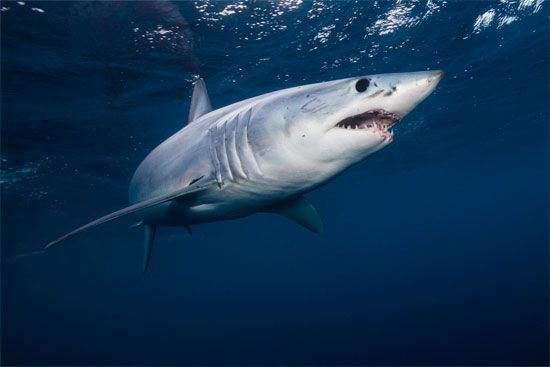
White Shark
White sharks (Carcharodon carcharias) are widely distributed throughout the world's oceans, though they are not abundant in any single location. Their…
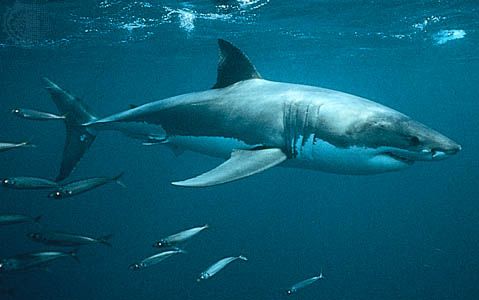
What is the geographical distribution of white sharks, and what types of habitats do they prefer?
White sharks (Carcharodon carcharias) are widely distributed throughout the world’s oceans, though they are not abundant in any single location. Their populations are primarily centered in highly productive temperate coastal waters, which are characterized by an abundance of fishes and marine mammals.12
Key regions for these populations include the coasts of the northeastern and western United States, Chile, northern Japan, southern Australia, New Zealand, southern Africa, and the Mediterranean Sea. While some individuals may travel into tropical waters or far out to sea, most return annually to these temperate feeding grounds.213
Regarding habitat, white sharks are known to frequent coastal areas to hunt, and juvenile white sharks specifically have been observed gathering in shallow waters—often within 1 km of the coast at depths of less than 10 meters—to utilize these areas as safer environments for their development.4
How do white sharks reproduce, and what is known about their mating behavior?
White shark (Carcharodon carcharias) reproduction is not fully documented, but it is assumed to follow the internal fertilization process common to most sharks. In this process, males use specialized copulatory organs called claspers to transfer sperm into the female’s cloaca. While specific courtship behavior for white sharks remains unknown, mating in many shark species involves the male biting and gripping the female’s pectoral fin to hold her in position.678
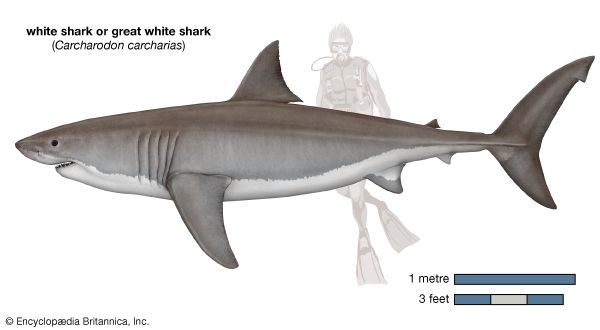
White sharks are viviparous, meaning they retain fertilized eggs within the body until birth. retain fertilized eggs within the body until birth. During gestation, which is estimated to last about 12 months, developing young may feed on unfertilized eggs and potentially their unborn siblings. Litters typically consist of 2 to 10 pups, each measuring over 1 meter at birth. Sexual maturity is reached at different stages: males mature at about 10 years of age (3.5–4 meters long), while females mature later, between 12 and 18 years of age (4.5–5 meters long).6
What is the diet of white sharks, and how do they hunt their prey?
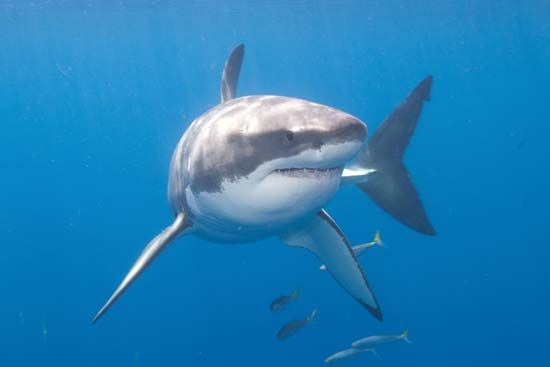
White sharks are formidable predators with a diet that evolves as they age. Newborn white sharks primarily consume fishes and other sharks. As they reach adulthood, their diet expands to include sea turtles, seals, sea lions, porpoises, dolphins, and small whales. Additionally, they act as opportunistic scavengers, feeding on the carcasses of whales and basking sharks.910
To locate prey, white sharks rely on a highly developed sense of smell and the ability to detect vibrations through their lateral line system.11 They typically hunt using an ambush strategy, rushing their target by surprise to inflict a massive, fatal bite. This initial impact is often so powerful that it may launch the prey—or the shark itself—out of the water. Following the strike, the shark often retreats to wait for the prey to die, a behavior known as “bite and wait” or “bite and spit.”119
What are some common misconceptions about white sharks?
Common misconceptions about white sharks often stem from media portrayals and outdated assumptions. Here are some of the most prevalent myths corrected by current research:
- Mistaken Identity: It is a common belief that white sharks attack humans because they mistake them for seals or sea lions. However, research suggests that sharks have excellent vision and are unlikely to confuse a human for their natural prey. Instead, many encounters are likely driven by curiosity or the shark “mouthing” an unfamiliar object to assess its food value, as their mouths serve as highly sensitive sensory organs.13
- “Man-Eater” Reputation: White sharks are often depicted as mindless man-eaters. In reality, most encounters with humans are not predatory attempts to consume a person. Sharks typically inflict a single bite and then retreat, often leaving the victim behind, which indicates they are not interested in humans as a food source.141315
- Obligate Swimming: There is a widespread belief that all sharks must swim constantly to stay alive. While some species are “obligate ram ventilators” that must keep moving to breathe, others use methods like buccal pumping or spiracles to remain stationary. Researchers have even observed white sharks in a state of rest while drifting in shallow water.4
- Rising Attack Rates: While media reports often suggest shark attacks are increasing, the per capita rate of attacks has not risen. The perceived increase is largely due to a growing human population spending more time in the water and improved methods for documenting these rare encounters.13
Sources
- white shark - Distribution — Encyclopædia Britannica
- white shark - Social behavior — Encyclopædia Britannica
- white shark - Conservation — Encyclopædia Britannica
- 10 of the World’s Most Dangerous Fish - Great White Shark — Encyclopædia Britannica
- Why are sharks coming closer to shore? — Encyclopædia Britannica
- white shark - Reproduction — Encyclopædia Britannica
- chondrichthyan - Reproduction and development — Encyclopædia Britannica
- chondrichthyan - Reproductive behaviour — Encyclopædia Britannica
- white shark - Feeding habits — Encyclopædia Britannica
- white shark: Top Questions — Encyclopædia Britannica
- chondrichthyan - Senses — Encyclopædia Britannica
- 14 Questions About Aquatic Animals Answered - Is it true that a shark can smell a drop of blood from a mile away? — Encyclopædia Britannica
- white shark - Attacks on humans — Encyclopædia Britannica
- Do Sharks Sleep? — Encyclopædia Britannica
- Why Do Sharks Attack? — Encyclopædia Britannica
Published on · 4 min read