Wigeon
Wigeons are dabbling ducks belonging to the family Anatidae. While specific details on the nesting habits of all four wigeon species are limited, they…
What are the breeding and nesting behaviors of wigeons?
Wigeons are dabbling ducks belonging to the family Anatidae. While specific details on the nesting habits of all four wigeon species are limited, they generally follow the reproductive patterns characteristic of waterfowl.12
In most waterfowl, the female selects the nest site and performs the construction, typically using materials found on-site that are within reach of her beaksite that are within reach of her beak. The nest is progressively lined with down plucked from the female’s breast, which serves to insulate the eggs and protect them from predators when the female is away. Incubation is generally performed solely by the female, lasting between 22 and 39 days.12
A notable exception among this group is the Chiloé wigeon (Anas sibilatrix) of South America, where the male assists in raising the young—a behavior that is considered rare among ducks. Like other waterfowl, wigeons do not typically nest in colonies, preferring to keep their nests scattered, though they may nest in higher densities in safe, suitable locations.12
How do wigeons differ from other duck species?
Wigeons are a group of four species of dabbling ducks within the family Anatidae that exhibit several distinct behaviors and characteristics compared to other duck species:
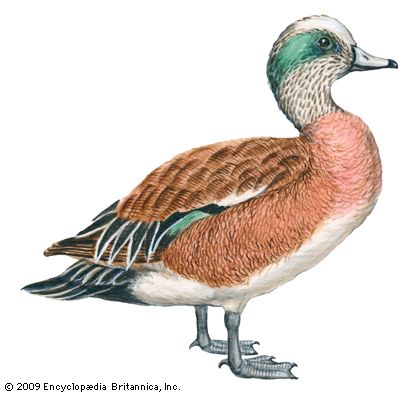
- Grazing Habits: Unlike many ducks that primarily sift through mud or dive for food, American wigeons (or baldpates) frequently graze on young grasses like geese. They are also known to steal food, such as eelgrass, from diving ducks like the canvasback.3
- Parental Care: The Chiloé wigeon of South America is notable for a rare trait among ducks: the male assists in raising the young.3
- Feeding Patterns: While most dabbling ducks feed by tipping up in shallows, the Cape wigeon of Africa is unique among this group for being a nocturnal feeder.3
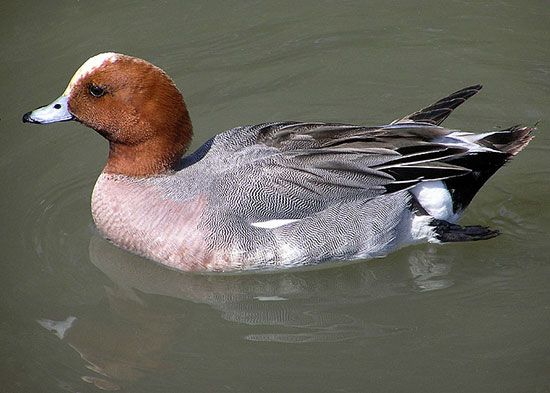
- Physical Traits: While their bills are typical of dabbling ducks—flattened with platelike lamellae for sifting—their plumage patterns, such as the white crown and green eye stripe of the American wigeon, serve to distinguish them from other species.34
What is the origin of the name ‘wigeon’ and its significance?
The term “wigeon” (also spelled “widgeon”) refers to several species of freshwater ducks within the genus Mareca.
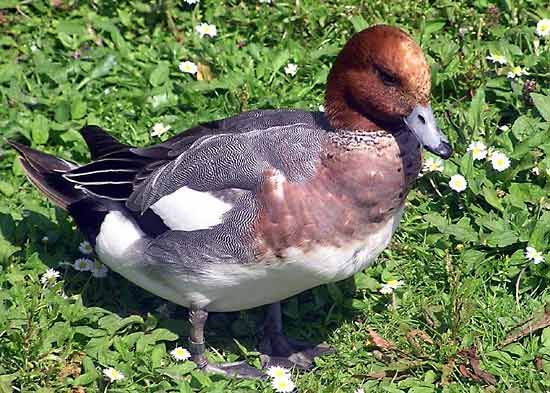
Regarding the origin of the name, etymological records indicate that the specific derivation of “wigeon” remains unknown. The word first appeared in the English language around 1508. While the name itself does not carry a documented historical or symbolic significance, it serves as a standard identifier for these birds, which are characterized by features such as the large white wing patches found on the Old World species (M. penelope). The spelling “widgeon” is simply a recognized variant of the primary term.78
What are the feeding habits and diet of wigeons?
Wigeons are classified as dabbling ducks, a group that typically feeds on water plants by tipping up in shallow water or foraging near the shore for seeds and insects. However, wigeons exhibit specific dietary behaviors that distinguish them from many other ducks:3
- Grazing: American wigeons, also known as baldpates, frequently graze on young grasses, a behavior more commonly associated with geese.5
- Kleptoparasitism: Wigeons are known to engage in kleptoparasitism, a feeding strategy where they steal food from other animals. Specifically, they are fond of eelgrass and will often steal it from diving ducks, such as the canvasback.5
- Nocturnal Feeding: The Cape wigeon of Africa is unique among this group for its habit of feeding at night.5
Like other dabbling ducks, wigeons possess a flat, broad bill equipped with lamellae, which allows them to sift through water and vegetation for sustenance.3
Sources
- Anseriform - Reproductive behaviour — Encyclopædia Britannica
- Reproductive behaviour - Birds — Encyclopædia Britannica
- Wigeon — Encyclopædia Britannica
- Anseriform - Anatomy — Encyclopædia Britannica
- Dabbling duck — Encyclopædia Britannica
- Anseriform - Annotated classification — Encyclopædia Britannica
- wigeon — Merriam-Webster
- widgeon — Merriam-Webster
- kleptoparasitism — Encyclopædia Britannica
- kleptoparasitism: Top Questions — Encyclopædia Britannica
- Duck — Encyclopædia Britannica
Published on · 3 min read