Wood Pigeon
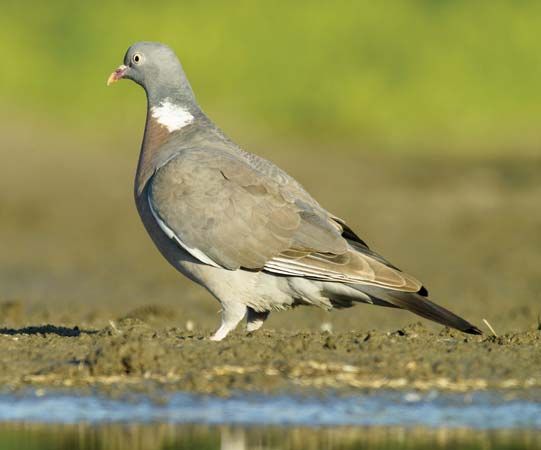
The wood pigeon (Columba palumbus) is widely distributed across the forested regions of Europe, North Africa, and western Asia, extending eastward to the…
Where are wood pigeons commonly found, and what is their natural habitat?
The wood pigeon (Columba palumbus) is widely distributed across the forested regions of Europe, North Africa, and western Asia, extending eastward to the mountains of Sikkim in India. Other species referred to as wood pigeons are found throughout Southeast Asia and the Pacific.1
Regarding their natural habitat, these birds are typically associated with woodlands and scrub areas where they construct simple, flat nests made of twigs. As ground feeders, they forage in open areas for seeds, grains, and berries, though they may also frequent agricultural lands, where they are sometimes considered pests. Because they spend significant time feeding on the ground, they are vulnerable to predators and often rely on flocking behavior to assist in locating food sources.21
What are the breeding habits and life cycle of wood pigeons?
The breeding habits and life cycle of the wood pigeon (Columba palumbus) are characterized by complex social behaviors and physiological adaptations that ensure the survival of their young.
Courtship and Pair Formation
Breeding begins with the male establishing a territory, which he defends through aggressive displays and an advertisement call. During courtship, the male performs display flights involving slow wing beats and loud clapping noises. Pair formation involves a “bowing” display, where the male approaches the female with vocalizations. If receptive, the female adopts a submissive posture, leading to mutual feather nibbling and “courtship feeding,” where the male feeds the female. This bond is further cemented as the pair collaborates to build a simple, flat nest of twigs in scrub or woodland areas.13
Reproduction and Development
- Clutch Size: Wood pigeons typically lay two eggs per clutch and may raise up to three broods in a single season.13
- Incubation: Both parents share incubation duties to ensure the eggs are rarely left unattended.3
- Pigeon Milk: A unique aspect of their life cycle is the production of “pigeon milk,” a protein-rich secretion from the crop gland. Stimulated by the sight of eggs or nestlings, this substance allows parents to provide high-quality nutrition to their young, known as squabs, without relying on animal protein.3
- Growth: Squabs are fed by regurgitation. As they grow, the crop gland regresses, and the young are gradually transitioned to environmental food sources. When nestlings are about three-quarters grown, parents may begin a new breeding cycle nearby.3
Seasonal Timing
In temperate regions, wood pigeons are highly responsive to day length. Their reproductive systems are typically stimulated by the increasing day lengths of March, with breeding activity continuing until September. This timing ensures that the rearing of young coincides with periods of peak food availability.3
What is the scientific name of the wood pigeon, and how is it classified taxonomically?
The scientific name of the wood pigeon is Columba palumbus.1
Taxonomically, it is classified as follows:
- Class: Aves (birds)14
- Order: Columbiformes Order:** Columbiformes4
- Family: Columbidae14
- Subfamily: Columbinae14
- Genus: Columba14
The genus Columba is a cosmopolitan group that includes the true or typical pigeons, such as the wood pigeon and the rock dove (C. livia). The subfamily Columbinae is the largest group within the pigeon family, consisting of more than 120 species across roughly 14 genera.4
How do wood pigeons differ from other common pigeon species like rock doves?
Wood pigeons (Columba palumbus) and rock doves (Columba livia) are both members of the family Columbidae, but they exhibit distinct differences in their physical appearance, nesting habits, and ecological adaptations.
Physical Characteristics
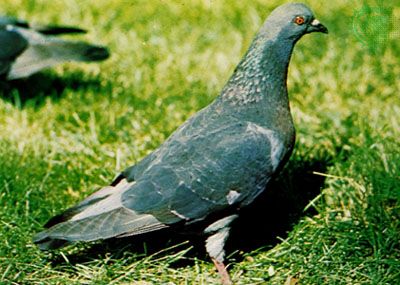
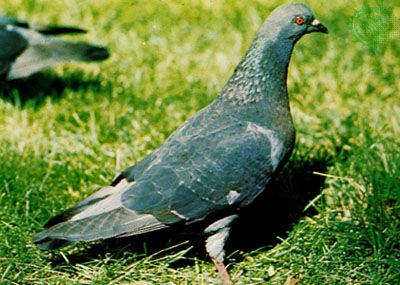
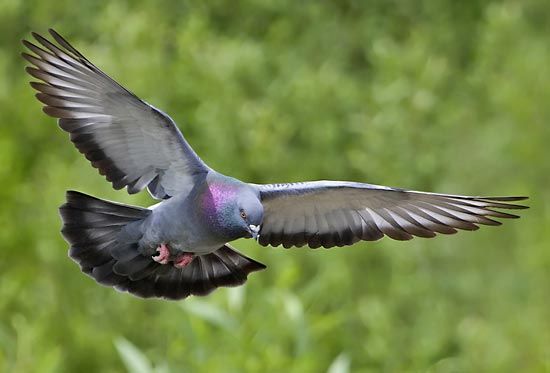
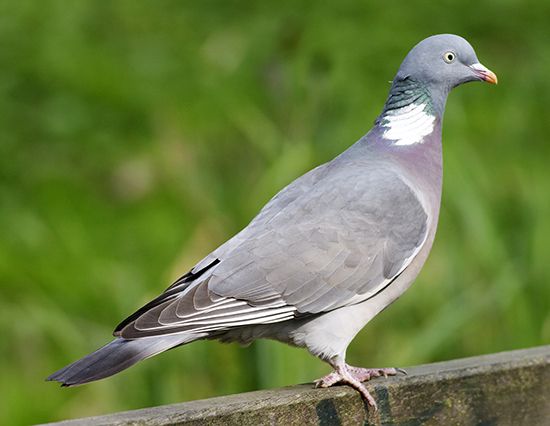
The wood pigeon is a larger bird, measuring approximately 40 cm (16 inches) in length, and is easily identified by its grayish plumage, white collar, and distinctive white wing bars that flash during takeoff. In contrast, the rock dove—often referred to as the domestic pigeon—is typically smaller and lacks the white neck collar, though it is known for its varied plumage patterns.132
Nesting and Habitat
Their nesting behaviors reflect different environmental specializations:
- Wood Pigeons: These birds typically build simple, flat platforms of twigs in scrub or woodland areas. They are highly adaptable and have expanded into open agricultural land to exploit food sources.35
- Rock Doves: These birds are primarily hole- and cavity-nesters. Because suitable nesting sites can be limited, they often exhibit semi-colonial nesting behavior, defending only the immediate area around their nest site rather than a large territory.3
Feeding Habits
While both species are ground feeders, the wood pigeon is particularly noted for its ability to feed in both trees and on the ground, consuming a diverse diet of seeds, berries, grains, and green vegetation like clover. Rock doves are more specialized toward ground feeding and are frequently found in urban environments, whereas wood pigeons are more commonly associated with woodland and agricultural landscapes.153
Sources
- Wood pigeon — Encyclopædia Britannica
- Columbiform - Behaviour — Encyclopædia Britannica
- Columbiform - General habits — Encyclopædia Britannica
- Pigeon — Encyclopædia Britannica
- Columbiform - Distinguishing characteristics — Encyclopædia Britannica
- Dove — Encyclopædia Britannica
Published on · 4 min read