Zebra Fish
The term "zebra fish" refers to two distinct and unrelated groups of fishes.
What is zebra fish?
The term “zebra fish” refers to two distinct and unrelated groups of fishes.1
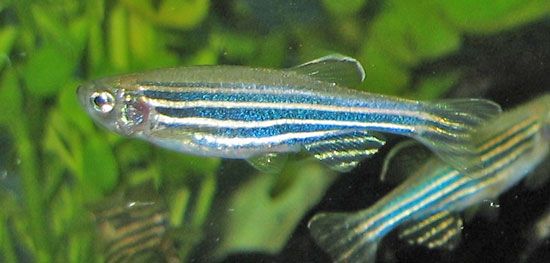
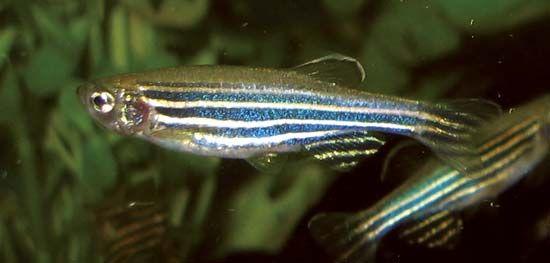
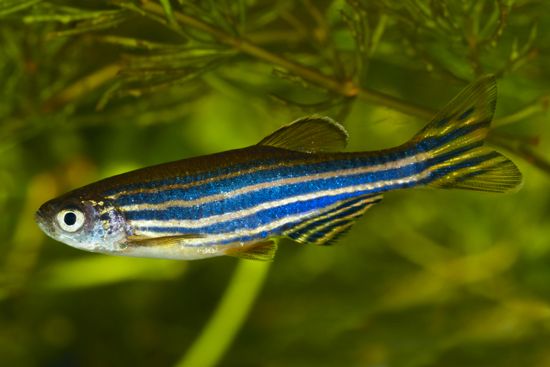
- Freshwater Zebra Fish: This group includes species in the genus Danio. The most well-known is the zebra danio (Danio rerio), a small, striped aquarium fish native to Asia. Because they possess clear embryos and reproduce rapidly, they are widely used as model organisms in developmental biology to study vertebrate development and human physiology.12
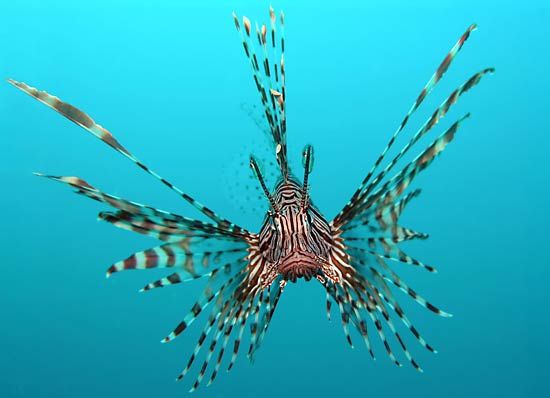
- Saltwater Zebra Fish: This group consists of species in the genus Pterois. These marine fish are characterized by large pectoral fins, colorful vertical stripes, and poisonous spines. They are also commonly referred to as lionfish or turkeyfish.1
Why are zebrafish considered ideal models for scientific research?
Sorry, the Britannica knowledge base does not contain information regarding why zebrafish are considered ideal models for scientific research.
What are the main differences between freshwater danios and saltwater lionfish?
Freshwater danios and saltwater lionfish belong to entirely different biological groups and possess distinct physical characteristics.1
Feature
Freshwater Danios (
Danio
)
Saltwater Lionfish (
Pterois
)
Freshwater environments
Marine (saltwater) environments
Size
Small (up to 4 cm / 1.5 inches)
Generally larger with expansive fins
Appearance
Dark-blue and silvery longitudinal stripes
Colorful vertical stripes
Key Traits
Standard fish morphology
Large pectoral fins and poisonous spines
While both are popular in the aquarium trade, they are taxonomically unrelated, with danios belonging to the family Cyprinidae and lionfish to the family Scorpaenidae.1
How does studying zebrafish help scientists understand human development?
Zebrafish (Danio rerio) are considered ideal models for studying developmental biology because they possess transparent embryos, reproduce rapidly, and are closely related to other vertebrates.2
By investigating these organisms, researchers—such as Nobel laureate Christiane Nüsslein-Volhard—have been able to observe the migration of cells within embryos as they move from their origins to their final destinations. This research is vital because it helps scientists elucidate the specific genes and cellular substances that govern human development and the regulation of normal human physiology. Because the fundamental mechanisms of early embryonic development are often shared across species, findings in zebrafish provide critical insights into the biological processes that shape all multicellular organisms.2
Sources
- zebra fish — Encyclopædia Britannica
- Christiane Nüsslein-Volhard — Encyclopædia Britannica
Published on · 2 min read