Barramundi
The barramundi (Lates calcarifer), also known as the Asian seabass or giant perch, is a highly regarded fish native to the tropical waters of northern…
What is barramundi?
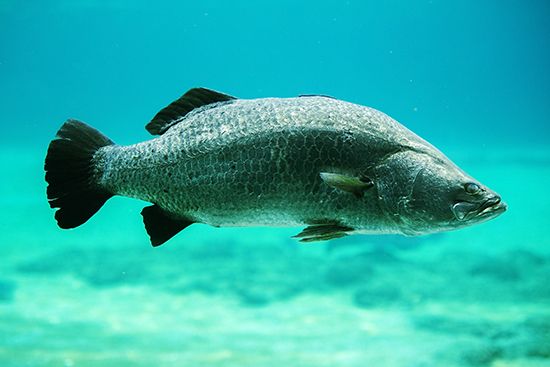
The barramundi (Lates calcarifer), also known as the Asian seabass or giant perch, is a highly regarded fish native to the tropical waters of northern Australia. Belonging to the order Perciformes, this species is prized both as a sporting fish and a culinary delicacy, with wild specimens capable of reaching weights between 65 and 130 pounds.1
The fish is catadromous, meaning it spends portions of its life cycle in both freshwater rivers and ocean waters. Beyond its wild population, barramundi is a significant product of the global aquacultural economy, particularly in Indonesia, Thailand, Vietnam, and Malaysia. It is often cited as a sustainable alternative to species like grouper or halibut. Nutritionally, barramundi is noted for being rich in omega-3 and omega-6 fatty acids while remaining lower in calories than wild salmon. Its flesh is characterized by a sweet flavor and a succulent texture, with farmed varieties typically offering a milder taste.1
What does it mean for a fish to live in both freshwater and saltwater?
Fish that live in both freshwater and saltwater are known as diadromous animals. These species possess the physiological ability to adjust to varying levels of salinity, a process often facilitated by spending time in brackish water to adapt to new environments. Because they can tolerate a wide range of salt concentrations, these fish are also described as euryhaline.234
The movement between these environments is generally driven by needs related to reproduction or feeding. Diadromous fish are categorized based on their migratory patterns:2
- Anadromous fish: These species spend most of their lives in the sea but migrate to freshwater rivers or lakes to spawn. A well-known example is the Atlantic salmon, which returns to its natal river to breed.25
- Catadromous fish: These species live in freshwater but migrate to the ocean to spawn. Freshwater eels, such as the European eel, are classic examples, traveling to marine environments like the Sargasso Sea to reproduce.26

Why is barramundi considered a sustainable choice for seafood?
Barramundi is widely considered a sustainable seafood choice primarily due to its efficient production within the global aquacultural economy. As a farmed species, it serves as an environmentally responsible alternative to other popular fish of similar size and texture, such as grouper and halibut.1
The sustainability of barramundi is supported by several factors:
- Production Efficiency: Large-scale farming operations in countries like Indonesia, Thailand, Vietnam, and Malaysia have established robust supply chains that reduce the pressure on wild fish populations.1
- Domestic Growth: The development of aquacultural industries in regions like the United States—including inland facilities—demonstrates that the species can be raised in controlled environments, further diversifying supply sources and minimizing the ecological footprint associated with wild-capture fisheries.1
- Nutritional Profile: Beyond its environmental benefits, barramundi is a nutrient-dense option, providing high levels of heart-healthy omega-3 and omega-6 fatty acids while maintaining a lower caloric profile compared to wild salmon.1
How does the life cycle of a barramundi change as it grows?
The provided search results do not contain information regarding the specific changes in the life cycle of a barramundi as it grows, such as its development stages or sex-change characteristics.
Sorry, the Britannica knowledge base does not contain this information.
Sources
- barramundi — Encyclopædia Britannica
- Do fish drink water? — Encyclopædia Britannica
- Marine ecosystem - Migrations of marine organisms — Encyclopædia Britannica
- Migration - Anadromous fish — Encyclopædia Britannica
- catadromous — Merriam-Webster
- euryhaline — Merriam-Webster
Published on · 3 min read