Bass Rock
Bass Rock is a small, circular island located at the entrance of the Firth of Forth in Scotland, northeast of North Berwick. Rising 350 feet (105 metres)…
What is Bass Rock?
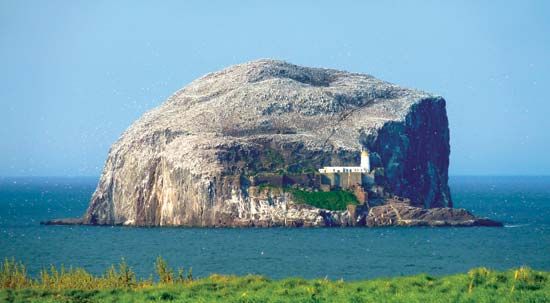
Bass Rock is a small, circular island located at the entrance of the Firth of Forth in Scotland, northeast of North Berwick. Rising 350 feet (105 metres) from the sea, this volcanic “plug” is known for its precipitous cliffs, which make access to the island nearly impossible.1
While currently uninhabited, the island has a rich history: it served as a site for a hermitage in the 7th century and later functioned as a prison during the 17th century. Today, it is most famous as a significant sanctuary for colonies of seabirds, particularly the solan goose (northern gannet).1
What are solan geese?
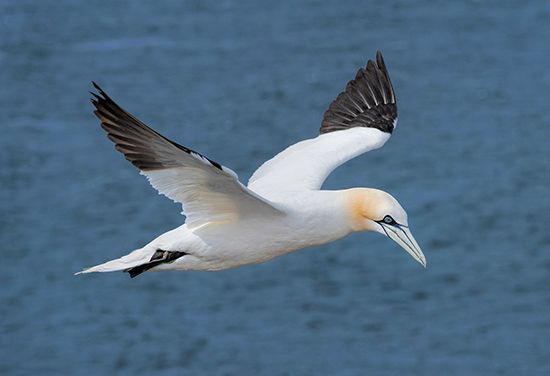
The term “solan goose” (also spelled “solent goose”) is a common name for the northern gannet (Morus bassanus or Sula bassana). It is not a goose, but rather the largest species of gannet, an oceanic bird within the family Sulidae.23
These birds are primarily white with distinctive black-tipped wing feathers and a large, yellowish or buff-colored head marked with black around the eyes. They are expert fliers that spend most of their lives over water, diving into the sea with half-closed wings to hunt for fish and squid. Northern gannets are known for nesting in dense colonies on cliffs across islands in regions such as Canada, Greenland, Iceland, and northeastern Europe.34
How was Bass Rock used as a prison?
During the 17th century, Bass Rock was utilized as a prison, taking advantage of its isolated and inaccessible nature to hold captives securely. Its precipitous cliffs and location at the entrance of the Firth of Forth made escape virtually impossible, effectively turning the island into a natural fortress for the state.1
While the provided records confirm its historical role as a prison during this period, the island’s primary identity remains that of a rugged, volcanic landmark and a vital sanctuary for wildlife.1
What is the Firth of Forth?
The Firth of Forth is an estuary located in eastern Scotland that serves as an inlet of the North Sea.6 It extends for 48 miles (77 km) from Kincardine to the Isle of May, marking the point where the River Forth meets the sea.67
The estuary is a significant geographical and historical feature, characterized by a notable constriction at North and South Queensferry. This narrow point is spanned by iconic engineering landmarks, including the Forth Bridge—a historic cantilever bridge completed in 1890—and the Forth Road Bridge, a suspension structure finished in 1964. The area surrounding the estuary has long been vital to Scotland’s industrial and historical landscape, with major sites like Grangemouth situated along its banks.789
Sources
- Bass Rock — Encyclopædia Britannica
- solent goose — Merriam-Webster
- solan goose — Merriam-Webster
- Gannet — Encyclopædia Britannica
- Did you know? — Merriam-Webster
- River Forth — Encyclopædia Britannica
- Forth Bridge — Encyclopædia Britannica
- Forth — Merriam-Webster
- Falkirk — Encyclopædia Britannica
Published on · 2 min read