Black Mountains
The name "Black Mountains" refers to two distinct geographical features:
What is Black Mountains?
The name “Black Mountains” refers to two distinct geographical features:
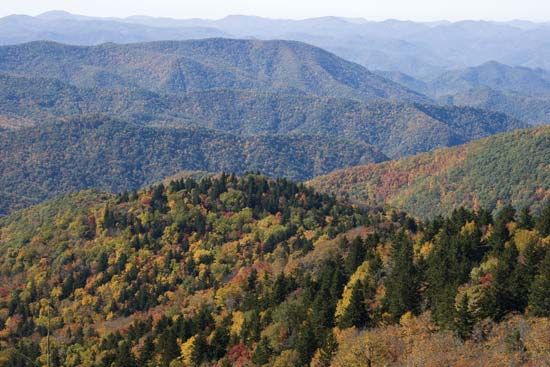
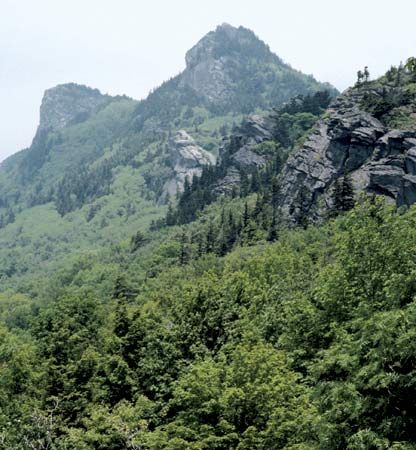
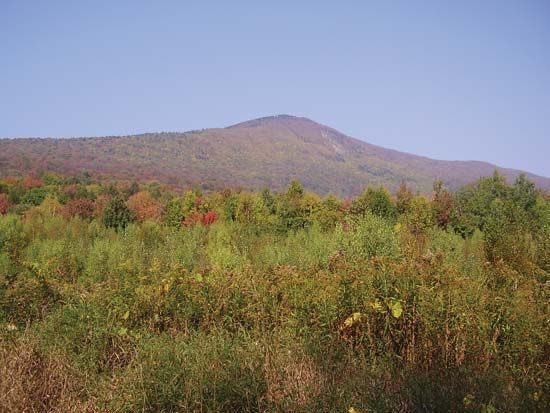
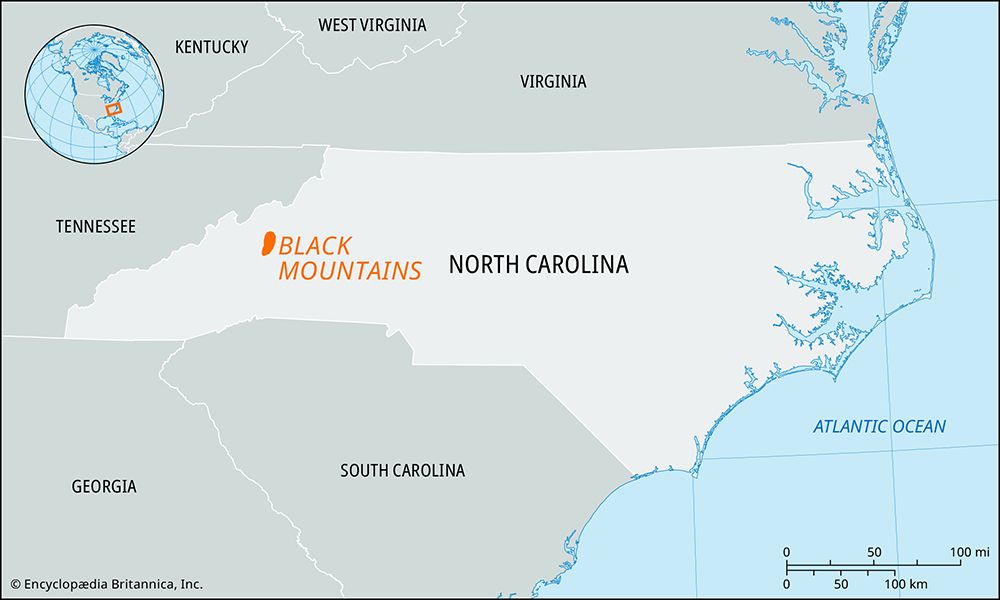
- North Carolina, U.S.: A mountain range in Yancey and Buncombe counties that forms part of the Appalachian Mountains. It extends north from the Blue Ridge and contains Mount Mitchell, which is the highest point east of the Mississippi River. Because the range was not subject to glaciation, its slopes are heavily wooded and covered with soil to the summit.12
- Wales: A plateau located in Powys county, situated east of the River Usk between Abergavenny and Hay-on-Wye. Its highest peak is Waun Fach.3
What makes Mount Mitchell the highest peak east of the Mississippi?
Mount Mitchell reaches an elevation of 6,684 feet (2,037 meters), making it the highest peak in the United States east of the Mississippi River. Its status as the highest point in the eastern United States was first established through a survey conducted in 1835 by Elisha Mitchell, a professor at the University of North Carolina, for whom the mountain was later named.5617
Located in the Black Mountains of western North Carolina, the peak is part of the Appalachian Mountains. Unlike many other regions in the Appalachians, the Black Mountains were not subject to glaciation, which has resulted in slopes that are heavily wooded and covered with soil up to the summit.56
How does glaciation affect the soil and vegetation of mountain ranges?
Glaciation profoundly reshapes mountain environments through intense erosion and the subsequent deposition of materials, which fundamentally alters the landscape’s ability to support soil and vegetation.
Erosional Impacts
In high-altitude regions, glaciers act as powerful agents of erosion. As ice moves, it scours the terrain, carving deep, U-shaped valleys and sharpening peaks into rugged, steep-sided forms like the Matterhorn. This process often strips away existing soil and loose rock, leaving behind exposed bedrock in the upper reaches of mountain ranges. Consequently, these high-elevation areas are frequently characterized by rocky, barren terrain where vegetation struggle to take root due to the lack of stable soil cover.101112
Depositional Impacts
As glaciers melt and retreat, they deposit vast quantities of geologic debris known as till, along with other sediments like sand and gravel. These deposits form distinct landforms such as moraines, drumlins, and eskers. In lower-lying areas and valleys, these glacial sediments can create fertile, flat-to-rolling plains that are among the world’s most productive agricultural regions. In these areas, the accumulation of mineral-rich glacial material provides a nutrient-dense foundation that supports diverse and lush vegetation, contrasting sharply with the scoured, rocky peaks above.1011
What are some other famous mountain ranges within the Appalachian system?
The Appalachian Mountain system is a vast and complex chain featuring numerous distinct ranges and subranges. Beyond the well-known Blue Ridge and Great Smoky Mountains, several other notable ranges define the system:
- White Mountains: Located primarily in New Hampshire, this range contains the highest elevations in the northeastern United States, including Mount Washington.1314
- Green Mountains: Extending through Vermont, these mountains are a prominent feature of the northern Appalachians and transition into the Berkshire Hills in Massachusetts, Connecticut, and New York.1514
- Cumberland Mountains: Situated along the border of Kentucky and Tennessee, these mountains form the high eastern margin of the Cumberland Plateau.16
- Allegheny Mountains: Rising in southwestern New York and extending through Pennsylvania, Maryland, and West Virginia, this range is a key component of the central Appalachians.15
- Catskill Mountains: Located in New York, these mountains are also considered part of the central Appalachian region.15
- Adirondack Mountains: While geologically related to the Canadian Shield, the Adirondacks are frequently included in the broader Appalachian system.17
Sources
- Black Mountains — Encyclopædia Britannica
- Black Mountains — Encyclopædia Britannica
- list of mountain ranges - North America — Encyclopædia Britannica
- Black Mountains — Merriam-Webster
- Mount Mitchell — Encyclopædia Britannica
- Appalachian Mountains - Study and exploration — Encyclopædia Britannica
- North America - The Appalachians — Encyclopædia Britannica
- Appalachian Mountains - Climate — Encyclopædia Britannica
- North Carolina - Relief — Encyclopædia Britannica
- Quaternary - Landforms — Encyclopædia Britannica
- Pleistocene Epoch - Glaciation — Encyclopædia Britannica
- glacial landform - Erosional landforms of valley glaciers — Encyclopædia Britannica
- White Mountains — Encyclopædia Britannica
- Great Smoky Mountains — Encyclopædia Britannica
- Appalachian Mountains - Physiography — Encyclopædia Britannica
- Blue Ridge — Encyclopædia Britannica
- Cumberland Plateau — Encyclopædia Britannica
- Adirondack Mountains — Encyclopædia Britannica
- United States - The Appalachian Mountain system — Encyclopædia Britannica
- Appalachian Highlands — Encyclopædia Britannica
Published on · 3 min read