Uintatherium
Uintatherium is an extinct genus of large, herbivorous, hoofed mammals that lived during the middle of the Eocene Epoch, approximately 55.8 to 33.9 million…
What is Uintatherium?
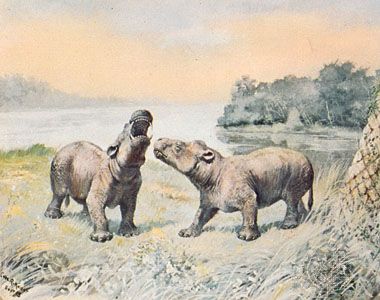
Uintatherium is an extinct genus of large, herbivorous, hoofed mammals that lived during the middle of the Eocene Epoch, approximately 55.8 to 33.9 million years ago. Fossils of these animals have been discovered in North America and Asia.1
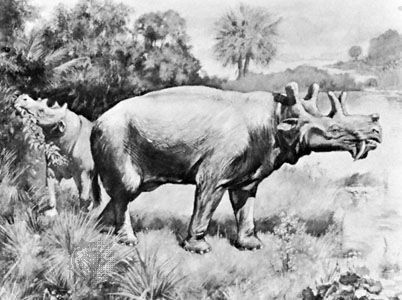
Comparable in size to a modern rhinoceros, Uintatherium was one of the largest animals of its era. Its physical characteristics were quite distinct:1
- Skull: The skull featured three pairs of bony protuberances on the nasal, maxillary, and parietal bones, with the anterior pair potentially supporting prominent horns.12
- Dentition: Males possessed large, powerful canine tusks, which were protected by downward-extending processes of the lower jaw. The upper jaw lacked incisors, while the upper molars featured characteristic V-shaped crests.12
- Body: The animal had strongly constructed limbs to support its massive frame and possessed a proportionately small brain.12
What was the Eocene Epoch like for mammals?
The Eocene Epoch (56 million to 33.9 million years ago) was a transformative period for mammals, characterized by rapid diversification and the rise of many modern groups. The name “Eocene,” derived from the Greek for “dawn,” reflects this emergence of new biological lineages.3
Diversification and Modern Groups
During the Eocene, archaic groups from the Paleocene were largely replaced by essentially modern mammalian orders. Key developments included:34
- Ungulates: The epoch saw the appearance of perissodactyls (odd-toed ungulates like early horses, rhinoceroses, and tapirs) and artiodactyls (even-toed ungulates like early deer and cattle).34
- Marine Mammals: The fossil record provides the first evidence of fully aquatic mammals, including cetaceans (whales, porpoises, and dolphins) and sirenians (manatees and dugongs).3
- Other Groups: The epoch also marked the early appearance of bats, proboscideans (elephant-like animals), and rodents, the latter of which began to usurp the ecological niches previously held by archaic primates.34
Environmental Context
The Eocene was generally warm and humid, with widespread temperate and subtropical forests. However, global cooling in the late Eocene triggered significant vegetation changes, shifting some rainforests into more open forests and grasslands. This environmental transition led to further evolutionary turnover, including the extinction of primitive herbivores like the brontotheres.34
How did the Uintatherium’s brain size compare to modern mammals?
The provided search results do not contain specific data comparing the brain size of Uintatherium to that of modern mammals, other than noting that the genus possessed a proportionately small brain. Furthermore, the available information regarding brain size in the Britannica knowledge base focuses primarily on the evolution of hominin brain capacity rather than providing a comparative analysis for Uintatherium against modern mammalian species.
What other prehistoric animals lived alongside Uintatherium?
Uintatherium lived during the middle of the Eocene Epoch, a time when many modern mammalian groups were beginning to diversify and archaic forms were gradually being replaced. As a large herbivorous ungulate, it shared its environment with a variety of other prehistoric creatures.31
Mammalian Neighbors
The Eocene landscape featured several groups that coexisted with Uintatherium:
- Ungulates: The epoch was defined by the rise of perissodactyls (odd-toed ungulates) and artiodactyls (even-toed ungulates). Early ancestors of modern groups, such as the dawn horse (Eohippus), were present in North American and European ecosystems.3
- Carnivores: Uintatherium lived alongside creodonts, an extinct order of carnivorous mammals. These included diverse forms such as the badger-like oxyaenids and the dog-like hyaenodontids, such as Sinopa and Hyaenodon, which coexisted with early members of the order Carnivora.5
- Other Groups: The Eocene also saw the emergence of early bats, proboscideans (elephant-like animals), and rodents, which were beginning to occupy niches previously held by archaic primates.3
Sources
- Uintatherium — Encyclopædia Britannica
- uintatherium — Merriam-Webster
- Eocene Epoch — Encyclopædia Britannica
- Tertiary Period - The rise of mammals — Encyclopædia Britannica
- Oligocene Epoch — Encyclopædia Britannica
- human evolution - Increasing brain size — Encyclopædia Britannica
- Creodonta — Encyclopædia Britannica
Published on · 3 min read