Reticulated Python
The reticulated python (Malayopython reticulatus) is a giant constricting snake native to the tropical forests of Southeast Asia, including Indonesia and the…
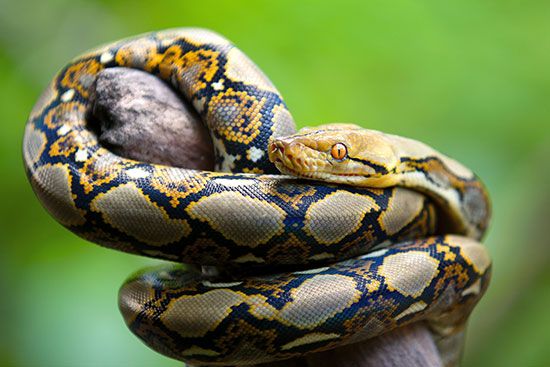
What is a reticulated python?
The reticulated python (Malayopython reticulatus) is a giant constricting snake native to the tropical forests of Southeast Asia, including Indonesia and the Philippines. It is widely recognized as the longest living snake in the world, with recorded individuals reaching lengths of up to 10 meters (32.8 feet), though most adults typically measure between 7 and 8 meters.12
These snakes are nocturnal predators that use heat-sensing pits on their lips to detect prey, which they capture by striking and then suffocating through constriction. Their diet includes birds, mammals, and occasionally pets or humans in rare instances. While they are currently classified as a species of least concern by the IUCN, they face threats from illegal trade and habitat loss. Notably, they are highly adaptable and can thrive in human-altered environments.12
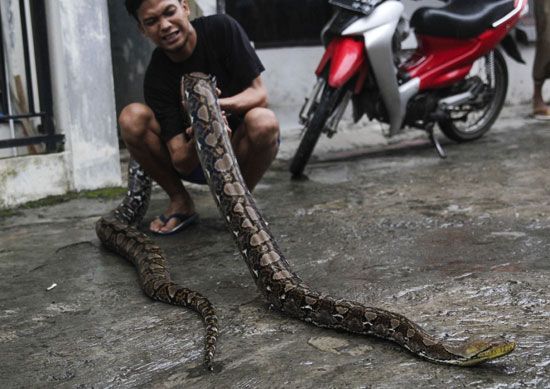
Where does the reticulated python live?
The reticulated python (Malayopython reticulatus) is native to tropical forest regions across Southeast Asia. Its extensive geographic range spans from Bangladesh in the west, eastward to the Philippines, and southward through Indonesia. Specifically, the species is found throughout Indonesia’s Greater Sunda Islands and reaches the small islands lining the eastern edge of the Banda Sea.1
These snakes are highly adaptable and are known to range into various environments beyond dense forests, including meadows, farmland, and even urban cities, where they may take shelter in trees, tall grasses, or sewers.1
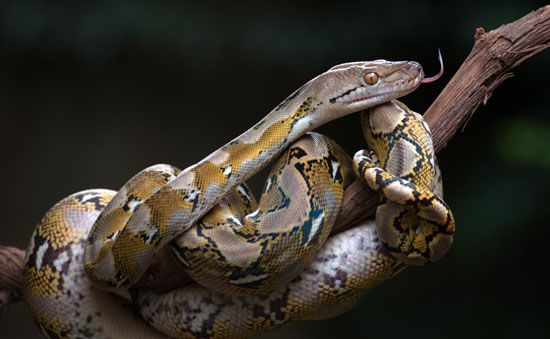
What does a reticulated python look like?
The reticulated python (Malayopython reticulatus) is a large, visually distinct snake characterized by a grayish-tan body patterned with X- or diamond-shaped blotches. These markings contain a complex mix of black, white, yellow, and red scales.1
Key physical features include:
- Head: The head is covered in smooth brown scales. A narrow black line runs from the snout to the neck, with additional black lines extending from the eye to the jaw.1
- Eyes: They possess orange eyes with vertical pupils that dilate in dim light.1
- Sensory Pits: Embedded within the lip scales are specialized heat-sensing pits used to detect the temperature of nearby prey.1
- Size: While they are the world’s longest snakes—with some individuals reaching up to 10 meters (32.8 feet)—most adults typically measure between 5 and 8 meters (16.4 to 26.2 feet) and weigh between 75 and 175 kg (165 to 386 pounds), with females generally being larger than males.1
How does the reticulated python hunt and eat its food?
The reticulated python is a nocturnal predator that relies on specialized sensory adaptations to hunt in the dark. It utilizes heat-sensing pits located in its lip scales to detect the body heat of nearby prey, as well as vibrations in the ground to identify when a potential meal—such as a bird, mammal, or reptile—is within striking range.14
Once the prey is close, the python strikes, typically grabbing the animal’s head with its teeth. As a constrictor, it then coils its body tightly around the prey to induce suffocation, a process that usually takes three to four minutes.1
The reticulated python is capable of consuming large animals, including pigs, deer, and monitor lizards, as well as smaller prey like bats and tree shrews. After consuming a large meal, the snake becomes inactive for several weeks while it digests its food.15
Sources
- reticulated python — Encyclopædia Britannica
- reticulated python — Merriam-Webster
- python — Encyclopædia Britannica
- reptile - Chemoreception — Encyclopædia Britannica
- reptile - Feeding habits — Encyclopædia Britannica
Published on · 3 min read