Calymene
Calymene is a genus of trilobites, which are extinct arthropods that lived during the Ordovician, Silurian, and Devonian periods.
What is Calymene?
Calymene is a genus of trilobites, which are extinct arthropods that lived during the Ordovician, Silurian, and Devonian periods1.1
These fossils are well-represented in the fossil record, and specimens of Calymene and its relative Flexicalymene are frequently discovered in a tightly rolled position. This behavior is believed to have been a defensive mechanism used to protect the animal’s soft, vulnerable underside, though it may also represent a death position. Notably, some Calymene fossils have been found with impressions or actual remains of their appendages preserved. The name is derived from the Greek word kalyptein, meaning to cover or conceal.21
What are trilobites?
Trilobites are a group of extinct fossil arthropods that were exclusively marine animals. They are easily recognized by their distinctive three-lobed, three-segmented form, which consists of a longitudinal axial lobe with two lobes on either side. Their bodies were divided into three regions: the cephalon (head), the thorax, and the pygidium (tail).3
These creatures first appeared approximately 521 million years ago during the Cambrian Period, where they dominated the seas. While they became less abundant over time, some forms persisted until the Permian Period. Trilobites possessed a chitinous exoskeleton that they shed as they grew, making their remains relatively common in the fossil record. They exhibited diverse lifestyles, including active predation, scavenging, and filter-feeding, and they are frequently used by scientists for stratigraphic correlations.3
Why did trilobites roll into balls?
Trilobites often rolled into balls as a defensive mechanism to protect their soft, vulnerable undersides from predators. By curling their bodies, they could shield their delicate appendages and internal organs behind their hard, chitinous exoskeleton, which acted as a protective armor.3
While the provided search results confirm that trilobites possessed a segmented body and an external skeleton that they shed as they grew, they do not explicitly detail the mechanics of this “enrollment” behavior. However, this defensive posture is a well-documented trait among many trilobite species, allowing them to survive in environments where they were susceptible to attack.3
What was the Ordovician Period like?
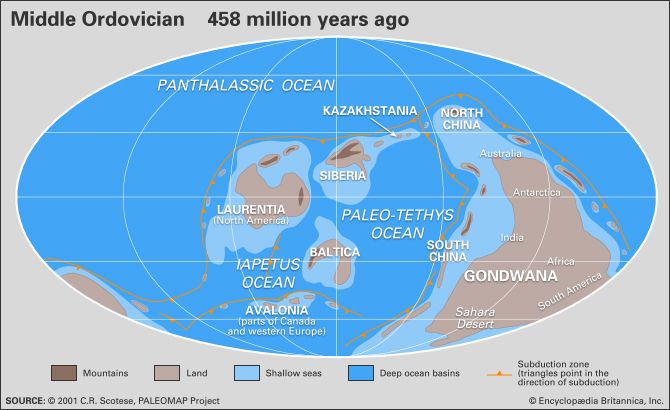
The Ordovician Period (485.4 to 443.8 million years ago) was a time of profound geological and biological transformation. Driven by rapid seafloor spreading, global sea levels rose to some of the highest in the Phanerozoic Eon, flooding continents and creating vast, shallow seas that deposited extensive fossil-rich sediments.67
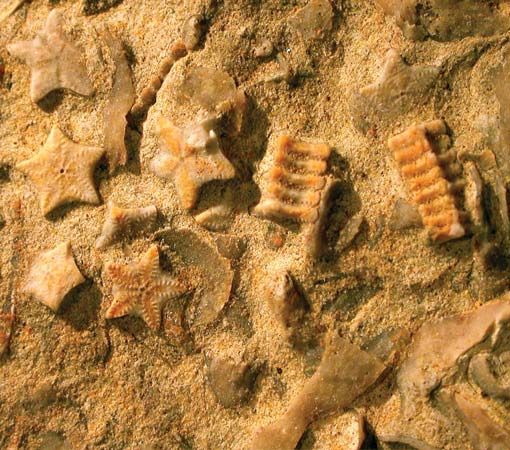
The period is defined by the Ordovician radiation, an intense diversification of marine life that saw the emergence of nearly every modern invertebrate phylum and the rise of fish. Ecosystems became increasingly complex, with life expanding into new habitats like reefs and “forest-like” tiers that reached up to 50 cm above the seafloor.678
However, the period ended with the second-largest mass extinction in Earth’s history, claiming roughly 85 percent of species. This event was likely triggered by intense glaciation in the Southern Hemisphere, which caused global cooling and a dramatic drop in sea levels, destroying critical shallow-water habitats.69
Sources
- Calymene — Encyclopædia Britannica
- Calymene — Merriam-Webster
- trilobite — Encyclopædia Britannica
- Devonian Period - Invertebrates — Encyclopædia Britannica
- Cambrian Period - Correlation of Cambrian strata — Encyclopædia Britannica
- A Journey Through Time Since the Precambrian - Ordovician Period: 485.4 million to 443.4 million years ago — Encyclopædia Britannica
- Ordovician Period — Encyclopædia Britannica
- Ordovician Period - Exploitation of habitats — Encyclopædia Britannica
- Ordovician Period - Mass extinction at the end of the Ordovician — Encyclopædia Britannica
Published on · 2 min read