Cayman Trench
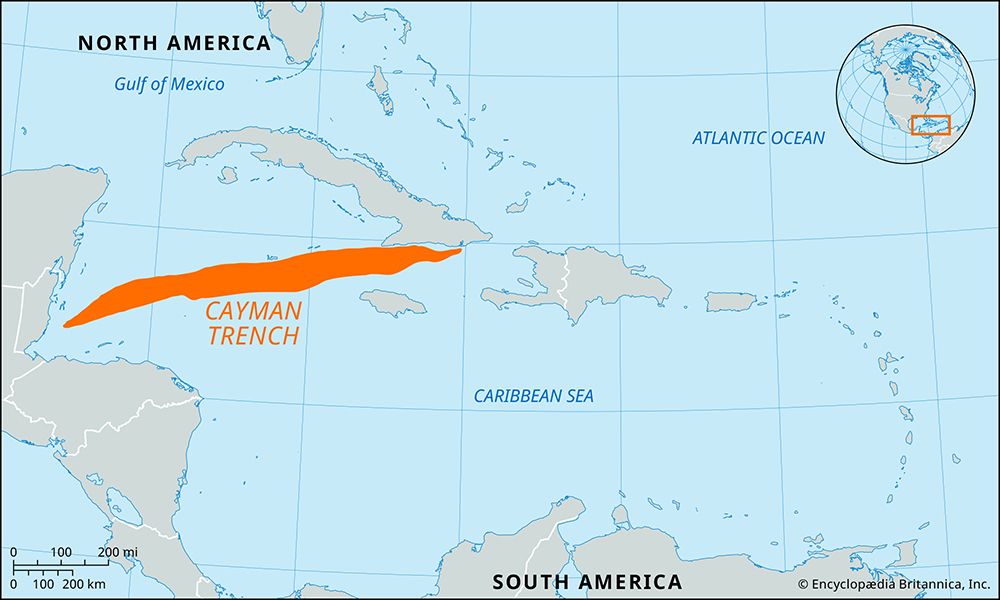
The Cayman Trench is a submarine trench located on the floor of the western Caribbean Sea, situated between Jamaica and the Cayman Islands.
What is Cayman Trench?
The Cayman Trench is a submarine trench located on the floor of the western Caribbean Sea, situated between Jamaica and the Cayman Islands.1
Extending from the Windward Passage near Cuba toward Guatemala, this narrow trough reaches a maximum depth of 25,216 feet (7,686 meters), marking it as the deepest point in the Caribbean Sea. The trench is bounded by the Cayman Ridge to the north and the Jamaica Ridge to the south. Due to its tectonic setting, the area is prone to submarine earthquakes. Additionally, the trench is home to some of the world’s deepest deep-sea vents, located approximately 5 kilometers below the ocean surface.1
How are deep-sea vents formed?
Deep-sea vents, also known as hydrothermal vents, are formed through the circulation of seawater through the oceanic crust. This process typically occurs in areas of high tectonic activity, such as spreading ridges where new crust is being created, or on submarine volcanoes.345
The formation process involves the following steps:
- Percolation: Cold seawater seeps downward into the hot oceanic crust through a network of fissures.4
- Heating: As the water circulates through the crust, it is heated by underlying volcanic activity.34
- Leaching: The hot, acidic solution leaches sulfide minerals—including iron, copper, and zinc—from the surrounding rock.34
- Discharge: The heated, mineral-rich water returns to the seafloor in a concentrated, pipelike flow. Upon emerging into the cold surrounding seawater, the dissolved minerals precipitate, often forming distinct deposits.43
These vents are significant because they support unique ecosystems that rely on chemosynthesis rather than photosynthesis.34
What causes earthquakes in submarine trenches?
Earthquakes in submarine trenches are primarily caused by the process of subduction, where a lithospheric plate bearing oceanic crust slides downward into the Earth’s interior.789
This movement occurs at convergent plate boundaries, where the descending plate is forced into the asthenosphere. The resulting seismicity is characterized by:78
- Seismic Zones: Earthquakes occur within tabular zones that dip landward beneath continents or island arcs.789
- Varying Depths: Seismological studies show that earthquake foci can range from shallow depths of 55 km (34 miles) or less near the trench to deep-focus events occurring as far as 700 km (435 miles) below the surface.79
- Tectonic Stress: These earthquakes mark the location of the dipping lithospheric slab, where stresses are aligned with the plate’s descent.8
Essentially, these trenches are the topographic expressions of this ongoing tectonic movement, where the destruction of oceanic lithosphere generates significant seismic activity.78
What are tectonic plates and how do they create trenches?
Tectonic plates are the rigid, outermost segments of the Earth’s lithosphere, typically 50 to 100 km thick. These plates rest upon the asthenosphere, a weaker, partially molten layer that allows the plates to move, interact, and reshape the planet’s surface.11
Deep-sea trenches are created at convergent plate boundaries through a process called subduction. When two plates collide, the denser, older oceanic plate is forced downward into the mantle beneath the other plate. This process creates a trench in several ways:121314
- Bending and Drag: As the descending plate bends to sink into the Earth’s interior, it creates a deep, V-shaped depression. The trench is further defined by the frictional drag between the two plates as they slide past one another.1214
- Accretionary Wedges: The overriding plate often scrapes sediments and crustal material off the descending plate, forming a chaotic mixture of deformed rocks known as an accretionary wedge within the trench.12
- Isostatic Forces: Trenches represent areas where the lithosphere is being forced down against buoyant isostatic forces, resulting in characteristic negative gravity anomalies.15
Sources
- Cayman Trench — Encyclopædia Britannica
- Cayman Trench — Merriam-Webster
- deep-sea vent — Encyclopædia Britannica
- Marine ecosystem - Organisms of the deep-sea vents — Encyclopædia Britannica
- oceanic ridge - Hydrothermal vents — Encyclopædia Britannica
- volcanism — Encyclopædia Britannica
- deep-sea trench - Origin of deep-sea trenches — Encyclopædia Britannica
- earthquake - Tectonic associations — Encyclopædia Britannica
- deep-sea trench - Types — Encyclopædia Britannica
- submarine fracture zone — Encyclopædia Britannica
- plate tectonics - Seafloor spreading — Encyclopædia Britannica
- plate tectonics - Principles of plate tectonics — Encyclopædia Britannica
- plate tectonics - Subduction zones — Encyclopædia Britannica
- How was the Mariana Trench formed? — Encyclopædia Britannica
- plate tectonics - Convergent margins — Encyclopædia Britannica
- continental crust — Encyclopædia Britannica
Published on · 3 min read