Chiton
Chitons are marine mollusks belonging to the class Polyplacophora, defined by several key anatomical characteristics that align with the broader molluscan…
What are the main characteristics that define chitons as mollusks?
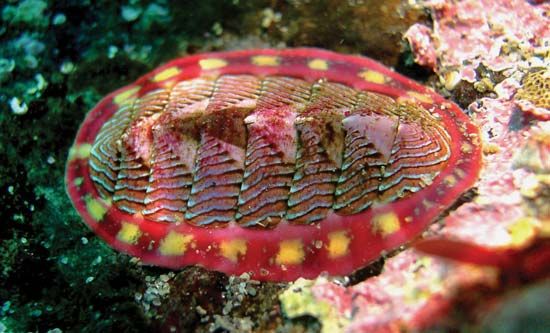
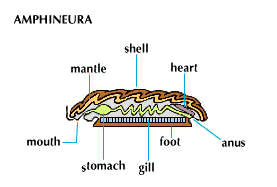
Chitons are marine mollusks belonging to the class Polyplacophora, defined by several key anatomical characteristics that align with the broader molluscan body plan.12
- Dorsal Plates: Their most distinctive feature is a shell composed of eight overlapping, calcified plates (or valves) on the dorsal surface, which are typically surrounded by a tough, spicule-covered girdle.132
- Foot: Like many other mollusks, they possess a large, flat, muscular foot that occupies the ventral surface, allowing them to creep along and cling firmly to rocky substrates.13
- Mantle and Cavity: They feature a mantle—a dorsal epidermis—and a mantle cavity located in a groove on either side of the foot. This cavity houses the gills, known as ctenidia, which are essential for respiration.12
- Radula: Chitons possess a well-developed radula, a filelike, ribbon-shaped structure in the mouth used to scrape algae and other food from rocks.14
These features, particularly the mantle and the radula, are hallmark traits of the phylum Mollusca.24
What is the structure and function of a chiton’s shell plates?
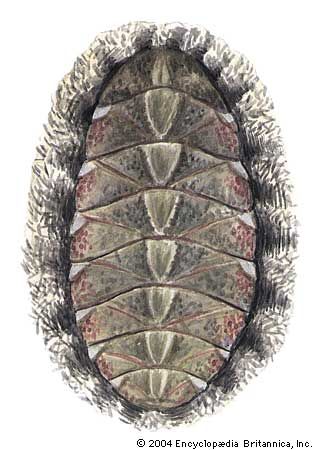
The shell of a chiton consists of eight overlapping, calcified plates arranged in a row along the dorsal surface. These plates are held together by a tough, muscular structure known as the girdle, which surrounds or partially covers the valves.1
The primary function of this segmented shell is to provide both protection and flexibility. Because the plates overlap, the chiton can remain highly maneuverable, allowing it to fit snugly into irregular rock crevices or curl into a protective ball if it becomes detached from a surface. This structural design enables the animal to maintain a low profile while clinging to rocks in the intertidal zone, where it must withstand wave action and potential predators.1
What is the typical habitat and distribution of chitons in the world’s oceans?
Chitons are found in oceans worldwide, though they are most abundant in warm regions. Their habitat preferences vary significantly based on the temperature of the water:1
- Warm Regions: In warmer climates, these mollusks are typically found in the intertidal zone or in shallow coastal waters, where they cling to rocky surfaces.1
- Colder Regions: In colder areas, chitons are more commonly found in deeper waters. While they frequently inhabit depths down to 4,000 meters (13,000 feet), some species have been discovered at depths as great as 7,000 meters.1
Regardless of their specific depth, most chitons are nocturnal and rely on their muscular feet to remain attached to rocks, where they graze on algae.1
What is the largest known species of chiton, and how big can they get?
The largest known species of chiton is Cryptochiton stelleri, commonly found along the Pacific coast of North America. While most chiton species reach a maximum length of only about 5 cm (2 inches), Cryptochiton stelleri can grow significantly larger, reaching lengths of up to 43 cm (approximately 17 inches).1
Sources
- chiton — Encyclopædia Britannica
- Polyplacophora — Merriam-Webster
- mollusk - External features — Encyclopædia Britannica
- radula — Encyclopædia Britannica
Published on · 2 min read