Chugach Mountains
The Chugach Mountains are a prominent segment of the Pacific mountain system located entirely within the U.S. state of Alaska. Named for an Eskimo tribe…
What is Chugach Mountains?
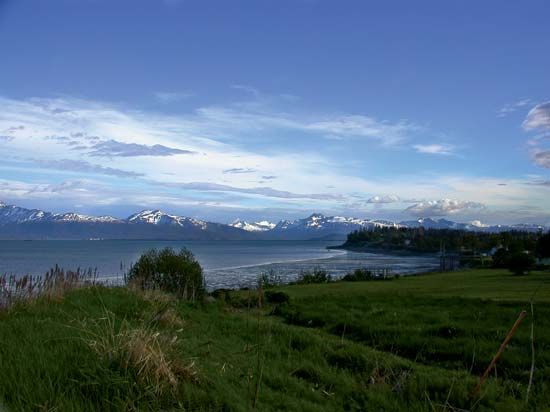
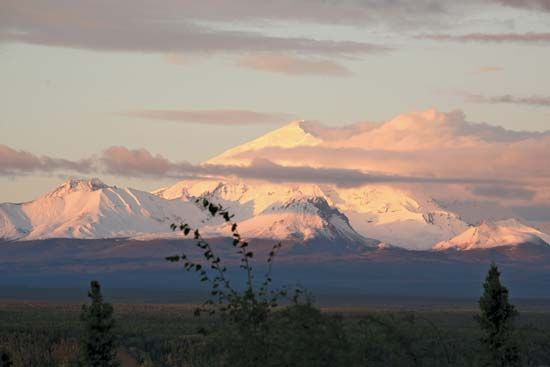
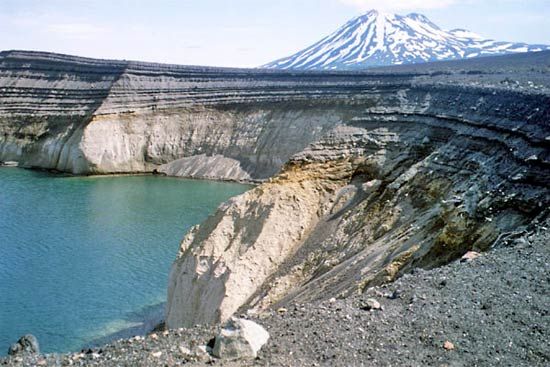
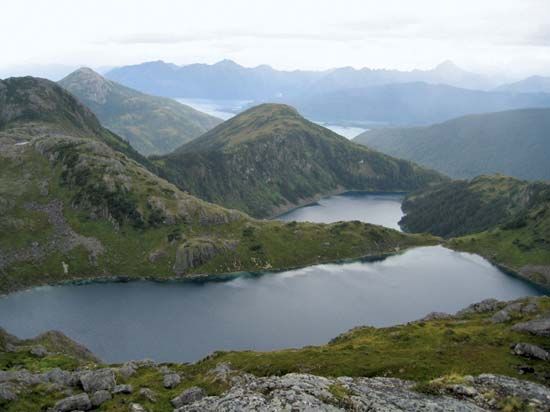
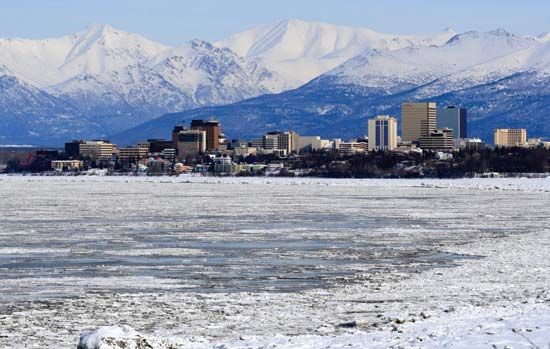
The Chugach Mountains are a prominent segment of the Pacific mountain system located entirely within the U.S. state of Alaska. Named for an Eskimo tribe, this rugged, heavily glaciated range extends approximately 300 miles (500 km) along the coast, stretching from the Turnagain Arm of the Cook Inlet to Cape Yakataga.1
The range features many peaks exceeding 11,000 feet (3,400 meters), with Mount Marcus Baker serving as the highest point at 13,176 feet (4,016 meters). Physiographically, the Chugach Mountains form part of an arcuate belt alongside the Kenai Mountains and Kodiak Island, acting as a barrier along the northeast margin of the Pacific Ocean. The eastern portion of the range extends into the Wrangell–St. Elias National Park and Preserve, which contains the Bagley Ice Field, the largest subpolar ice field in North America.1234
Popular for outdoor activities like skiing, hiking, and biking, the mountains are frequently accessed via the Glen Alps trailhead near Anchorage.1
What are some of the most famous glaciers found in the Chugach Mountains?
The Chugach Mountains are characterized by their extreme ruggedness and heavy glaciation, forming part of one of the most extensive systems of highland and valley glaciers in North America.1
While the range is defined by its vast ice cover rather than a list of individual famous glaciers, the following features are central to its glacial landscape:
- Bagley Ice Field: Located in the eastern portion of the Chugach Mountains, this is the largest subpolar ice field in North America. It serves as a massive reservoir that spawns several large glaciers, acting as the primary source for the region’s glacial activity.42
- Glacial Systems: The mountains are home to numerous long and spectacular glaciers that descend from the crests of the range. These glaciers are part of a broader, interconnected system that includes the ice fields of the neighboring St. Elias Mountains, collectively forming a massive, ice-armored landscape.1
The Chugach Mountains, alongside the Kenai and St. Elias ranges, represent a critical component of the Pacific mountain system’s glacial geography, contributing to the significant ice cover found along the Gulf of Alaska.1
How do the Chugach Mountains compare to other major mountain ranges in Alaska?
The Chugach Mountains are a key component of the Pacific mountain system in Alaska, forming a massive, arcuate barrier along the northern margin of the Gulf of Alaska. When compared to other major Alaskan ranges, they are distinguished by their specific location, structure, and glacial intensity:52
- Physiographic Context: The Chugach Mountains are part of a coastal belt that includes the Kenai Mountains and Kodiak Island. Unlike the interior Alaska Range, which serves as a drainage divide between the Yukon River system and the coast, the Chugach range acts as a direct coastal wall.56
- Glaciation: Along with the St. Elias Mountains, the Chugach range contains one of the most extensive systems of highland and valley glaciers in North America. While the Alaska Range features great valley glaciers radiating from massive peaks, the Chugach range is defined by its heavy, continuous ice cover, including the Bagley Ice Field.62
- Elevation and Scale: While the Alaska Range contains the highest peak in North America, Denali, the Chugach Mountains are generally lower, with average elevations of 7,000 to 8,000 feet and a high point of 13,176 feet at Mount Marcus Baker.6
- Geological Connection: The Chugach range is geologically continuous with the St. Elias Mountains to the east, sharing similar metamorphic and fault-block characteristics that distinguish them from the volcanic-heavy Aleutian Range or the sedimentary-dominated interior basins.6
What kind of wildlife can be found in the Chugach National Forest?
The Chugach National Forest, which encompasses the lower regions of the Chugach, Kenai, and Kodiak mountain areas, supports a diverse array of wildlife adapted to its coastal and mountainous terrain.8
Large Mammals
The forest is home to several prominent large mammals:
- Bears: Both black bears and brown (grizzly) bears inhabit the region.8
- Ungulates: Mountain goats are found within the Chugach and Kenai ranges. Moose are also present, typically occupying lower elevations but occasionally ranging into higher country.8
- Other Species: Sitka deer are abundant in parts of the Prince William Sound region.8
Smaller Animals
The area supports various smaller fur-bearing animals, including lynx, martens, and weasels. Additionally, porcupines are native to the mountains throughout this range.8
While the forest’s vegetation is predominantly hemlock-spruce coastal forest, these habitats provide the necessary cover and food sources for the diverse wildlife populations mentioned above.8
Sources
- Chugach Mountains — Encyclopædia Britannica
- Alaskan mountains - Physiography of the southern ranges — Encyclopædia Britannica
- Chugach Mountains — Merriam-Webster
- Wrangell–Saint Elias National Park and Preserve — Encyclopædia Britannica
- Alaskan mountains — Encyclopædia Britannica
- St. Elias Mountains — Encyclopædia Britannica
- Alaska - Relief — Encyclopædia Britannica
- Alaskan mountains - Plant and animal life — Encyclopædia Britannica
Published on · 3 min read