Cuckoo Wasp
Cuckoo wasps (family Chrysididae) derive their name from a behavioral analogy to cuckoo birds, which are known for laying their eggs in the nests of other…
How did cuckoo wasps get their name, and what does it reveal about their behavior?
Cuckoo wasps (family Chrysididae) derive their name from a behavioral analogy to cuckoo birds, which are known for laying their eggs in the nests of other bird species.1
This naming reflects the cuckoo wasp’s status as a brood parasite. In this reproductive strategy, a female cuckoo wasp infiltrates the unfinished, untended nest of another solitary wasp or bee to deposit her egg. Once the host owner seals the nest—having provided food for her own offspring—the cuckoo wasp larva hatches and either kills the host larva or starves it to death by consuming all the available provisions.12
This behavior is a specific form of kleptoparasitism, a strategy where one animal steals resources—in this case, the energy and materials invested by the host in nest building and child care—from another. Because they rely entirely on these hosts to raise their young, cuckoo wasps do not need to build their own nests or provision them with food.312
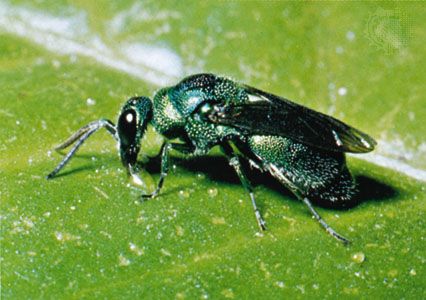
What are the distinguishing physical characteristics of cuckoo wasps?
Cuckoo wasps (family Chrysididae) are characterized by several distinct physical traits that make them easily recognizable:
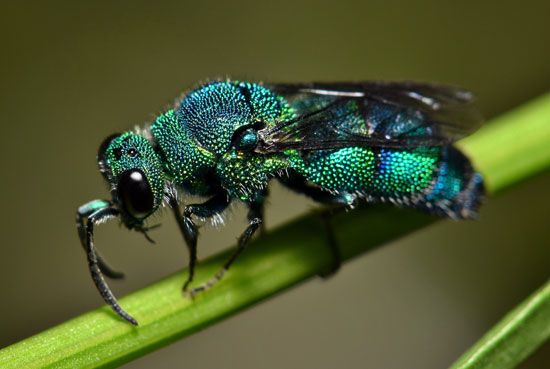
- Coloration: They are renowned for their brilliant, metallic-green or blue coloration, which often gives them a shining, jewel-like luster.167
- Size: They are generally small insects, typically measuring no more than 1.2 cm (about 0.5 inches) in length.1
- Body Structure: Like other wasps, they possess a head, thorax, and abdomen, along with six legs. They typically feature a long, slender, curved abdomen attached to the thorax by a narrow waist.16
- Exoskeleton: Their bodies often display intricate sculpturing on the exoskeleton, which adds to their unique appearance.6
- Defensive Flexibility: A notable behavioral-physical trait is their ability to curl their flexible abdomen into a ball when they are disturbed or attacked, providing a measure of protection.1
How do cuckoo wasps compare to other parasitic insects in terms of their strategies and success rates?
Cuckoo wasps (family Chrysididae) are specialized brood parasites that, unlike many other parasitic insects, do not construct their own nests or provision them with food. Their strategy is a form of kleptoparasitism, where they exploit the labor of solitary bees or wasps by depositing eggs in unfinished, untended nests.1365
When comparing their strategies to other parasitic Hymenoptera:
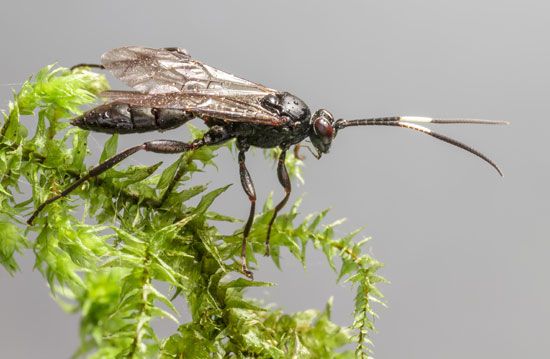
- Cuckoo Wasps vs. Ichneumonids: While cuckoo wasps typically target nests, members of the superfamily Ichneumonoidea often deposit eggs directly in or on the larvae or pupae of their hosts. Ichneumonid larvae may develop internally or externally, feeding on host fluids and fats, whereas cuckoo wasp larvae primarily consume the host’s food provisions or the host larva itself.19
- Cuckoo Wasps vs. Tiphiids and Scoliids: These wasps are also parasitic but generally target beetle grubs in the soil. The female must dig to locate the host, sting it to induce paralysis, and then lay an egg on the host’s body.93
- Cuckoo Wasps vs. Social Parasites: Unlike beetles such as Lomechusa, which use chemical secretions to pacify and be reared by social ants, cuckoo wasps rely on stealth and the timing of the host’s nest-building cycle to ensure their offspring’s survival.110
Data regarding specific success rates for cuckoo wasps compared to other parasites is not available in the provided Britannica records.
Which insect families are commonly targeted by cuckoo wasps for parasitism?
Cuckoo wasps (family Chrysididae) primarily target the nests of solitary bees and wasps to deposit their eggs. By exploiting these nests, the cuckoo wasp larvae are able to consume the host’s food provisions or the host larvae themselves.163
While the majority of species focus on these Hymenopteran hosts, some cuckoo wasps have evolved to parasitize other insects:
Sources
- cuckoo wasp — Encyclopædia Britannica
- kleptoparasitism — Encyclopædia Britannica
- Hymenoptera - Solitary forms — Encyclopædia Britannica
- Orthoptera - Annotated classification — Encyclopædia Britannica
- cuckoo bee — Encyclopædia Britannica
- wasp — Encyclopædia Britannica
- Chrysididae — Merriam-Webster
- caddisfly - Annotated classification — Encyclopædia Britannica
- kleptoparasitism: Top Questions — Encyclopædia Britannica
- Hymenoptera - Social parasitism — Encyclopædia Britannica
Published on · 3 min read