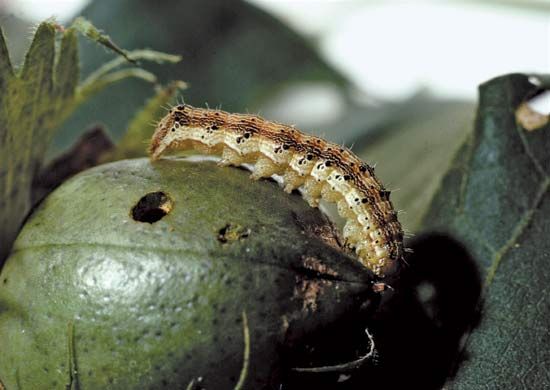
Cutworm
A cutworm is not a true worm, but rather the larva of specific species of owlet moths belonging to the family Noctuidae.
What is cutworm?
A cutworm is not a true worm, but rather the larva of specific species of owlet moths belonging to the family Noctuidae.1
These insects are considered serious agricultural pests. Many species are nocturnal, emerging at night to feed on crops such as tobacco, corn, tomatoes, beans, and grasses by severing their stems and roots near the soil surface. Other varieties of cutworms remain underground, where they feed directly on the root systems of plants.1
What is the life cycle of an owlet moth?
The life cycle of an owlet moth (family Noctuidae) follows the process of complete metamorphosis, consisting of four distinct stages: egg, larva, pupa, and adult.21
- Egg: Females typically lay eggs on or within a suitable food plant, either singly or in masses. Development may be regulated by diapause, a state of inactivity that ensures larvae hatch when environmental conditions and food sources are optimal.3
- Larva: This is the primary nutritive stage. Larvae grow by molting—shedding their skin multiple times as they mature. Depending on the species, they may feed on foliage, bore into stems and fruits, or live underground to consume roots.12
- Pupa: After reaching maturity, the larva enters a nonfeeding prepupal stage and forms a pupa. Many owlet moths pupate underground in loosely woven cocoons, while others construct stronger cocoons incorporating materials like wood chips.2
- Adult: The adult emerges from the pupal case to reproduce and disperse. Adults are typically nocturnal and feed on fluids such as nectar, sap, or fruit juice to gain energy for flight.24
How can gardeners protect their seedlings from cutworms?
To protect seedlings from cutworms, gardeners can employ several physical and cultural strategies to prevent these larvae from reaching or severing the stems of young plants:
- Physical Barriers: Create “collars” around the base of each seedling using cardboard tubes (such as toilet paper rolls), plastic cups with the bottoms removed, or aluminum foil. These should be pressed at least an inch into the soil to prevent the larvae from accessing the stem.
- Hand-Picking: Since many cutworms are nocturnal, inspecting the garden at night with a flashlight can allow you to manually remove and dispose of the larvae.
- Soil Disturbance: Tilling or hoeing the soil around the base of plants can expose larvae to predators like birds or cause them to perish from exposure.
- Delayed Planting: Waiting until the soil warms up and plants are more robust can help them better withstand potential damage.
- Sanitation: Removing weeds and debris from the garden area reduces the habitat and alternative food sources for the larvae.
What are some natural predators of cutworms?
Cutworms are the larvae of various owlet moths (family Noctuidae) that feed on the roots and stems of crops like corn, tomatoes, and beans. While the provided information identifies them as significant agricultural pests, it does not detail their specific natural predators.1
Sources
- cutworm — Encyclopædia Britannica
- owlet moth — Encyclopædia Britannica
- Lepidoptera - The adult — Encyclopædia Britannica
- Coleoptera - General features — Encyclopædia Britannica
- Lepidoptera - Egg — Encyclopædia Britannica
Published on · 2 min read