Cyprus
The education system in Cyprus is divided between the Greek and Turkish sectors, both of which provide high-quality public schooling and specialized…
How does the education system in Cyprus work?
The education system in Cyprus is divided between the Greek and Turkish sectors, both of which provide high-quality public schooling and specialized postsecondary opportunities.1
In the Greek Cypriot sector, children receive 12 years of free education starting at age 5, with compulsory attendance required through age 15. After completing the initial stages, students may choose to attend a lyceum—which offers specialized tracks in classical studies, sciences, or economics—or pursue technical and vocational training.1
The Turkish Cypriot sector operates its own separate administration, maintaining a public-school system with facilities comparable to those in the Greek sector. Both administrations offer diverse postsecondary options, including institutions for teacher training, nursing, public health, and technical instruction. While local universities exist, such as the University of Cyprus, many students from both communities choose to pursue higher education abroad in countries like Britain, the United States, Greece, or Turkey2. A notable challenge for both sectors is the “brain drain,” as many highly qualified graduates seek employment outside of Cyprus.1
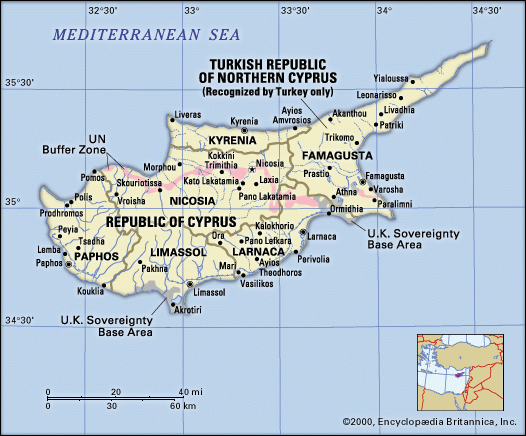
What is the geographical location of Cyprus and its significance in the Mediterranean?
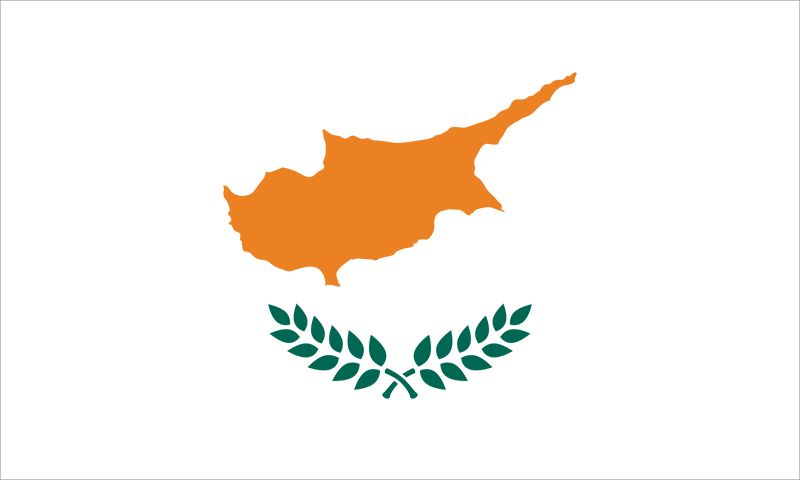
Cyprus is the third-largest island in the Mediterranean Sea, located in the eastern portion of the basin. It is situated approximately 40 miles (65 km) south of Turkey, 60 miles (100 km) west of Syria, and 480 miles (770 km) southeast of mainland Greece.34
The island’s geographical position has historically made it a significant crossroads between Europe and the Middle East, influencing its role as a hub for international air services and telecommunications. Its strategic location in the eastern Mediterranean has also gained modern economic importance due to the discovery of large natural gas deposits off its coast in the 21st century. Furthermore, the island has been renowned since ancient times for its mineral wealth—particularly copper—and its natural beauty, which continue to support its economy through trade and tourism.5674
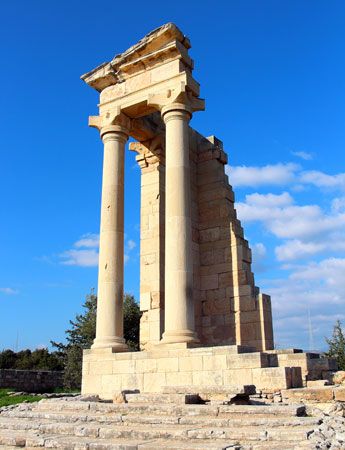
How has Cyprus’s history been influenced by various ancient civilizations?
Cyprus’s history has been profoundly shaped by its strategic position as a crossroads for ancient civilizations, which utilized the island for trade and territorial expansion.
Early Foundations and Trade
During the Bronze Age, Cyprus became a vital international trading hub, likely identified as Alashiya in ancient records due to its abundant copper resources11. The island maintained extensive contacts with Egypt, Syria, and Anatolia, adopting writing systems and artistic techniques from these regions.11
Greek and Phoenician Influence
Beginning around 1200 BCE, significant Greek immigration from the Peloponnese established a lasting cultural and linguistic foundation, leading to the creation of several ancient Greek kingdoms. By 800 BCE, Phoenician influence was solidified through the colony at Citium.12
Medieval and Renaissance Legacies
Later periods introduced diverse architectural and political structures. The Lusignan dynasty established a feudal monarchy, while subsequent Genoese and Venetian rule left a lasting mark on the island’s military architecture and Gothic cathedrals. These layers of history are preserved today in UNESCO World Heritage sites, ranging from Neolithic settlements to Byzantine churches.1314
How has Cyprus’s membership in the European Union affected the country?
Cyprus’s membership in the European Union, which began in 2004, has had a profound impact on the country’s economic and political landscape.
Economic Integration and Challenges
Following its accession, Cyprus adopted the euro as its official currency in 2008. However, the nation became deeply entangled in the euro-zone debt crisis by 2011. Due to heavy exposure to Greek government bonds, Cyprus was forced to implement strict austerity measures and eventually secured a €10 billion bailout from the EU and the International Monetary Fund in 2013. This “bail-in” required significant restructuring of the Cypriot banking sector.171819
Citizenship and Investment
During the financial recovery, Cyprus utilized a citizenship-by-investment (CBI) program to attract foreign direct investment. While this brought in wealthy investors, the program faced intense scrutiny for lack of oversight and corruption, leading to its suspension in 2020.18
Geopolitical Context
The EU membership applies to the entire island, though in practice, it is limited to the government-controlled south due to the 1974 partition. The EU has played a role in regional tensions, particularly regarding offshore natural gas exploration, where the EU has imposed sanctions on Turkey for its activities in the region.1718
Sources
- Crete - Government and society — Encyclopædia Britannica
- Cyprus - Education — Encyclopædia Britannica
- Cyprus - Land — Encyclopædia Britannica
- Cyprus - Climate — Encyclopædia Britannica
- Cyprus: Top Questions — Encyclopædia Britannica
- Cyprus - Resources and power — Encyclopædia Britannica
- Cyprus - Finance and trade — Encyclopædia Britannica
- list of islands - Cyprus — Encyclopædia Britannica
- Cyprus - The Persian empire — Encyclopædia Britannica
- Cyprus - Transportation and telecommunications — Encyclopædia Britannica
- Cyprus - The Bronze Age — Encyclopædia Britannica
- Cyprus - Greek immigration — Encyclopædia Britannica
- Cyprus - Earliest periods — Encyclopædia Britannica
- Cyprus - Ottoman rule — Encyclopædia Britannica
- Cyprus - The Lusignan kingdom and Genoese and Venetian rule — Encyclopædia Britannica
- Cyprus - Cultural institutions — Encyclopædia Britannica
- Cyprus - Effects of partition — Encyclopædia Britannica
- Cyprus - Efforts toward reunification — Encyclopædia Britannica
- European Union - The euro-zone debt crisis — Encyclopædia Britannica
- Cyprus — Encyclopædia Britannica
Published on · 3 min read