Bounty Islands
The Bounty Islands are an uninhabited, outlying island group belonging to New Zealand, located in the South Pacific Ocean approximately 415 miles (668 km)…
What is Bounty Islands?
The Bounty Islands are an uninhabited, outlying island group belonging to New Zealand, located in the South Pacific Ocean approximately 415 miles (668 km) east of the South Island.1
The group consists of 13 rugged granite islets covering a total area of about 320 acres (130 hectares). They were discovered in 1788 by Captain William Bligh, who named them after his ship, the Bounty. While the islands were historically home to large herds of fur seals, these populations were decimated by hunters during the early 19th century, though they have since begun to recover. Today, the islands serve as a significant habitat for various seabirds, particularly penguins.1
It is important to distinguish these islands from the historical event known as the Mutiny on the Bounty, which involved a revolt against Captain Bligh in 1789, one year after he discovered the island group.12
Who was Captain William Bligh?
William Bligh (1754–1817) was an English navigator and Royal Navy officer best known for his command of the HMS Bounty during the famous 1789 mutiny.3
A skilled navigator who served under James Cook, Bligh was commissioned to transport breadfruit from Tahiti to the West Indies. During the return voyage, his first mate, Fletcher Christian, led a revolt. Bligh and 18 loyalists were set adrift in a small launch; through remarkable navigation, Bligh successfully led them 3,600 miles to Timor.3
While often portrayed as a tyrant in literature like the novel Mutiny on the Bounty, historical records indicate Bligh used corporal punishment less than his peers. However, his verbally abusive nature and inability to manage interpersonal relationships led to further conflicts, including the Rum Rebellion during his tenure as governor of New South Wales. Despite these controversies, he achieved the rank of vice admiral and was elected to the Royal Society of London. to the Royal Society of London.32
What happened during the mutiny on the HMS Bounty?
The mutiny on the HMS Bounty occurred on April 28, 1789, during a voyage intended to transport breadfruit trees from Tahiti to the West Indies.243
Tensions had been building between the ship’s commander, William Bligh, and his first mate, Fletcher Christian. Bligh, a skilled navigator, was known for his volatile temper and verbal abuse, which alienated his crew despite his relatively infrequent use of physical corporal punishment. Following a five-month stay in Tahiti, the crew grew eager to return home, but Bligh became increasingly enraged by their perceived incompetence.34
On the morning of the mutiny, Christian and a group of supporters seized the ship. Bligh and 18 loyalists were forced into a 20-foot launch with minimal supplies. In a feat of remarkable navigation, Bligh led the group 3,600 miles to Timor. Meanwhile, the mutineers eventually settled on Pitcairn Island, where they burned the Bounty and remained undiscovered until 1808.432
What types of penguins live on the Bounty Islands?
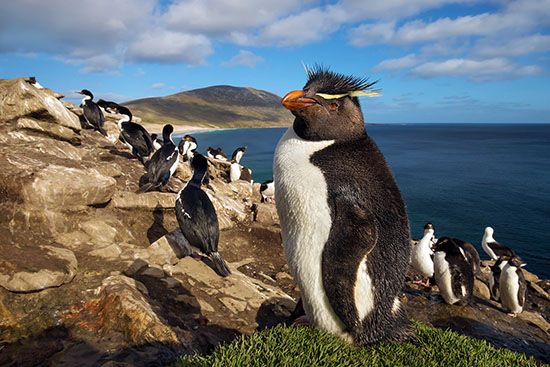
The Bounty Islands, an inhospitable group of granite islets belonging to New Zealand, host a significant population of seabirds, most notably the erect-crested penguin.
The erect-crested penguin (Eudyptes sclateri) is a species of crested penguin characterized by yellow plumes that extend from the bill to the back of the head. While they travel widely throughout the Southern Ocean, their breeding populations are limited to the Bounty Islands and the Antipodes Islands. These penguins are among the largest of the six crested species, standing up to 67 cm (26 inches) tall and weighing as much as 6 kg (13 pounds).
Unfortunately, the population of erect-crested penguins on the Bounty Islands has experienced a significant decline since the late 1970s, leading the International Union for Conservation of Nature to list the species as endangered. Scientists have not yet identified the specific cause of this population decrease.1
Sources
- Bounty Islands — Encyclopædia Britannica
- Mutiny on the Bounty — Encyclopædia Britannica
- William Bligh — Encyclopædia Britannica
- Fletcher Christian — Encyclopædia Britannica
- Erect-crested penguin — Encyclopædia Britannica
- Cook Islands - Plant and animal life — Encyclopædia Britannica
- Hawaii - Plant and animal life — Encyclopædia Britannica
Published on · 3 min read