Gulf of Argolís
The Gulf of Argolís (Argolikós Kólpos) is a deep inlet of the Mirtóön Sea, which serves as a western arm of the Aegean Sea in eastern Peloponnese, Greece.…
What is Gulf of Argolís?
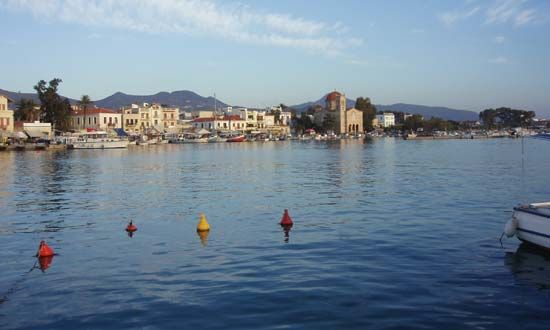
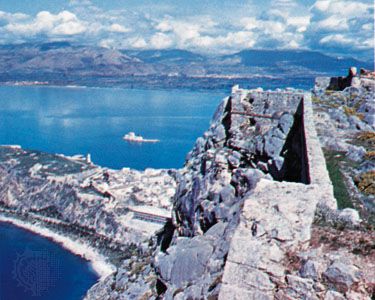
The Gulf of Argolís (Argolikós Kólpos) is a deep inlet of the Mirtóön Sea, which serves as a western arm of the Aegean Sea in eastern Peloponnese, Greece. Separated from the Saronikós Gulf by the Argolís peninsula, the gulf measures approximately 30 miles (50 km) in length and 20 miles (30 km) in width.12
The region is historically significant, with the ancient city of Árgos—a major center since the Bronze Age—located just north of the gulf’s head. The principal port at the head of the gulf is Nauplia, which served as the first capital of independent Greece in the 19th century. The gulf includes several small islands, such as Psilí and Platiá, while the island of Spétsai, a popular summer resort, sits at its entrance. In antiquity, these waters were vital for trade and the exchange of ideas between Greece, Crete, and Egypt.12
What is the historical significance of the city of Argos?
The city of Árgos holds significant historical importance as a dominant power in the Peloponnese and a central figure in ancient Greek history. Occupied since the early Bronze Age, it was a prominent site during the Mycenaean era and served as the capital of the Argolís region3.
Key aspects of its historical significance include:
- Political Dominance: Under King Pheidon in the 7th century BCE, Árgos was the leading city-state in the Peloponnese. It remained a persistent rival to Sparta, notably defeating them at Hysiae (669 BCE) before later suffering significant military setbacks.34
- Strategic Alliances: Throughout the Classical period, Árgos navigated complex power dynamics, frequently allying with Athens and later Thebes to counter Spartan influence.3
- Religious Center: The Argive Heraeum, a sanctuary dedicated to the goddess Hera, served as the religious heart of the region long before the Dorian arrival.3
- Modern Legacy: Following the War of Greek Independence, the city hosted the first free Greek Parliament in 1821 and 1829.3
How did ancient trade routes in the Aegean Sea influence Greek civilization?
Ancient trade routes in the Aegean Sea were fundamental to the development and expansion of Greek civilization, acting as conduits for both material goods and cultural exchange.
Economic and Material Exchange
The Aegean’s intricate coastline, characterized by numerous bays and ports, facilitated maritime contact between the Greek peninsula, the islands, and three continents. During the Bronze Age, trade networks connected the Aegean with Egypt, the Levant, and Anatolia, importing essential raw materials like copper from Cyprus and tin for bronze production. In return, Aegean civilizations exported goods such as olive oil, timber, and pottery. These routes were not merely for luxury items; they were vital for survival, particularly for resource-poor islands like Aegina, which relied on trade to support its population.678
Cultural and Technological Diffusion
Trade routes served as the primary mechanism for the transmission of knowledge and technology:
- Writing Systems: Through commercial contacts with the Phoenicians, the Greeks adopted and adapted the Phoenician alphabet, introducing vowels to create the Greek alphabet, which became the foundation for Western writing systems.910
- Social Networks: Early trade was often conducted by aristocratic entrepreneurs who utilized “guest-friendships” to establish networks across the Mediterranean, laying the groundwork for political alliances and colonial expansion.8
- Hellenistic Expansion: Later, the conquests of Alexander the Great integrated disparate city-states into a single economic sphere, extending trade routes as far as India and China, which facilitated the exchange of silk, spices, and artistic styles.11
The sea was both a bridge and a source of vulnerability, as its accessibility made Greece susceptible to invasion, yet it remained the essential artery for the cultural and economic vitality of the Greek world.12
What are some famous archaeological sites located in the Argolis region?
The Argolis region in the Peloponnese is renowned as an archaeological treasure house, containing several of the most significant sites from ancient Greek history.
- Mycenae: Celebrated by Homer as the “golden” capital of King Agamemnon, this is the chief Late Bronze Age site in mainland Greece. It is famous for its citadel, the monumental Lion Gate, and its association with the Mycenaean civilization.143
- Tiryns: A prehistoric city noted for its impressive Cyclopean masonry, which legend claims was built by the Cyclopes. It served as a major center of Mycenaean culture and was inhabited from the Neolithic Age.153
- Epidaurus: An important ancient commercial center, it is best known for its sanctuary of Asclepius, the god of healing. The site features a famous ancient theatre, a stadium, and the remains of various medical and religious buildings.163
- Argos: As the capital of the region, the city of Argos is built over much of the ancient site. Excavations have uncovered a temple of Apollo, a Bouleuterion (council house), and the Argive Heraeum, a major sanctuary dedicated to the goddess Hera.2
Sources
- Gulf of Argolís — Encyclopædia Britannica
- Argolís — Encyclopædia Britannica
- Árgos — Encyclopædia Britannica
- ancient Greek civilization - The role of Cleomenes — Encyclopædia Britannica
- ancient Greek civilization - The Peloponnesian League — Encyclopædia Britannica
- Aegean civilizations - Trade — Encyclopædia Britannica
- Hellenistic age - Economic developments — Encyclopædia Britannica
- Aegean Sea — Encyclopædia Britannica
- Greece - History — Encyclopædia Britannica
- Greek language - The Greek alphabet — Encyclopædia Britannica
- ancient Greek civilization - The Lelantine War — Encyclopædia Britannica
- Aegean civilizations - Transport — Encyclopædia Britannica
- alphabet - Development and diffusion of alphabets — Encyclopædia Britannica
- Tiryns — Encyclopædia Britannica
- Mycenae — Encyclopædia Britannica
- Epidaurus — Encyclopædia Britannica
- Hellenistic age - The great cities — Encyclopædia Britannica
Published on · 4 min read