Dolomites
The Dolomites are a mountain group situated in the eastern section of the northern Italian Alps. They are bounded by several major valleys, including those…
Where are the Dolomites located, and what makes them unique among mountain ranges?
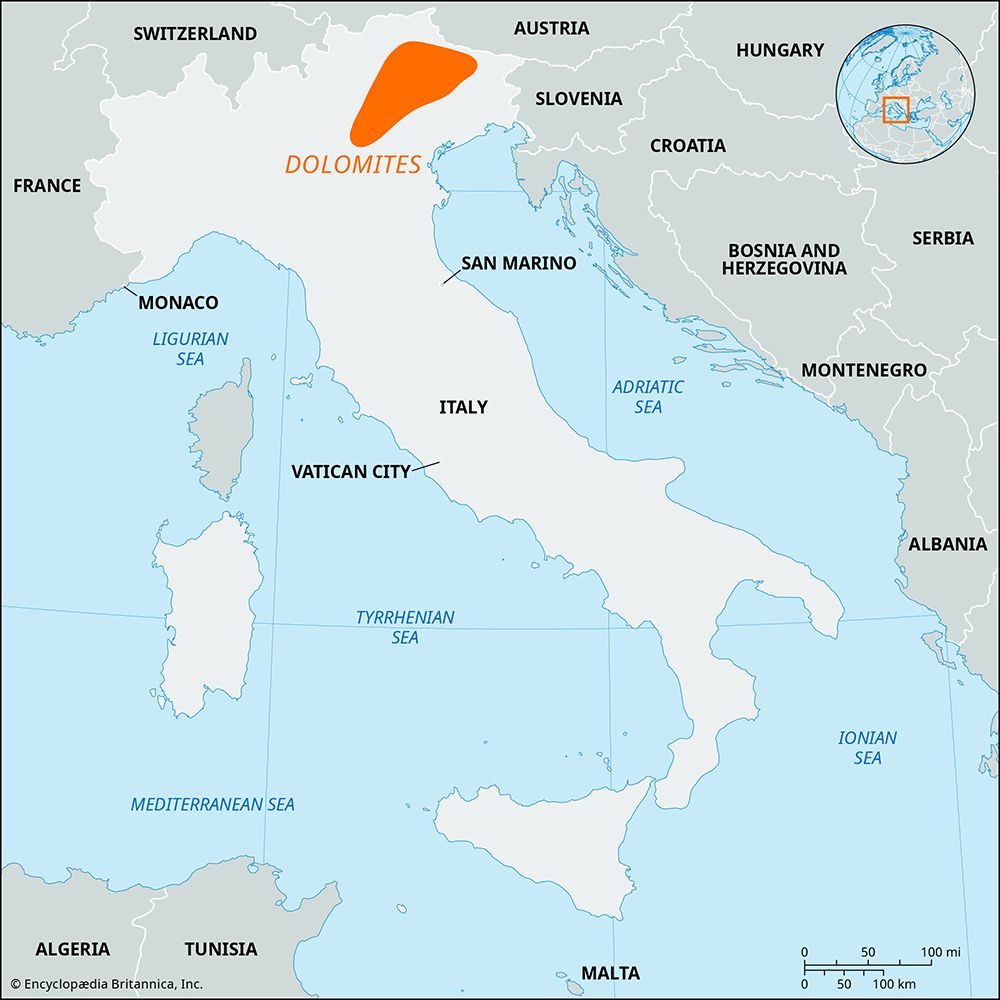
The Dolomites are a mountain group situated in the eastern section of the northern Italian Alps. They are bounded by several major valleys, including those of the Adige and Piave rivers.1
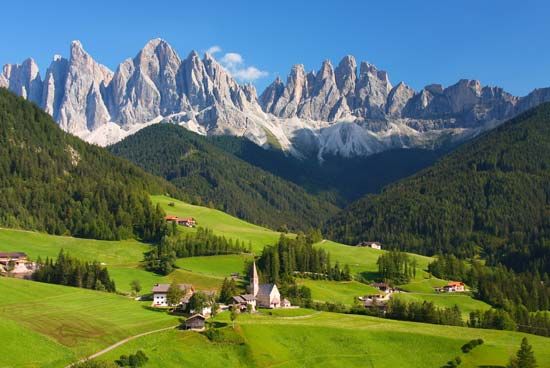
What makes the range unique is its distinct geological composition. The mountains are formed of light-colored dolomitic limestone, a rock type named after the 18th-century geologist Dieudonné Dolomieu1. This specific material has been carved by erosion into striking, “grotesque” landforms, including jagged, saw-edged ridges, rocky pinnacles, deep gorges, and steep rock faces. Unlike many other ranges, these formations often feature scree slopes of limestone debris at lower levels, while the higher elevations contain 41 glaciers. The region’s unique geological and aesthetic value led to its inscription on the UNESCO World Heritage List in 2009.1
What is the geological history of the Dolomites, and how were they formed?
The geological history of the Dolomites is rooted in the complex tectonic evolution of the Alpine system. The mountains are primarily composed of light-colored dolomitic limestone, a rock type that originated from sedimentary deposits on the margins of the ancient Tethys Ocean.
The formation of these peaks involved several key geological processes:
- Sedimentation and Tectonics: During the Early Jurassic period, the movement of the African continent away from Europe created new continental margins where thick layers of sedimentary rock, such as limestone, were deposited.3
- Dolomitization: The characteristic rock of the range, dolomite, is formed through dolomitization. This process occurs when magnesium-rich water filters through limestone, replacing the original calcite with the mineral dolomite (CaMg(CO3)2CaMg(CO_3)_2). This recrystallization often obscures original fossils and textures.1
- Orogeny: As the Italian peninsula—a promontory of the African continent—converged with Europe, these sedimentary layers were uplifted, folded, and faulted to form the modern mountain range.3
- Erosion: Following their uplift, the mountains were sculpted by intense erosion, which carved the rock into the jagged ridges, pinnacles, and deep gorges that define the landscape today.4
What are some of the most famous peaks and landmarks in the Dolomites?
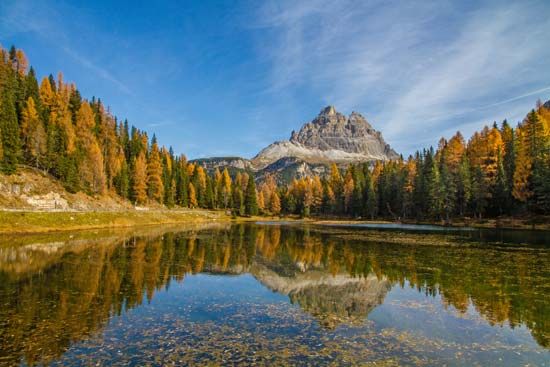
The Dolomites are home to numerous iconic peaks and landmarks, characterized by their dramatic, jagged limestone formations. Among the most notable are:
- Marmolada: Standing at 10,964 feet (3,342 meters), this is the highest peak in the entire Dolomites range. It is famous for its massive southern face, which features a 2,000-foot (610-meter) precipice.16
- Mountain Passes: The region is defined by its high-altitude transit points, which are popular for both travel and scenery. Key passes include the Pordoi (7,346 feet), Sella (7,404 feet), Gardena (6,959 feet), and Falzarego (6,906 feet).1
- Tourist Centers: Cortina d’Ampezzo serves as the primary hub for tourism and mountaineering in the region. Other significant centers include Ortisei, Auronzo, and San Martino di Castrozza.1
- Vaiont Dam: Located on a tributary of the Piave River, this site is historically significant due to the tragic 1963 disaster caused by landslides, which resulted in the destruction of the village of Longarone.1
Who was Dieudonné Dolomieu and what did he discover?
Dieudonné Dolomieu (1750–1801) was a French geologist and mineralogist who is best known for his scientific contributions to the study of the Alps and the identification of the mineral that now bears his name: dolomite.7
Following a life that included early military service and travel across Europe, Dolomieu conducted a significant scientific study of the Alps between 1789 and 1790. In 1791, he described the specific type of limestone that characterizes the mountain range now known as the Dolomites. This rock, which he identified as distinct from common limestone, was later named “dolomite” in his honor.78
Dolomieu’s career was marked by both scientific rigor and adventure. He participated in Napoleon’s expedition to Egypt in 1798, during which he was captured and imprisoned in Messina. During his confinement, he demonstrated his dedication to his field by writing his major treatise, Sur la philosophie minéralogique et sur l’espèce minérale (1801), on the margins of a Bible.7
Sources
- Dolomites — Encyclopædia Britannica
- dolomite - General considerations — Encyclopædia Britannica
- dolomitization — Encyclopædia Britannica
- Italy - Mountain ranges — Encyclopædia Britannica
- mountain - The western segment of the system — Encyclopædia Britannica
- Marmolada — Merriam-Webster
- Dieudonné Dolomieu — Encyclopædia Britannica
- dolomite — Merriam-Webster
- dolomite - Origin and occurrence — Encyclopædia Britannica
Published on · 3 min read