Euoplocephalus
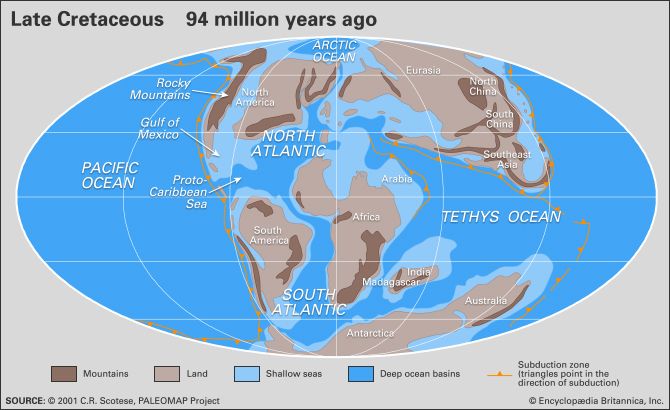
Euoplocephalus was a massive, armored dinosaur that lived in North America during the Late Cretaceous Period, approximately 99.6 to 65.5 million years ago.…
What is Euoplocephalus?
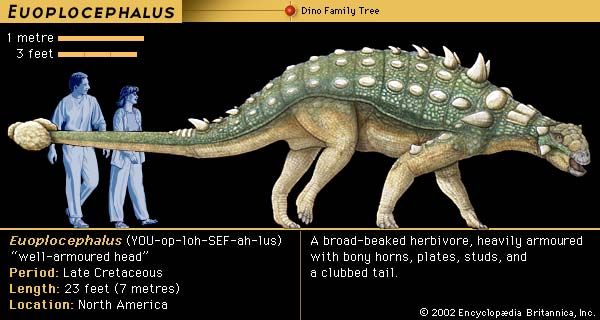
Euoplocephalus was a massive, armored dinosaur that lived in North America during the Late Cretaceous Period, approximately 99.6 to 65.5 million years ago. Weighing over two tons, this herbivore belonged to the group Ankylosauria, known for their extensive mosaic of bony plates that protected their backs and flanks.12
Physically, Euoplocephalus was low and broad, moving slowly on short, stocky legs. A unique feature distinguishing it from other ankylosaurs was the presence of a protective bone covering its eyelid. Like other members of its group, it possessed a boxlike skull and small, leaf-shaped teeth adapted for consuming soft, pulpy plant matter. As an advanced ankylosaurid, it also featured a massive bony club at the end of its tail, a defensive structure absent in more basal forms like the Nodosaurus.21
How did the tail club of an ankylosaurid function as a defense mechanism?
The tail club of an ankylosaurid functioned as a formidable defensive weapon against carnivorous dinosaurs. This structure was formed by the animal’s final tail vertebrae, which were fused together into a rigid, tightly nested unit and encased in a sheath of heavy bony plates.3
By swinging this massive bony club, the dinosaur could deliver powerful blows to deter potential attackers. This specialized adaptation is a defining characteristic of the advanced Ankylosauridae family, distinguishing them from more basal forms like the Nodosaurus, which lacked such tail weaponry and relied on different armor patterns for protection.32
What are the main differences between Nodosauridae and Ankylosauridae?
The Ankylosauria infraorder is divided into two primary families: the more basal Nodosauridae and the more advanced Ankylosauridae. While both were heavily armored, herbivorous, quadrupedal dinosaurs, they exhibit several key differences:
- Tail Weaponry: The most conspicuous difference is that Ankylosauridae possessed a massive bony club at the end of their tails, which served as a defensive weapon. Nodosauridae completely lacked this tail structure.23
- Skull Morphology: Ankylosaurid skulls were typically shorter, broader, and more boxlike than those of nodosaurs. Furthermore, ankylosaurid skulls were often heavily encrusted with protective bony plates (scutes), a feature less pronounced in the Nodosauridae.23
- Evolutionary Timeline: Nodosaurids are considered more primitive and appeared earlier in the fossil record, with ancestors dating back to the Middle Jurassic Period. Most Ankylosauridae emerged later, primarily during the Late Cretaceous Period. Cretaceous Period.23
What other types of armored dinosaurs lived during the Cretaceous Period?
During the Cretaceous Period, several groups of ornithischian dinosaurs utilized various forms of armor or defensive structures to protect themselves from predators. While the Ankylosauria (including Nodosauridae and Ankylosauridae) are the most famous for their extensive bony plates, other groups also featured defensive adaptations:
- Stegosauria: Although primarily associated with the Jurassic Period, some members like Wuerhosaurus persisted into the Early Cretaceous. These dinosaurs were characterized by double rows of large, triangular bony plates along their backs and tail, as well as pairs of long, pointed bony spikes on the end of their tails, which likely served as defensive weapons.52
- Ceratopsia: These “horned” dinosaurs, such as the well-known Triceratops, were prominent during the Late Cretaceous. They were characterized by elaborate head ornamentation, including horns and large bony frills that protected the neck and provided a formidable defense against theropod predators.36
- Pachycephalosauria: Often grouped with ceratopsians, these dinosaurs were distinguished by their thickened, dome-shaped skulls. While primarily used for display or intraspecific combat, these reinforced craniums provided a significant layer of protection for the head.3
Sources
- Euoplocephalus — Encyclopædia Britannica
- dinosaur - Ankylosauria — Encyclopædia Britannica
- Ankylosaurus — Encyclopædia Britannica
- Nodosaurus — Encyclopædia Britannica
- ornithischian — Encyclopædia Britannica
- stegosaur — Encyclopædia Britannica
- Stegosaurus — Encyclopædia Britannica
- A Journey Through Time Since the Precambrian - Cretaceous Period: 145 million to 66 million years ago — Encyclopædia Britannica
- Jurassic Period - Vertebrates — Encyclopædia Britannica
- dinosaur - Theropoda — Encyclopædia Britannica
Published on · 3 min read