Feathered Dinosaur
Fossil evidence reveals that dinosaurs possessed a diverse range of feather structures, which evolved from simple, keratin-based filaments into more complex…
What types of feathers have been found on dinosaur fossils?
Fossil evidence reveals that dinosaurs possessed a diverse range of feather structures, which evolved from simple, keratin-based filaments into more complex forms. These structures include:123
- Simple Filaments: The earliest known forms were straight, dense, hair-like filaments, often described as a “pelage” or coat. These are seen in dinosaurs like Sinosauropteryx and the tyrannosaur Dilong.13
- Branched and Downy Structures: Some fossils exhibit branched filaments or tufts of filaments with a strong fused base, resembling the downy feathers of modern birds.13
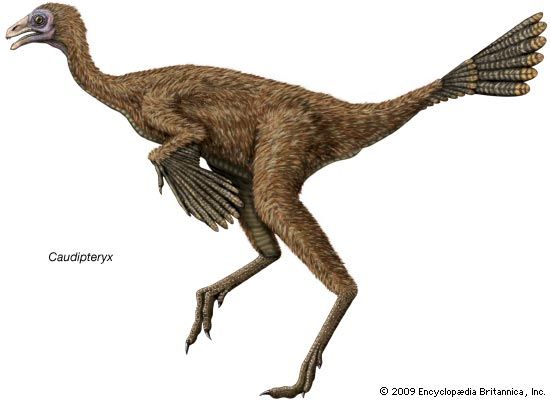
- Vaned Feathers: More advanced forms featured a central stalk (rachis) with vanes on either side. These include rudimentary vaned feathers found in genera like Caudipteryx and Protarchaeopteryx.23
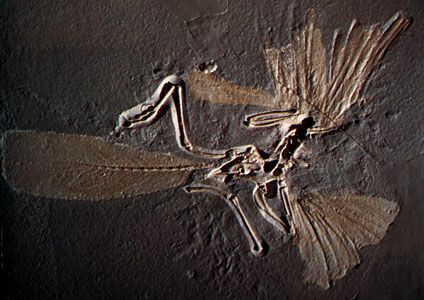
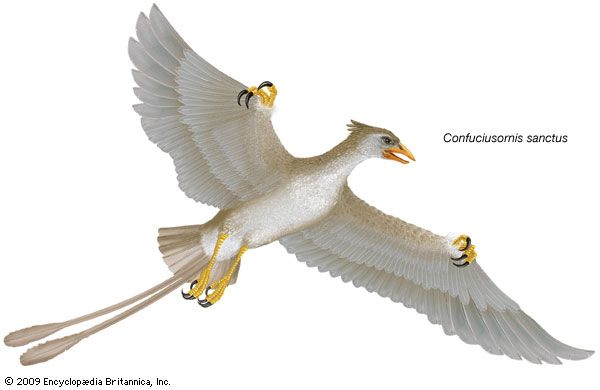
- Flight Feathers: By the time of Archaeopteryx and Confuciusornis, some dinosaurs possessed long, complex feathers with asymmetrical vanes, which provided the mechanical structure necessary for flight.13
These feathers likely served functions such as insulation, camouflage, display, and egg brooding before eventually being adapted for flight in the lineage that became modern birds.3
How did feathers evolve in dinosaurs, and what were their initial purposes?
The evolution of feathers in dinosaurs represents a transition from simple, keratin-based filaments to the complex, aerodynamic structures seen in modern birds. Contrary to older hypotheses, feathers did not evolve from reptilian scales; rather, they developed through distinct molecular pathways involving the invagination of the epidermis.234
Evolutionary Progression
Phylogenetic analysis suggests that the earliest feather precursors were simple, straight, and dense filaments, often described as a “pelage” or hair-like coat, which provided thermal insulation and helped stabilize body temperature, indicating that many dinosaurs were warm-blooded. Over time, these structures increased in complexity:23
- Branched and Downy: Filaments evolved into branched, tufted structures similar to modern down.23
- Vaned Feathers: Eventually, a central stalk (rachis) developed with vanes on either side, which later evolved into barbs and barbules to provide structural integrity.23
Initial Purposes
Before the emergence of flight, feathers served several non-aerodynamic functions:
- Insulation: Maintaining body heat.34
- Display and Camouflage: Used for signaling or blending into the environment.35
- Brooding: As seen in fossils like Caudipteryx, long feathers helped protect and warm eggs in nests.3
How did the discovery of feathered dinosaurs change our understanding of dinosaur evolution?
The discovery of feathered dinosaurs has fundamentally transformed our understanding of dinosaur evolution, confirming that birds are not merely descendants of dinosaurs but are, in fact, living members of the dinosaur lineage.126
Key shifts in scientific understanding include:
- Origin of Feathers: Evidence from the Liaoning deposits in China revealed that feathers did not evolve for flight. Instead, they originated as simple, keratin-based filaments used for insulation, camouflage, display, and egg brooding.267
- Evolutionary Continuity: The presence of feathers in diverse theropods—ranging from small species like Sinosauropteryx to large tyrannosaurs like Yutyrannus—suggests that a feathery covering was widespread among dinosaurs, indicating they were likely warm-blooded.127
- Refined Classification: Fossils such as Archaeopteryx and Xiaotingia provide clear anatomical links between theropods and birds, showing that avian features like hollow bones and specific wrist joints evolved long before the emergence of modern flight.26
- Developmental Biology: Research has falsified the old hypothesis that feathers are modified scales, showing they arise from distinct molecular pathways.7
How do feathered dinosaurs relate to modern birds?
The relationship between feathered dinosaurs and modern birds is one of direct ancestry: modern birds are living dinosaurs that evolved from a lineage of theropod dinosaurs more than 150 million years ago.12
Evolutionary Connection
Scientific classification now recognizes that birds belong within the dinosaur group, much like humans are classified as both primates and mammals. This connection is supported by significant anatomical evidence:2
- Shared Features: Both birds and certain theropods (such as Velociraptor and Oviraptor) share unique skeletal traits, including hollow bones, a specific pelvis structure, and a specialized wrist joint that allows for sideways flexion—a motion essential for flight in birds but originally used by dinosaurs for catching prey.82
- Fossil Evidence: Genera like Archaeopteryx and Xiaotingia serve as critical links, possessing both dinosaurian and avian characteristics.2
The Origin of Feathers
The discovery of feathered fossils, such as Sinosauropteryx, proved that feathers did not evolve for flight](https://www.britannica.com/animal/Sinosauropteryx)*, proved that feathers did not evolve for flight. Instead, they originated as simple, keratin-based filaments used for thermal insulation, display, camouflage, and egg brooding. These structures only later became adapted for the aerodynamic requirements of flight.126
Sources
- How Do We Know That Dinosaurs May Have Had Feathers? — Encyclopædia Britannica
- Did Dinosaurs Really Have Feathers? — Encyclopædia Britannica
- feathered dinosaur — Encyclopædia Britannica
- dinosaur: Top Questions — Encyclopædia Britannica
- Bird - The origin of feathers — Encyclopædia Britannica
- dinosaur - Dinosaur descendants — Encyclopædia Britannica
- Origins of Birds — Encyclopædia Britannica
- dinosaur - Theropoda — Encyclopædia Britannica
Published on · 4 min read