Fir
True firs, belonging to the genus Abies, are distinguished from other members of the pine family by several specific physical characteristics:

What are the distinguishing characteristics of fir trees in the Abies genus?
True firs, belonging to the genus Abies, are distinguished from other members of the pine family by several specific physical characteristics:12
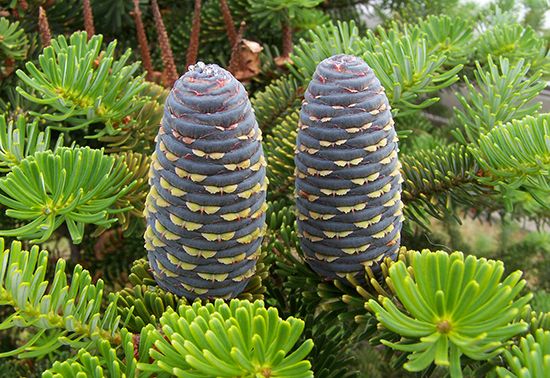
- Leaves: The needlelike leaves grow directly from the branch. Their bases are shaped like suction cups, which leave behind conspicuous, circular scars on the twig when the leaves fall. These leaves are generally described as flattish.12
- Cones: Unlike many other conifers, the female cones of Abies are borne in an upright position. When the mature cones fall apart, the spikelike axis remains attached to the branch. Each thin, rounded cone scale contains two broadly winged seeds.12
It is important to note that while trees such as the Douglas fir are commonly called “firs,” they belong to different genera and do not share these specific botanical traits. True firs are native to temperate regions across North and Central America, Europe, Asia, and northern Africa.12
How are fir trees different from other coniferous trees like pines or spruces?
True firs (Abies) are distinguished from other conifers, such as pines and spruces, by specific structural differences in their leaves and reproductive cones.6
Key Distinctions
- Leaf Attachment: The needlelike leaves of a true fir grow directly from the branch. Their bases are shaped like suction cups, which leave behind distinct, circular scars on the twig when the needles fall. In contrast, pines typically bear their needles in bundles (fascicles) of two to five.62
- Cone Orientation and Structure: Female cones of true firs are borne in an upright position. When these cones reach maturity, they fall apart while still on the tree, leaving only a persistent, spikelike axis attached to the branch. Conversely, pine cones are woody and typically fall from the tree intact; they often develop over a two- to three-year period and may remain closed for years until opened by environmental factors like fire or decay.62
While many trees are colloquially called “firs”—such as the Douglas fir—they belong to different genera and do not share these unique botanical characteristics.6
Are there any threatened or endangered species of fir trees, and what conservation efforts exist?
Several species within the genus Abies are currently recognized as threatened or endangered by the IUCN Red List of Threatened Species. Notable examples include the Guatemalan fir, Korean fir, Spanish fir, and Ziyuan fir. Furthermore, the Algerian fir and Sicilian fir are classified as critically endangered, primarily due to the combined pressures of overharvesting and habitat loss.2
Conservation and management efforts for fir forests focus on several strategies to mitigate these threats:
- Forest Management: Foresters utilize selective cutting and thinning to stimulate vigorous growth, which helps trees better resist pests and diseases.2
- Quarantine and Monitoring: To prevent the spread of invasive species that can devastate specific fir populations, authorities enforce strict plant quarantine laws. Foresters also conduct routine monitoring to detect outbreaks early, allowing for sanitation and salvage harvests to limit the spread of pathogens.2
- Genetic Programs: Many forestry programs prioritize the selection and breeding of trees that demonstrate natural resistance to specific insects and diseases.2
- Silvicultural Systems: Techniques such as natural regeneration—where surrounding trees are left standing to provide shelter and seed—are employed to ensure the sustainable replacement of harvested timber.8
What is a fir tree?
A fir tree is an evergreen conifer belonging to the genus Abies within the pine family. While the term “fir” is sometimes applied to other conifers like the Douglas fir, true firs are distinct in their physical characteristics.42
True firs are native to North and Central America, Europe, Asia, and northern Africa. They are identified by their needlelike leaves, which grow directly from the branch and leave circular scars when they fall, as well as their erect female cones. Unlike many other conifers, the mature cones of a true fir fall apart while still on the tree, leaving only a spikelike axis behind.2
These trees are economically and ecologically significant, valued for their wood and widely used as Christmas trees. Some species, such as the oyamel fir, provide critical habitats, including overwintering grounds for monarch butterflies.2
Sources
- needle fir — Merriam-Webster
- fir — Encyclopædia Britannica
- gymnosperm - Pinophyta — Encyclopædia Britannica
- fir — Merriam-Webster
- spruce — Encyclopædia Britannica
- Pinaceae — Encyclopædia Britannica
- pine - Physical description and natural history — Encyclopædia Britannica
- forestry - Insect and disease control — Encyclopædia Britannica
- Oyamel fir: Top Questions — Encyclopædia Britannica
- forestry - Natural regeneration — Encyclopædia Britannica
- conifer - Fertilization and embryogeny — Encyclopædia Britannica
Published on · 3 min read