Flying Squirrel
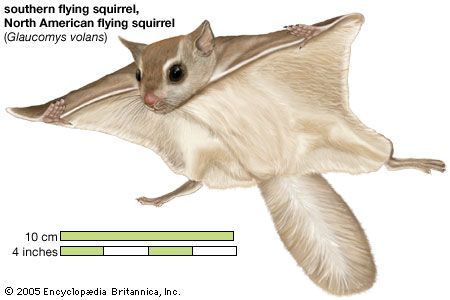
Flying squirrels (tribe Pteromyini) have adapted to a nocturnal lifestyle by evolving specific physical traits that support their activity in low-light…
How have flying squirrels adapted to nocturnal life, and what special features do they possess for night vision?
Flying squirrels (tribe Pteromyini) have adapted to a nocturnal lifestyle by evolving specific physical traits that support their activity in low-light environments. Unlike other squirrels, these rodents are strictly nocturnal, spending their days resting in tree cavities, rock crevices, or globular nests constructed from materials like moss, bark, and lichen.1
Regarding their vision, flying squirrels are characterized by their notably large eyes, which are a primary adaptation for navigating and foraging in the dark. While the provided search results confirm that these large eyes are a key feature of their anatomy, they do not detail the specific physiological mechanisms of their night vision beyond this morphological observation. Their nocturnal habits are further supported by their ability to glide between trees, a behavior that allows them to traverse their forest habitats efficiently under the cover of night.1
What is the typical diet of a flying squirrel?
The diet of a flying squirrel is diverse and varies depending on the specific species. These rodents are opportunistic feeders, and their nutritional intake can include a wide range of plant and animal matter, such as:
- Plant-based foods: Seeds, fruit, leaves, flower buds, nuts, fungi, lichens, pollen, ferns, and tree sap.
- Animal-based foods: Insects, spiders, other invertebrates, small birds, eggs, snakes, and smaller mammals.
While most flying squirrels spend the majority of their time in trees, North American flying squirrels are known to descend to the ground regularly to forage and bury nuts. This behavior of caching food is a strategic way to manage resources, and some squirrels use “spatial chunking”—organizing different types of food into separate, specific caches—to help them remember where their stashes are located.
What are the different species of flying squirrels and where are they found around the world?
Flying squirrels (tribe Pteromyini) comprise more than 50 species of gliding rodents distributed across various regions of the world. Their geographic range is categorized as follows:
- North America: There are three species of flying squirrels native to this region, all belonging to the genus Glaucomys (G. volans, G. oregonensis, and G. sabrinus).12
- Eurasia: Two species are found in northern Eurasia.1
- Asia and India: The vast majority of the remaining species inhabit the temperate and tropical forests of India and other parts of Asia.1
These 50-plus species are organized into 15 genera, exhibiting a wide range of sizes. For example, the giant flying squirrels (Petaurista) of tropical India and southeastern Asia can weigh up to 2.5 kg (5.5 pounds), while the dwarf flying squirrels (Petaurillus) found in northern Borneo and the Malay Peninsula are among the smallest, with bodies measuring only 7 to 9 cm in length.1
What is the evolutionary history of flying squirrels?
The evolutionary history of flying squirrels (tribe Pteromyini) is a subject that has seen significant clarification through modern scientific study. While earlier researchers occasionally speculated that these rodents might have originated from multiple distinct groups or even non-squirrel ancestors, recent evidence—derived from fossil records and detailed anatomical analysis of their wrists and gliding membranes—indicates that all living species are closely related.
Current scientific consensus suggests that flying squirrels evolved from a common tree squirrel ancestor during the Oligocene Epoch, which occurred approximately 33.9 million to 23 million years ago. Taxonomically, they are generally classified as the tribe Pteromyini within the subfamily Sciurinae of the squirrel family (Sciuridae).
It is important to distinguish these true flying squirrels from other gliding mammals, such as the anomalure, which are sometimes referred to as “scaly-tailed flying squirrels” but belong to an entirely different family, the Anomaluridae.
Sources
- flying squirrel — Encyclopædia Britannica
- flying squirrel — Merriam-Webster
- What do squirrels eat? — Encyclopædia Britannica
- Is It True That Squirrels Forget Where They Bury About Half of Their Food? — Encyclopædia Britannica
- squirrel — Encyclopædia Britannica
Published on · 3 min read