Gastrioceras
Gastrioceras is a genus of extinct cephalopods related to modern squids, octopuses, and the nautilus. These organisms are found in marine rocks dating to the…
What is Gastrioceras?
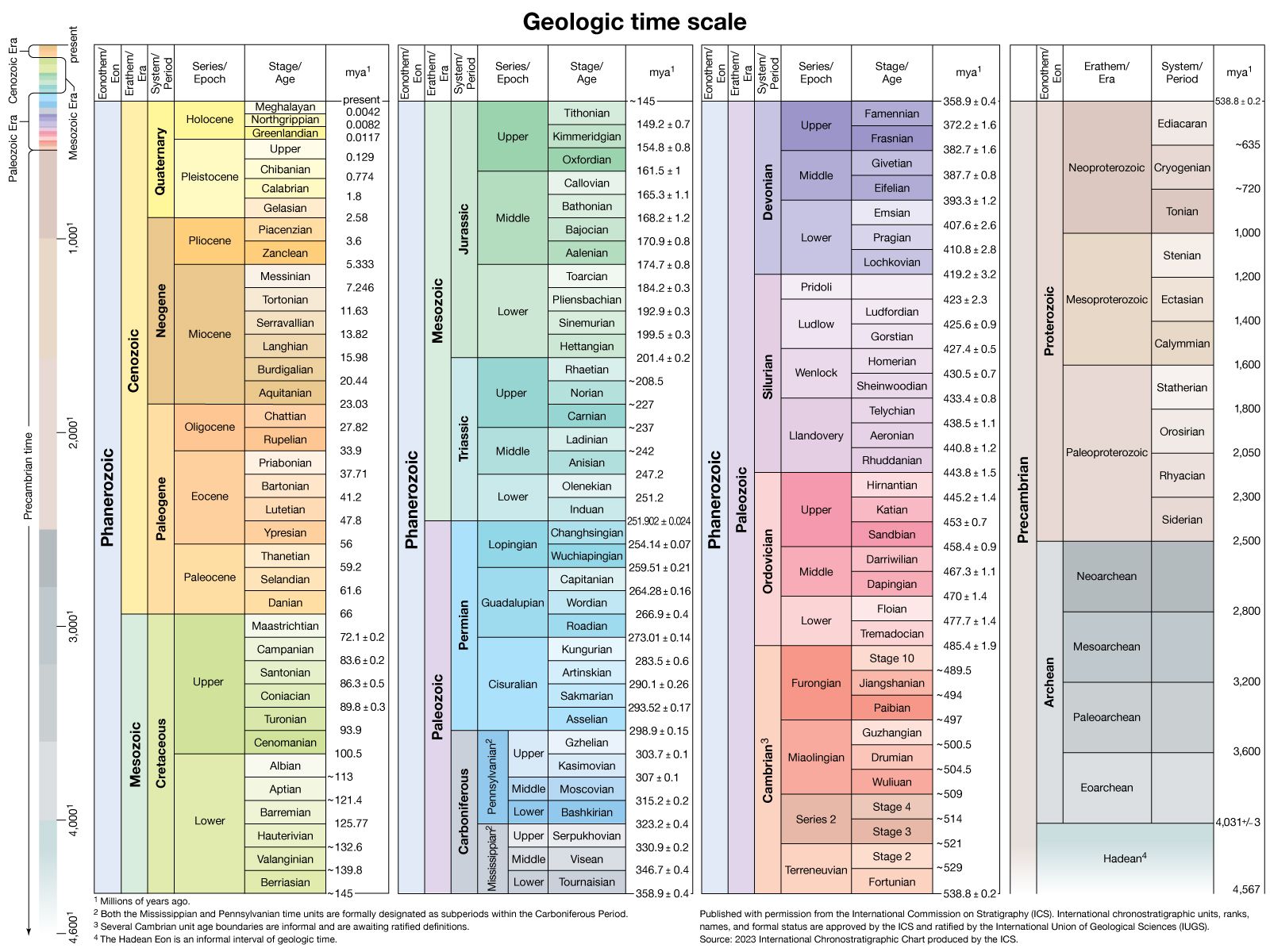
Gastrioceras is a genus of extinct cephalopods related to modern squids, octopuses, and the nautilus. These organisms are found in marine rocks dating to the Pennsylvanian Subperiod, which began approximately 318 million years ago.1
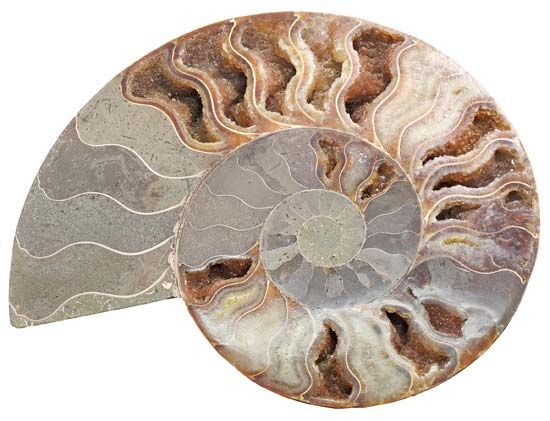
The animal possessed a round, coiled shell composed of a series of chambers. A defining feature of the genus is its suture pattern—the line where internal partitioning walls meet the outer shell—which displays a simple, sinuous arrangement of arches and troughs known as a goniatite suture pattern. As a type of ammonoid, Gastrioceras belongs to a group of shelled, likely predacious mollusks that served as important index fossils due to their wide geographic distribution and rapid evolution.12
What are index fossils and why are they important to scientists?
An index fossil is any plant or animal preserved in the Earth’s rock record that serves as a diagnostic marker for a specific span of geologic time or a particular environment.4
To be considered a useful index fossil, a specimen should ideally possess the following characteristics:
- Short temporal range: The species existed for only a brief moment in geologic history, allowing for precise dating.45
- Wide geographic distribution: The organism was cosmopolitan, meaning it can be found in many locations, which helps correlate separated rock outcrops.45
- Abundance: The fossilized population is sufficiently common to make discovery highly probable.45
- Distinctive appearance: The fossil is easily recognizable, preventing misidentification.45
Scientists use these fossils as the primary tools for stratigraphic correlation—the process of piecing together the history of separated rock layers. By applying the principle of faunal succession, geologists can determine the relative age of rock strata based on the unique fossil assemblages they contain. This method is fundamental for defining boundaries in the geologic time scale and understanding the Earth’s history.54
How do goniatite, ceratite, and ammonite suture patterns differ?
Ammonoids are classified into three distinct groups based on the increasing complexity of their suture patterns—the lines where internal partitioning walls meet the outer shell.2
Suture Pattern Evolution
- Goniatite: These forms feature a simple, sinuous suture pattern. They were most prevalent during the Paleozoic Era.2
- Ceratite: Replacing the goniatites, these ammonoids are characterized by a more highly folded suture pattern. They were most abundant during the Triassic Period and display a distinctive arrangement of lobes (arches) and troughs.27
- Ammonite: Emerging after the Triassic, these forms possess the most complex, interwoven suture pattern. This group diversified significantly during the Cretaceous Period before the extinction of the remaining ammonoid groups.2
This evolutionary progression toward increasingly complex sutures is a key feature used by scientists to distinguish between these groups in the fossil record.2
What are the main differences between nautiloids and ammonoids?
While both ammonoids and nautiloids are shelled cephalopods, they are primarily distinguished by the complexity of their internal shell structure.
The most significant difference lies in the suture patterns—the lines where the internal partitioning walls (septa) meet the outer shell wall. Ammonoids are characterized by highly crenulated and complex suture patterns, which evolved from simple to increasingly intricate forms over time. In contrast, nautiloids typically possess much simpler, less complex sutures.2
Additionally, while the pearly nautilus is the last surviving genus of the ancient order Nautiloidea, all ammonoids are extinct. Ammonoids were highly successful index fossils due to their rapid evolution and wide geographic distribution, whereas the nautilus remains a living representative of its lineage. While both groups utilized their shells as protective structures and hydrostatic devices to manage buoyancy, their distinct evolutionary trajectories and suture complexities serve as the primary markers for paleontologists to differentiate between them in the fossil record.28
Sources
- Gastrioceras — Encyclopædia Britannica
- ammonoid — Encyclopædia Britannica
- mollusk - Critical appraisal — Encyclopædia Britannica
- index fossil — Encyclopædia Britannica
- dating - Principles and techniques — Encyclopædia Britannica
- biostratigraphy — Merriam-Webster
- Ceratites — Encyclopædia Britannica
- cephalopod - Evolution and paleontology — Encyclopædia Britannica
- nautilus — Encyclopædia Britannica
Published on · 3 min read