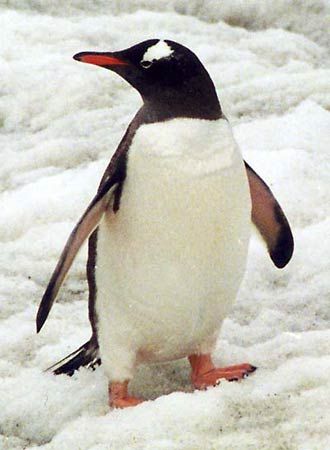
Gentoo Penguin
Gentoo penguins breed in colonies on ice-free areas of rock or grass near sandy beaches. Most pairs are monogamous and construct new nests annually using…
How do gentoo penguins breed and raise their young?
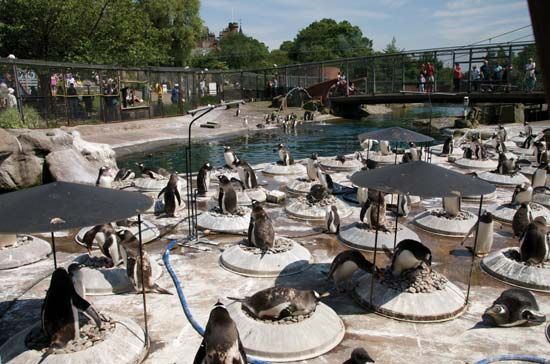
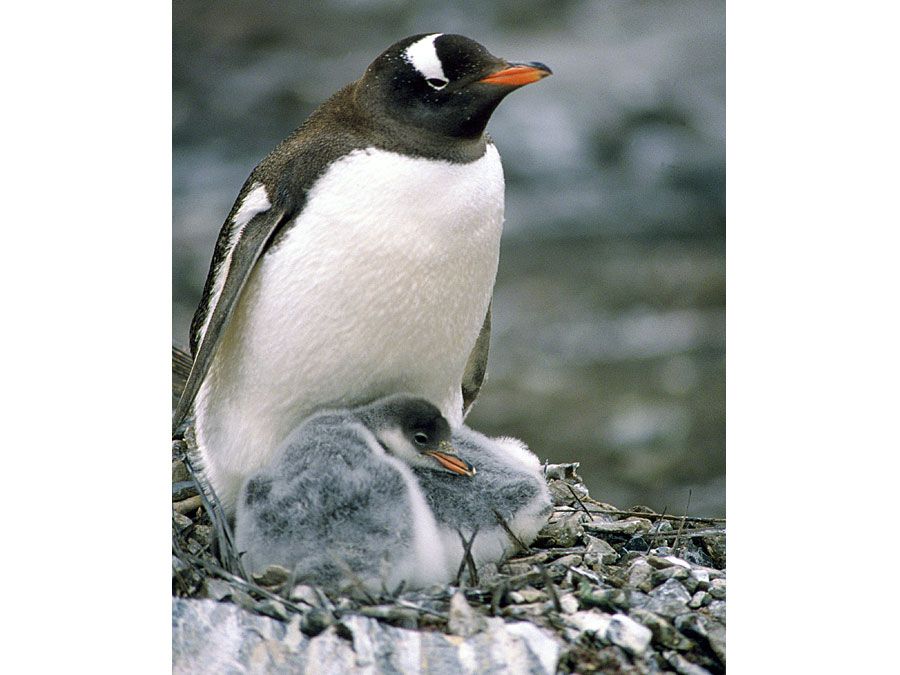
Gentoo penguins breed in colonies on ice-free areas of rock or grass near sandy beaches. Most pairs are monogamous and construct new nests annually using stones, grasses, and debris.1
The breeding season typically spans from late June to November, though timing varies by location. Females lay two eggs, usually within three days of each other. Both parents share incubation duties for 34 to 37 days.12
After hatching, both parents forage to feed the chicks, which remain in the nest for about a month. The young then join a crèche—a nursery group with other chicks—for protection while parents gather food. During this time, chicks are fed a regurgitated “soup” of fish or crustaceans. Fledging concludes around 14 weeks of age, typically in February or March, when juveniles head to sea to forage independently. Some may return to the nest periodically to be fed by parents before achieving full independence.12
What is the diet of gentoo penguins and how do they hunt for food?
Gentoo penguins are opportunistic foragers that subsist on a diet consisting of small fish, cephalopods (such as squid and cuttlefish), and krill or other crustaceans.32
To hunt for food, they rely on their exceptional swimming abilities, as they are the world’s fastest underwater birds. When foraging, they can reach speeds of up to 36 km (about 22 miles) per hour and are capable of diving to depths between 170 and 200 metres (approximately 560 to 660 feet).2
How fast can gentoo penguins swim, and how does this compare to other penguin species?
Gentoo penguins are recognized as the world’s fastest underwater birds, capable of reaching speeds of up to 36 km (about 22 miles) per hour when foraging for food or evading predators.4
While all penguins are highly specialized for an aquatic existence, with their forelimbs transformed into rigid, paddle-like flippers for propulsion, the gentoo penguin’s speed is a standout adaptation. Other species, such as the emperor penguin, are noted more for their extraordinary endurance and diving depth—reaching approximately 550 metres (1,800 feet)—rather than their top swimming speed. The gentoo penguin’s morphology, including its streamlined body and dense plumage that minimizes friction and turbulence, allows it to achieve these high velocities efficiently.25
Are there any unique behaviors or adaptations that set gentoo penguins apart from other penguin species?
Gentoo penguins (Pygoscelis papua) possess several unique physical and behavioral characteristics that distinguish them from other penguin species:
Physical Adaptations
- Distinctive Markings: They are easily identified by a prominent white band of feathers that extends across the top of their heads from above each eye, as well as a deep orange or red bill.2
- Tail Morphology: Gentoos possess a brush-like tail that is notably larger than those found on other penguin species.2
- Speed: They are the world’s fastest underwater birds, capable of reaching speeds of up to 36 km (about 22 miles) per hour while foraging or evading predators.2
Behavioral Traits
- Breeding Flexibility: Unlike many other species that follow a strict annual cycle, some gentoo populations are known to breed in winter. They are also notable for a lack of synchrony in their breeding schedules across different geographic populations.6
- Nesting Habits: Gentoos form sizable colonies on flat, ice-free areas of rock or grass. They are diligent nest builders, constructing new nests each year using stones, grasses, and debris.2
- Foraging: They are opportunistic foragers that dive to depths of 170–200 metres (about 560–660 feet) to hunt for krill, fish, and cephalopods.2
Sources
- penguin - Reproduction — Encyclopædia Britannica
- Gentoo penguin — Encyclopædia Britannica
- penguin - Food habits — Encyclopædia Britannica
- Emperor penguin: Top Questions — Encyclopædia Britannica
- penguin - Form and function — Encyclopædia Britannica
- Antarctica - Birds — Encyclopædia Britannica
Published on · 3 min read