Geyser
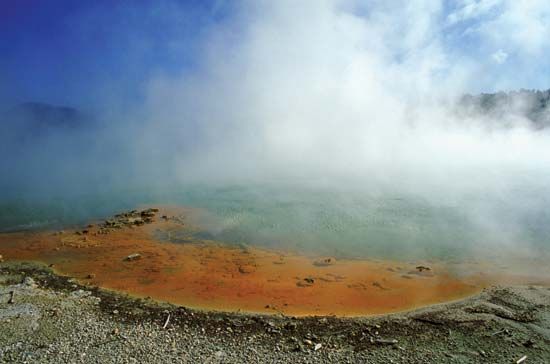
A geyser is a rare type of hot spring that intermittently discharges jets of steam and hot water into the air. The term originates from the Icelandic word…
What is a geyser and how does it form?
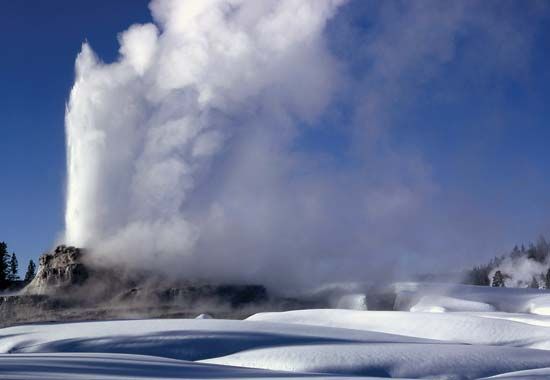
A geyser is a rare type of hot spring that intermittently discharges jets of steam and hot water into the air. The term originates from the Icelandic word geysir, meaning “to gush”.12
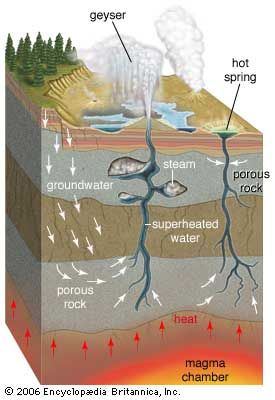
Geysers form in areas with past or present volcanic activity, where groundwater is heated by shallow bodies of magma or hot igneous rocks. The eruption process is a chain reaction driven by pressure changes:12
- Confinement: Water in deep, narrow conduits is kept under high pressure, which raises its boiling point.12
- Trigger: As steam or gas bubbles form and rise, some hot water spills from the vent, reducing the pressure on the water column below.12
- Eruption: With the pressure lowered, the deep water suddenly exceeds its boiling point and flashes into steam, forcing the remaining water out of the conduit.12
- Recharge: Once the supply is exhausted, the conduits refill with groundwater, and the heating cycle begins again.2
How do geysers differ from hot springs or other hydrothermal features?
While all are manifestations of volcanic or hydrothermal activity, geysers, hot springs, and other features differ primarily in their discharge behavior and physical characteristics.
Key Differences
- Geysers: These are a specific type of hot spring characterized by the intermittent, explosive discharge of steam and water. This action is driven by a unique chain reaction where water in deep, narrow conduits reaches its boiling point and flashes into steam due to a sudden drop in pressure.342
- Hot Springs: These are springs where water temperatures are significantly higher than the surrounding air. Unlike geysers, they generally flow steadily rather than erupting. While many are heated by magma, some are heated simply by deep circulation within the Earth’s crust, independent of volcanic activity.5
- Fumaroles: These are vents that emit steam and volcanic gases (such as carbon dioxide or sulfur dioxide) rather than liquid water. If the water table rises, a fumarole may transition into a hot spring.6
- Hydrothermal Vents: Found on the seafloor, these are localized discharges of heated seawater. They support unique ecosystems that rely on chemosynthesis rather than sunlight.7
What are some famous geysers around the world, and where are they located?
Geysers are rare geological features, with only about 1,000 known worldwide, primarily concentrated in areas with past or present volcanic activity.2
Major Geyser Locations
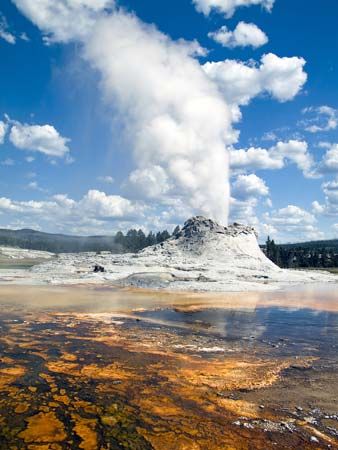
- Yellowstone National Park (United States): Home to more than 300 geysers, this park contains approximately half of the world’s total. Its most famous feature is Old Faithful, a cone geyser in the Upper Geyser Basin known for its relatively predictable eruptions of steam and boiling water.24
- Kamchatka Peninsula (Russia): This region in the Russian Far East hosts about 200 geysers.2
- New Zealand: This island nation contains approximately 40 geysers.2
- Iceland: Known for its significant geothermal activity, Iceland is home to about 16 geysers. Notably, the word “geyser” is derived from Geysir, a famous spouting hot spring in the Haukadalur valley that has been documented since the 13th century.29
Beyond these primary locations, there are approximately 50 other geysers scattered across various volcanic regions globally.2
What can studying geysers teach us about Earth’s subsurface and volcanic activity?
Studying geysers provides significant insights into Earth’s subsurface conditions and volcanic history. Because geysers are manifestations of volcanic activity, their presence indicates the interaction between groundwater and magma or hot igneous rocks located at shallow depths.42
By analyzing these features, scientists can better understand:
- Heat Sources: Geysers reveal the location of cooling magma chambers or recent volcanic intrusions that provide the necessary thermal energy to drive hydrothermal systems.4
- Subsurface Plumbing: The mechanics of a geyser—specifically the chain reaction where water flashes into steam due to pressure changes—offer a window into the depth, temperature, and pressure conditions of underground conduits.42
- Geothermal Potential: The principles governing geysers, such as the relationship between boiling points and depth-related pressure, are the same foundations used to harness geothermal energy from steam wells.2
- Surface Deposits: The formation of sinter mounds around vents provides a record of the minerals dissolved in the water, reflecting the chemical composition of the subsurface environment.2
Sources
- geyser — Merriam-Webster
- geyser — Encyclopædia Britannica
- Did you know? — Merriam-Webster
- volcano - Hot springs and geysers — Encyclopædia Britannica
- hot spring — Encyclopædia Britannica
- volcano - Other volcanic structures and features — Encyclopædia Britannica
- fumarole — Encyclopædia Britannica
- oceanic ridge - Hydrothermal vents — Encyclopædia Britannica
- Old Faithful — Encyclopædia Britannica
- Geysir — Encyclopædia Britannica
- Iceland - Land — Encyclopædia Britannica
- Old Faithful — Merriam-Webster
Published on · 4 min read